




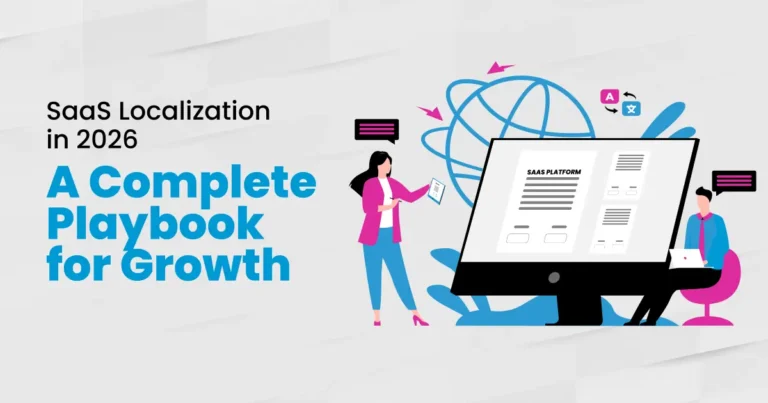
Going global is no longer a Series B question for product-led SaaS. The day a free trial converts in São Paulo or a growth team books ad spend in Berlin, localization stops being a roadmap item. It becomes a product feature.
That shift is what makes 2026 different. In a sales-led world, you could let international expansion lag the home market because deals closed through humans. A salesperson in Madrid could translate context on a call. In product-led SaaS, the product is the salesperson. If activation step three is in English when the user expects Portuguese, conversion drops and there is no human in the loop to recover.
This playbook is for product, growth, and localization leads at product-led SaaS companies who want to ship in three to five new languages without breaking the brand, the product, or the budget.
KEY TAKEAWAYS
- Localization for product-led SaaS is a product problem, not a marketing one.
- Pick markets by free trial conversion data, not by gut feel.
- Pure AI translation fails at SaaS scale. Pure human is too slow and too expensive.
- A hybrid AI plus human workflow is the model that works in 2026.
- Quality is measurable. LQA error rates and locale-specific conversion are the metrics that matter.
- A 90-day rollout plan can take a SaaS team from English-only to three live locales.
Why SaaS localization looks different in 2026
Product-led growth changed the localization game. Distribution is global by default. Self-serve onboarding cannot wait for an account exec to translate context. Localized strings are part of activation, not marketing.
A bad translation in step three of onboarding is a churn event. A good one is invisible. That asymmetry is why the stakes are higher than they used to be.
When localization sits across product, growth, and marketing, ownership is the first thing to clarify. The product team owns the i18n architecture. The growth team owns market selection. The marketing team owns landing pages and ads. The companies getting this right in 2026 set up tooling and ownership so that:
Translation quality is measured per locale, not just at launch.
- Strings are externalized from code on day one.
- New strings flow into a translation workflow automatically.
- New languages can ship without engineering downtime.
- Translation quality is measured per locale, not just at launch.
The three layers of a SaaS localization stack
SaaS localization has three distinct layers. Each has different volume, freshness, and quality requirements. Treating them as a single content type leads to bad outcomes.
The product UI layer covers onboarding flows, settings, error messages, and in-app strings. Volume is high, updates are frequent, and the quality bar is very high. A typo in an error message reaches every active user.
The marketing surface covers landing pages, ads, pricing, and blog. Volume is medium. Freshness varies. The quality bar is high because this is the first impression a new market gets.
The lifecycle content layer covers lifecycle emails, support docs, and in-app messages. Volume is high. Freshness is medium. The quality bar is medium-high.
Common surfaces to plan for in the first localization rollout include:
- In-product strings managed through i18next, FormatJS, or a TMS integration.
- Marketing pages with hreflang, locale subdirectories, and per-locale meta tags.
- Lifecycle emails templated per locale and tracked in the same translation memory.
- Help center articles synced from the source language with locale review cycles.
Choosing the first three markets
For most SaaS companies, the first three locales are not a creative decision. They are a data decision.
Look at four signals before picking:
- Free trial conversion by region. Where are people signing up but not converting?
- Existing inbound traffic by language preference, based on browser settings and hreflang behavior.
- Competitor density. Are competitors localized into a market where you are not?
- Linguistic complexity and bundling. Spanish opens LATAM and Spain together. Brazilian Portuguese is a meaningful add-on. Japanese is a heavier lift but high LTV.
A common starting set for B2B SaaS in 2026 is Spanish, German, and either Brazilian Portuguese or French. Japanese tends to be phase two. The work is harder and the LTV justifies it, but only after the lighter wins are banked.
Why AI-only translation fails at SaaS scale
AI-only translation is fast, cheap, and tempting. It also fails in predictable ways at SaaS scale.
Terminology drifts across pages. The same UI element gets translated differently in onboarding and in settings. Brand voice gets flattened. AI translates accurately but loses the personality that took the marketing team years to build.
Locale-specific UX bugs surface. String length variance breaks layouts. Plural forms come out wrong. Date formats miss the target.
Then there is the compounding support burden. A bad translation in onboarding creates a ticket. The ticket costs more than the translation did.
The trade-off is real, but it is asymmetric. The cost of a bad translation in onboarding is much higher than the cost of a slightly slower translation pipeline. For product-led SaaS, that argument is settled. AI alone is not enough.
Common failure patterns of AI-only translation in SaaS include:
- Inconsistent terminology across product surfaces.
- Loss of brand voice on marketing pages.
- Broken layouts from string length variance.
- Wrong plural forms and date formats.
- Higher support ticket volume in localized markets.
The hybrid AI plus human workflow
What works in 2026 is a hybrid model with four stages. This is the workflow we run for SaaS customers at NexTranslate, and it is built around the failure modes above.
Stage one is the AI Draft. An initial translation pass at speed and scale, tuned for the product domain.
Stage two is Human Refinement. A trained linguist edits the draft for accuracy, tone, terminology, and locale fit.
Stage three is AI Quality Assurance. Automated checks catch consistency, formatting, and terminology drift across content. This stage runs on polished output, not raw drafts.
Stage four is Final Human Approval. A senior reviewer signs off before delivery. Nothing leaves the workflow without a human approving it.
This pattern preserves the speed advantage of AI while adding the judgment that prevents the failure modes from the previous section. The cost profile scales with content volume rather than vendor hourly rates, which makes localization a budgetable line item rather than a moving target.
For a recent example of how this plays out for a growth-stage company, see the Astravue case study.
Measuring localization quality
If you cannot measure quality, you cannot improve it. Four metrics matter for SaaS localization in 2026.
Linguistic Quality Assurance error rate per 1000 words is the foundational quality signal. Best-in-class is under five errors per 1000.
Locale-specific conversion deltas tell you whether localization is working in market. The same A/B test variant should win across locales unless the localization is broken.
Time to publish for new strings is the operational signal. Shipping a new feature in five languages should not take more than five to ten business days.
Customer feedback signal in the locale, not in English, is the trailing indicator. Sentiment, ticket volume, and review scores by language should be tracked separately.
A localization workflow without these measurements is a black box. The metrics to lock down on day one are:
- LQA error rate per 1000 words, by locale.
- Conversion delta vs source language, by locale and surface.
- Time to publish for new strings, by locale.
- Locale-specific support ticket volume and sentiment.
Common pitfalls to avoid
Five patterns show up repeatedly when a SaaS team’s localization strategy stalls.
Treating localization as a marketing project. It is a product workflow that touches marketing, not the other way around.
Hardcoded strings in the product. Externalize on day one or pay for the rework later.
One-time content push instead of continuous flow. New features ship with new strings every sprint. The translation pipeline has to match that rhythm.
Skipping LQA on AI output. The whole reason to add humans is the QA layer. Removing it defeats the model.
Ignoring locale-specific UX. String length variance, plural forms, and right-to-left languages all need engineering attention before launch.
The 90-day rollout plan
For most product-led SaaS teams shipping their first three locales, this 90-day plan works.
Days 0 to 30: foundation
Pick three target markets using the data approach in section three. Audit existing content. Identify strings that are externalized versus hardcoded. Set up the i18n architecture if it does not already exist. Pick a localization partner.
Days 30 to 60: ship MVP locales
Ship MVP localizations of the highest impact surfaces. Onboarding, the pricing page, and the top three landing pages are the right starting point. Set the quality bar by running LQA on the first batch. Build the workflow for new strings to flow into translation automatically.
Days 60 to 90: measure and expand
Compare locale-specific conversion to baseline. Iterate. Fix the bottom 10 percent of strings that LQA flagged. Expand to lifecycle email and support content once the product surface is stable.
By day 90, the team has three locales live with measurable quality. The workflow is set up to scale to the next market without redoing the foundation.
Frequently asked questions
What is SaaS localization?
SaaS localization is the process of adapting a software product, its marketing surface, and its lifecycle content for users in a different language and region. It includes translation but covers locale-specific UX, currency, date formats, and cultural fit.
How is localization different from translation?
Translation converts words from one language to another. Localization adapts the entire experience to a target market, including UI flow, terminology, currency, dates, brand voice, and cultural context. For SaaS, localization is the broader and more important task.
When should a SaaS company start localizing?
When meaningful free trial signups or paying customers come from a market where the product is not in their language. For most product-led SaaS, this happens earlier than expected, often during the first year of self-serve growth.
How much does SaaS localization cost?
Cost varies with content volume, target language, and quality model. A hybrid AI plus human workflow lands somewhere between AI-only pricing and traditional agency rates, with predictable per-word or per-project pricing.
Conclusion: localization as a product function
The SaaS companies that scale into new markets in 2026 without a localization mess are the ones that treat translation as part of the product. They externalize strings on day one. They pick markets with data. They run a hybrid AI plus human workflow that combines speed and quality. They measure what they ship.
At NexTranslate, we work with product-led SaaS teams running exactly this motion. The four-stage hybrid workflow is what we run by default, and it is built around the failure modes that pure AI translation hits at scale.
If your SaaS is moving into new markets and you want a localization stack that grows with you, NexTranslate can help.
Written by: Karuppusamy Arunachalam, NexTranslate
Published: May 2026 · Filed under Localization
