




A translation can pass every automated check and still be wrong. That is the part most teams discover late, usually after a customer, a regulator, or a support ticket finds it first.
The failure is rarely dramatic. No one ships gibberish anymore. Modern engines produce target text that is grammatical, idiomatic, and confident. What they do not reliably produce is text that means what the source meant. When those two things separate, the output still reads perfectly, which is exactly why nobody catches it.
This post is not an argument that AI translation is bad. It is a map of the six specific ways AI-only output fails, which of those failures automated quality checks can catch, and the four points in a pipeline where a human being changes the outcome rather than just adding cost.
Where AI-only translation actually breaks
AI-only translation breaks at the point where fluency and accuracy stop being the same signal. An engine optimises for output that looks like well-formed target language, not for output that preserves source meaning, and those two objectives diverge exactly when the source gets difficult.
Industry benchmarks published through 2026 put neural machine translation accuracy at roughly 70 to 85 percent on general content, against 95 percent and above for professional human translation. On marketing copy, a 15 percent gap is an annoyance. On a drug dosage line, a contract clause, or a fee disclosure, the same 15 percent is the whole risk. The error rate matters far less than what sits inside the errors.
Large language models have made this harder, not easier. Statistical and early neural systems failed loudly. Output was stiff, word order was odd, and a reviewer could see the seams. LLM output has no seams. It smooths over ambiguity in the source instead of surfacing it, and when it lacks the context to resolve a term it produces the most probable rendering with complete composure. The visible warning signs that used to trigger a second look have been engineered away.
The practical takeaway is that the question is never whether to use AI. It is which segments carry consequence, and what happens to those segments before they reach a customer.
The six failure modes of AI-only translation
AI-only output fails in six recurring classes: fluent mistranslation, negation flips, terminology drift, number and unit errors, register mismatch, and omission or invention. Almost every incident a localization team investigates resolves into one of these six.
They are not equally dangerous. Three of them (fluent mistranslation, number errors, and omission) are silent by construction. They leave no trace in the target text for a monolingual reviewer to notice.
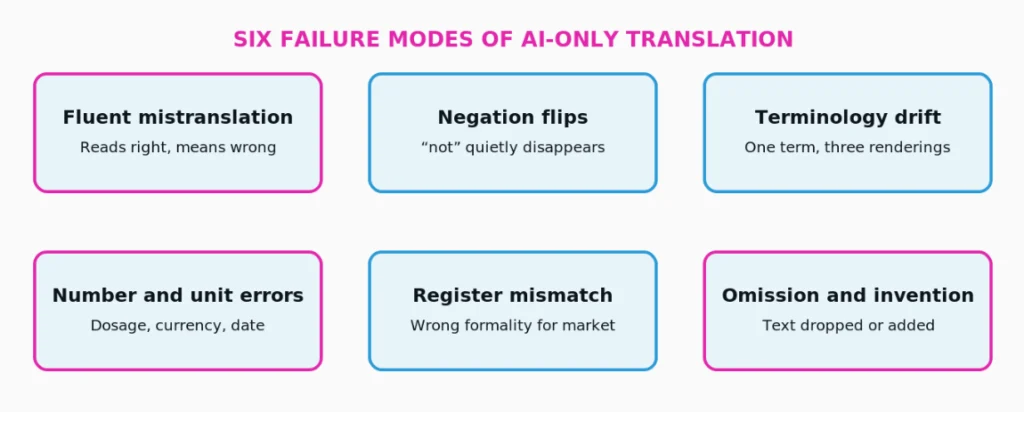
The six recurring failure modes of unreviewed machine output. The three outlined in pink leave no visible trace in the target language.
| Failure mode | What it looks like | Where it bites hardest |
|---|---|---|
| Fluent mistranslation | Grammatical target text carrying a different claim than the source | Legal terms, warranties, SLAs |
| Negation flips | A negative clause rendered as a positive one, or the reverse | Contraindications, contract exclusions |
| Terminology drift | One source term rendered three ways across a release | Product UI, help centre, docs |
| Number and unit errors | Decimal separators, currencies, dates, and dosages altered | Finance, healthcare, e-commerce |
| Register mismatch | Formality that is wrong for the locale or the audience | Sales copy, onboarding, support |
| Omission and invention | Source content dropped, or plausible content added | Compliance text, disclosures |
Failure modes ranked by how invisible they are to a reader who only sees the target text.
Why fluency hides the error, and why internal reviewers miss it
Fluency hides error because the reviewer reads the target text alone and finds nothing wrong with it. A mistranslation that produces broken grammar gets caught in seconds. A mistranslation that produces a clean, confident sentence gets approved.
Three habits make this worse in practice. Teams ask a bilingual employee to spot-check, and that employee reviews the target for readability rather than comparing it segment by segment against the source. Teams treat engine confidence scores as accuracy scores, when confidence measures how certain the model is about its own output, not whether that output is correct. And teams review a sample of the easy content while the high-consequence strings, which are usually the shortest, go straight to production.
There is a length paradox worth naming. The strings that carry the most risk are usually the shortest: a button label, a consent line, a dosage field, a fee percentage, an error message that tells someone whether their transaction went through. Short strings also carry the least context for an engine to work from, and they are the first thing skipped when a reviewer is sampling by volume. Risk and review attention move in opposite directions unless someone deliberately intervenes.
The fix is structural rather than motivational. Review has to be bilingual, comparative, and pointed at the segments that carry consequence, not spread evenly across the word count.
What automated quality checks catch, and what they cannot
Automated checks reliably catch the mechanical failure classes and reliably miss the semantic ones. That split is stable across tooling, and it defines where human effort has to go.
Quality estimation models have improved considerably, and recent research shows they meaningfully reduce post-editing time by flagging which segments deserve attention. What they do not do is decide whether a fluent sentence is true to the source. Quality estimation is a routing tool, not a verdict.
| Check type | Reliably catches | Reliably misses |
|---|---|---|
| Automated QA rules | Tags, placeholders, number mismatches, forbidden terms | Meaning shifts that keep the numbers intact |
| Glossary and TM checks | Terminology drift against an approved list | Terms absent from the glossary |
| Quality estimation scoring | Segments statistically likely to need editing | Confident, fluent, wrong output |
| Human post-editing | Meaning, negation, register, omission | Systemic issues across a whole release |
| Independent LQA sampling | Severity patterns, drift, reviewer error | Errors outside the sampled set |
No single layer covers the full error surface. The coverage comes from stacking them.
Translation Memory (TM) and glossary enforcement belong in this stack too, but both only cover what someone has already defined. They harden consistency; they do not establish correctness.
Where human review changes the outcome
Human review changes the outcome at four points: source preparation, engine output triage, full post-editing, and independent quality assurance. Adding a human anywhere else mostly adds cost.
The third point is the one with a published standard behind it. ISO 18587:2017 defines full machine translation post-editing (MTPE) as the process that brings machine output to a level comparable with human translation, and it sets competence requirements for the post-editor covering linguistic, research, cultural, technical, and subject-matter ability. Full post-editing is a defined discipline with an auditable process, which is precisely why it belongs in a procurement conversation rather than in a caveat.
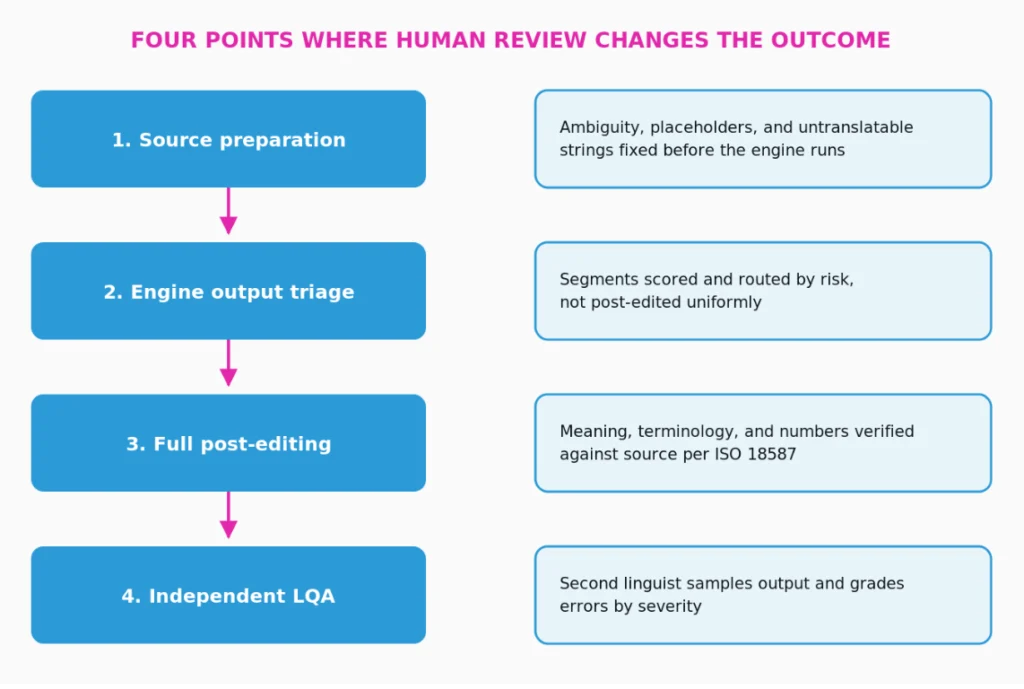
The four intervention points, each paired with the specific check performed there. Human effort placed anywhere else produces cost without coverage.
The first two points are the cheapest and the most neglected. Source preparation means resolving ambiguity before the engine sees it: a string that reads ‘Set’ with no context will be translated as a noun in one language and a verb in another, and no amount of downstream review recovers the intent that was never written down. Adding developer comments, disambiguating UI labels, and locking placeholder syntax costs hours once and removes an entire error class permanently.
Engine output triage is the second lever. Instead of post-editing everything at the same depth, segments get scored and routed, so specialist attention lands on the strings that carry consequence and low-risk segments move through at speed. This is what makes the economics work at volume, and it is the difference between a workflow that scales and one that simply costs more each quarter.
The fourth point is the one teams skip most often. Linguistic quality assurance (LQA) puts a second linguist across a sample of finished output and grades what they find by severity rather than by count, which is what turns a list of complaints into a signal about the process. A worked example of how severity grading works in practice makes the difference concrete: ten minor style preferences and one critical meaning error are not the same finding, and a raw error count treats them as if they were.
Match review depth to consequence, not to word count
Review depth should be set by what breaks when a segment is wrong, not by how much content there is. This single reframe is what makes AI plus human economics work, because it stops teams paying for deep review on content that does not need it and stops them shipping thin review on content that does.
A blog post with a clumsy sentence costs a little credibility. A mistranslated fee disclosure costs a regulatory finding. Both might be 800 words. They are not the same job.
A typical SaaS product splits cleanly along this line. Blog content, changelog entries, and community answers sit in the low-consequence lane. Product interface strings, onboarding flows, and documentation sit in the middle, because an error there does not create liability but it does create support tickets and churn. Terms of service, data processing terms, billing language, and anything with a regulator behind it sits at the top. Most teams price all three as one line item, then wonder why quality feels inconsistent.
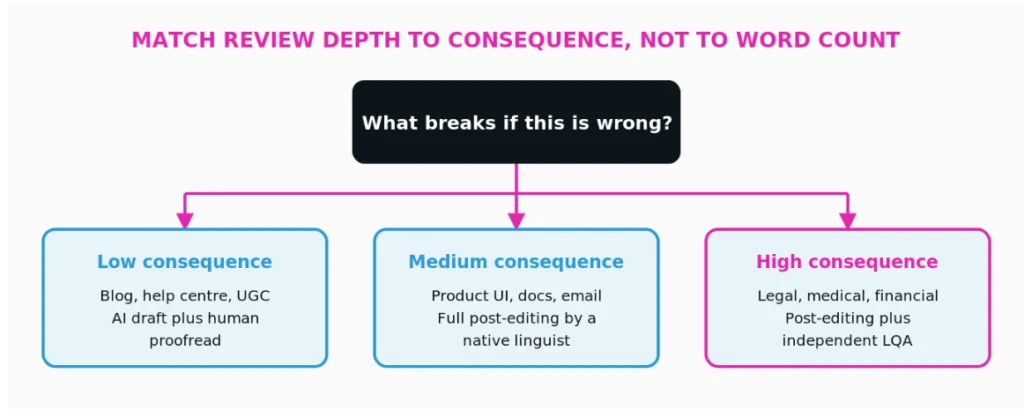
Route content by consequence. The question at the top of the tree is the only one that reliably sorts a backlog.
This is also the honest way to read a price list. Tiered transparent translation pricing exists so that low-consequence content can move at speed and high-consequence content can carry a specialist linguist, an independent reviser, and terminology management, without one subsidising the other. Content in regulated financial content and similar categories should never sit in the same review lane as a help centre article.
How NexTranslate structures AI plus human review
NexTranslate runs a rubric-driven, human-in-the-loop workflow rather than a single review pass. AI produces the draft, native linguists evaluate output against defined criteria (factual accuracy, fluency, contextual relevance, cultural appropriateness, safety), and senior reviewers validate the scoring itself before anything is signed off. The same framework underpins the multilingual AI evaluation services used by teams evaluating large language model output, not just translated content.
Two structural choices matter more than any feature. Human proofreading sits inside every tier rather than as a paid add-on, which removes the incentive to skip it on a tight budget. And review depth is assigned per content type rather than per account, so a single company can run help centre content at speed and compliance content at full depth in the same programme.
For teams that want the full evaluation methodology rather than the summary, the guide to AI translation quality covers benchmarking, error typologies, and how to build a scorecard you can actually defend to a stakeholder.
Frequently asked questions
Is AI translation accurate enough to use without human review?
For low-consequence content, often yes. For anything where an undetected error creates legal, financial, clinical, or contractual exposure, no. Published benchmarks place neural machine translation at roughly 70 to 85 percent accuracy on general content, and the residual errors concentrate in exactly the segments that carry the most risk.
What is the difference between light and full post-editing?
Light post-editing aims to make machine output understandable. Full post-editing, as defined by ISO 18587:2017, aims for output comparable to human translation, which means meaning, terminology, numbers, and register are all verified against the source. Only full post-editing is appropriate for published or regulated content.
Can automated quality checks replace a human reviewer?
No. Automated checks catch mechanical failures such as tag mismatches, number inconsistencies, and glossary violations. They cannot determine whether a fluent, confident sentence carries the source meaning, and that is the error class that causes the most damage.
Why does my bilingual employee not catch these errors?
Because most internal reviewers read the target text for readability instead of comparing it segment by segment against the source. Fluent mistranslation reads perfectly well on its own. Catching it requires bilingual comparative review, which is a different task from proofreading.
How much does adding human review increase translation cost?
Less than most teams expect when review depth is matched to content risk rather than applied uniformly. Providers that charge proofreading separately inflate the perceived cost of review; including it at every tier makes the real difference between tiers the depth of specialist involvement, not whether a human looked at all.
What is linguistic quality assurance and when do I need it?
Linguistic quality assurance (LQA) is an independent review of finished translation, sampled and graded by error severity. It is worth running when you need evidence of quality rather than an assurance of it, typically for regulated content, enterprise procurement, or when auditing a vendor’s actual output against their claims.
Conclusion: AI-only translation is a review-design problem, not a quality problem
The engines are not the weak point. Unreviewed output is. Every one of the six failure modes above is catchable, and the ones that cause real damage are catchable only by a bilingual human comparing target against source at a defined point in the pipeline.
Teams that get this right do not choose between speed and trust. They decide, per content type, what breaks if a segment is wrong, and they buy review depth accordingly. AI gives the speed. Humans give the trust. Neither works alone.
If you want to see where your current output actually sits, we run scoped pilot evaluations across selected languages and content types, with severity-graded findings you can take to a stakeholder. Request a pilot evaluation and we will scope it against your real content.
Written by Karuppusamy Arunachalam, NexTranslate
Published July 2026 · Filed under AI & LLM Evaluation
