




A translation can be grammatically perfect and still hurt your brand. The verb agrees, the spelling is clean, nothing looks wrong to a spell-checker. Then a native speaker opens the page and sees a price written in the wrong currency format, a feature name that no local user recognizes, and a tone that reads like a stiff instruction manual instead of a product they would trust. The words were translated. The message was not protected.
This is the gap linguistic quality assurance is built to close. Translation produces the words. Proofreading catches surface errors. Linguistic quality assurance (LQA) is a separate, structured check that asks a harder question: does this content actually work for the market it is going to, and is it safe to ship? For any company putting a product in front of paying customers in a new language, that question is the difference between growth and a quiet reputation problem.
This guide explains what LQA is, what it reviews, how reviewers score errors by severity, and how to tell when your content genuinely needs it versus when a lighter check will do.
What is linguistic quality assurance (LQA)?
Linguistic quality assurance is the structured, independent review of already-translated content to confirm it is accurate, consistent, culturally appropriate, and safe to publish. It is a distinct stage, not a synonym for translation or proofreading.
Translation converts meaning from one language to another. Editing and proofreading fix grammar, spelling, and flow inside that translated text. LQA sits above both. A separate qualified linguist, ideally one who did not produce the translation, reviews the content against the source, a glossary, a style guide, and the expectations of the target market, then documents what they find in a scored report. The output is not a corrected file. It is evidence: a quality score, a list of errors ranked by how much damage each one does, and guidance on what to fix.
That independence is the point. A translator checking their own work sees what they meant to write. A fresh reviewer sees what the reader will actually receive.
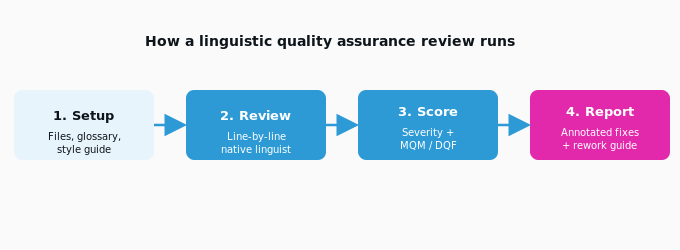
The four stages of an LQA review. Notice that scoring and reporting are separate steps, not a single pass/fail stamp.
What does an LQA review actually check?
An LQA review checks far more than grammar. It evaluates accuracy against the source, terminology consistency, tone and brand voice, cultural fit, formatting, and market-specific conventions like date, number, and currency formats.
The reviewer reads the translated content line by line against the original, not in isolation. A sentence that reads smoothly on its own can still be wrong: it can drop a qualifier that changes the legal meaning, use a term the client’s glossary explicitly bans, or carry a tone that undercuts the brand. LQA is designed to surface exactly these problems, the ones a spell-checker and a casual read will always miss.
In practice, a review covers these areas:
- Accuracy against the source: meaning preserved, nothing added, dropped, or reversed.
- Terminology the same term is translated the same way every time, in line with the glossary.
- Style and voice tone matches the brand and suits the audience, from a legal notice to a marketing headline.
- Cultural fit idioms, references, and examples make sense in the target market and cause no offense.
- Locale conventions dates, numbers, currency, addresses, and units follow local conventions.
- Formatting nothing is truncated, no character encoding breaks, layout survives text expansion.
The scope scales to the content type. A software UI string is judged on whether it fits the button and reads clearly in context. A medical instruction is judged on whether a single wrong word could put someone at risk. Same discipline, different stakes.
It helps to see where LQA sits relative to the steps around it:
| Step | Core Question | Who Does It | What You Get Back |
|---|---|---|---|
| Translation | What does this mean in the target language? | Translator | Translated text |
| Proofreading | Is the text clean and readable? | Editor / Proofreader | Corrected text |
| LQA | Is this accurate, on-brand, and safe to ship? | Independent Linguist | Scored report with ranked errors |
Translation and proofreading fix the file. LQA evaluates it and tells you whether it is fit to release.
How are translation errors scored in LQA?
LQA scores errors by severity, not by raw count. A review classifies each issue as Critical, Major, or Minor, then weights it, so ten small style tweaks never outrank one mistranslated dosage or price.
This is the mechanism that makes LQA useful to a decision-maker. A flat error count is misleading: a page with twelve minor preference edits looks worse than a page with one critical compliance error, even though only one of them can get you sued. Severity weighting fixes that. Reviewers apply an industry framework to keep the scoring consistent and defensible across reviewers, languages, and vendors.
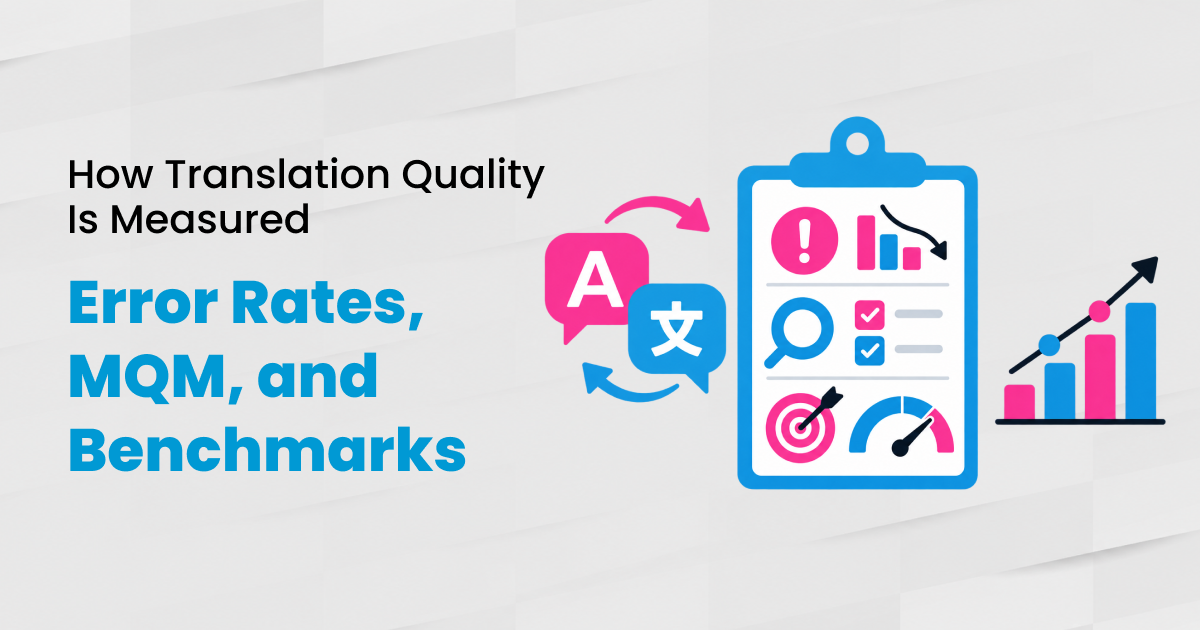
The two frameworks you will hear most often are MQM (Multidimensional Quality Metrics) and the TAUS Dynamic Quality Framework (DQF). Both define standard error categories and severity levels so that a score means the same thing on every project. The MQM approach in particular has become the reference model behind most modern quality programs, and it underpins ISO 5060, the standard for evaluating human translation output. A review can also run against a client’s own internal standard when one exists.
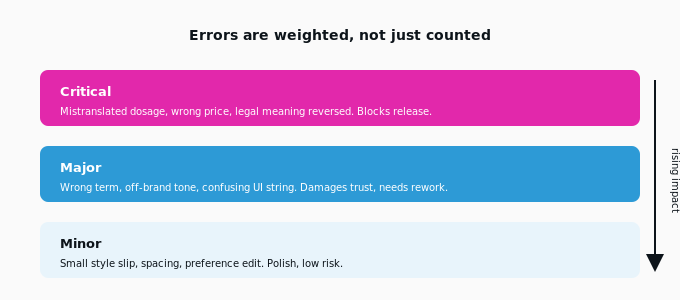
Severity weighting in practice. One critical error carries more weight than a page full of minor edits, which is why LQA counts impact, not volume.
Here is how the severity levels translate into real brand risk:
| Severity | Example | Brand Impact |
|---|---|---|
| Critical | Wrong dosage, wrong price, reversed legal clause | Blocks release, legal or safety risk |
| Major | Banned term, off-brand tone, confusing UI label | Erodes trust, needs rework |
| Minor | Small style slip, spacing, preference edit | Cosmetic, low risk |
The same three-tier severity model NexTranslate applies in its LQA reports, mapped to what each error costs the brand.
When does your content actually need LQA?
Your content needs LQA when the cost of a translation error is higher than the cost of the review. That threshold arrives fast for regulated, high-visibility, or conversion-critical content, and stays low for internal or throwaway text.
Not every string deserves an independent review, and pretending otherwise just slows teams down. The practical filter is risk. Ask what happens if this specific content is wrong in this specific market. If the answer involves a regulator, a refund, a churned customer, or a screenshot on social media, LQA earns its place. If the answer is that a colleague is mildly confused, it does not.
Content that almost always warrants LQA:
- Internal notes, drafts, and low-stakes communication read by a handful of people.
- Temporary or experimental copy that will be rewritten before it matters.
- Regulated material in medical, legal, and financial contexts, where a wrong word carries compliance risk.
- Customer-facing product UI, where a confusing string blocks users from completing a task.
- High-visibility marketing and brand campaigns that represent the company at scale.
- Output from machine translation or crowdsourced work that has not yet been independently verified.
Content that usually does not:
- Internal notes, drafts, and low-stakes communication read by a handful of people.
- Temporary or experimental copy that will be rewritten before it matters.
This risk-tiering is also how you keep costs sane. You do not run premium LQA on everything. You run it where a mistake is expensive and lighter checks where it is not.
How LQA fits an AI plus human workflow
In a modern workflow, LQA is the independent quality gate that sits after AI drafting and human editing and before launch. It is what lets a team move at AI speed without shipping AI mistakes.
The reason this matters more now than it did five years ago is machine translation. AI can draft a language in seconds, and the temptation is to treat fluent output as finished output. But fluency is not accuracy. A model can produce a confident, natural-sounding sentence that quietly inverts a condition or invents a term. Human editing catches most of it. An independent LQA pass is what confirms it, on the record, before customers see it.
This is the logic behind the NexTranslate model. AI gives speed, humans give trust, and quality assurance is the step that proves the trust is real. It is why human proofreading and standard LQA checks are built into every translation and localization services tier rather than sold as an upsell, and why machine translation post-editing output is always verified rather than trusted on faith. If you want the deeper comparison of where machine and human effort each pay off, the breakdown in MTPE vs human translation covers it.
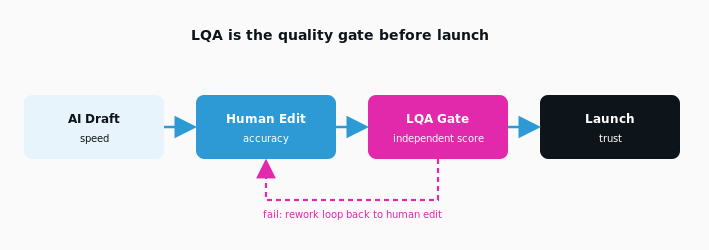
LQA as a release gate. Content that fails loops back to human editing instead of reaching customers, which is how speed and safety coexist.
What a good LQA report gives you
A good LQA report gives you a decision, not just a critique. It combines a quality score, errors ranked by severity, specific annotations, and clear rework guidance, so anyone can see whether the content is ready to ship.
The value of LQA lives in the report. A useful one includes an overall quality score or pass/fail status, error categories with severity ratings, terminology and consistency checks, context notes such as screenshots for UI reviews, and concrete revision guidance. When a company runs LQA across multiple vendors or languages, the report also becomes a way to compare quality objectively instead of arguing about it. That reporting depth is the core of professional LQA services, and it is what turns a subjective sense that a translation feels off into an auditable record a team can act on.
For regulated work, that record is not a nice-to-have. In fields like healthcare, an LQA report is part of how a company demonstrates that its multilingual content was reviewed, scored, and approved before release, which is exactly the standard expected in medical and healthcare translation.
That is also why quality-first teams often keep LQA independent of translation and price it against risk. NexTranslate publishes transparent pricing with human review included at every tier, so the quality step is never the line item a team is tempted to cut.
Frequently asked questions
Is LQA the same as proofreading?
No. Proofreading fixes surface errors like spelling and grammar inside the text. LQA is a separate, independent evaluation that scores accuracy, terminology, tone, and cultural fit against the source and a style guide, and returns a ranked report rather than a corrected file.
Who performs linguistic quality assurance?
A qualified native linguist, usually one who did not produce the original translation. That independence is what makes the review credible, because a fresh reviewer sees what the reader will receive rather than what the translator intended.
What frameworks are used to score LQA?
The most common are MQM (Multidimensional Quality Metrics) and the TAUS Dynamic Quality Framework (DQF), often alongside a client’s internal standard. Both define standard error categories and severity levels so a quality score means the same thing across reviewers, languages, and vendors.
Can LQA be run on translations from another provider?
Yes. Independent LQA on third-party or machine-translated content is one of its most common uses. The reviewer audits work they did not produce and returns an objective score, which is how teams verify a new vendor or check crowdsourced and AI output before launch.
Does LQA slow down a fast release cycle?
Not when it is scoped by risk. High-stakes and customer-facing content gets a full review, while low-risk internal text gets a lighter check or none. Built into an AI plus human workflow as a release gate, LQA adds a confidence step without stalling the pipeline.
Conclusion: LQA is brand protection, not proofreading
Linguistic quality assurance is easy to mistake for a final spell-check and expensive to treat that way. It is the step that decides whether translated content is accurate, on-brand, and safe enough to represent your company in a market you cannot personally read. As AI makes translation faster and more fluent, that independent verification stops being optional and starts being the thing that separates a trustworthy global product from a fluent-sounding liability.
If your team is shipping into new languages and is not sure your quality step is doing real work, that is worth a conversation. Request a quote and we will help you scope LQA to the content that actually carries risk, so you move fast without betting the brand on it.
Written by: Karuppusamy Arunachalam, NexTranslate
Published: July 2026 · Filed under AI & LLM Evaluation
