




The best website translation service depends on your goal. For accurate, on-brand translation that customers trust, with human review built in, NexTranslate leads. For instant free machine translation, Google Translate, Bing Translate, and DeepL are the top free engines. For a no-code marketing site, Weglot and ConveyThis launch fastest. For enterprise scale, Smartling and Phrase. This guide ranks all ten and shows which one fits your situation.
Most US teams choose a website translation service the wrong way. They compare price per word or reach for the biggest brand name, translate the site, publish, and wait for international traffic to convert. It rarely does. The pages are readable, but the tone is off, the terminology drifts from screen to screen, and search engines never rank the translated pages because the multilingual SEO was never set up. The tool worked. The result did not.
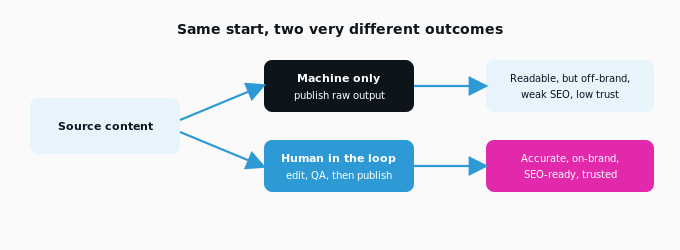
The same source content, two paths. Machine-only publishing is fast and cheap and lands on low trust. Human-in-the-loop review is what produces an on-brand, SEO-ready result.
The reason is simple. Website translation is not one job. It is machine translation, human review, multilingual SEO, layout adaptation, and quality assurance, bundled together, and different services are strong at different parts of that bundle. A free machine engine is perfect for understanding a foreign page and useless for a brand you want customers to trust. An enterprise platform is built for governance and overkill for a ten-page marketing site.
This guide ranks the ten best website translation services for US teams in 2026 and, more usefully, tells you which one fits which situation. It leads with the option built for accuracy and trust, then works through the fast, free, and enterprise choices so you can match the tool to the stakes of your content. For the broader how-to on translating your site end to end, see the complete guide to website translation services.
Disclosure: this guide is published by NexTranslate, which is one of the services reviewed. The competitor assessments below are written to be accurate and fair, because a ranking that only flatters the publisher is worth nothing to the reader or to the search engines that surface it.
How NexTranslate decides what receives AI and what receives human review
Every page on a website doesn’t carry the same business risk. A homepage, pricing page, legal notice, help article, and blog post all require different levels of review. That’s why NexTranslate uses the NEX Translation Matrix™, our decision framework for matching each content type to the appropriate translation workflow based on business risk, customer impact, and quality requirements.
Instead of translating every page the same way, the matrix determines where AI accelerates delivery, where human linguists refine meaning, and where independent quality assurance is required before publication.
How these website translation services were ranked
Every service here was judged on six criteria that decide whether a translated website actually performs: trust and human review, multilingual SEO, CMS and workflow fit, layout handling, terminology control, and pricing transparency. Speed and price matter, but they are worthless if the output cannot be trusted in front of customers.
The six criteria, in plain terms:
- Trust and human review: does a qualified human review the output, or are you publishing raw machine text?
- Multilingual SEO: does it produce hreflang tags, indexable translated URLs, and search-ready pages, or just swap text on the fly?
- CMS and workflow fit: can your team deploy it without an engineer, or does it need developer setup?
- Layout handling: does it handle string expansion, right-to-left languages, and truncation?
- Terminology control: glossaries and translation memory to keep terms consistent across the whole site?
- Pricing transparency: clear, predictable cost, or an opaque enterprise contract?
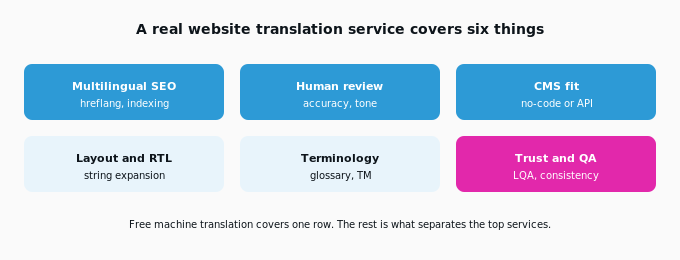
A complete website translation service covers all six requirements. Free machine translation covers one, which is why it sits at the bottom of the ranking.
Why credibility and trust decide this choice
Trust is the criterion that separates a website translation service that grows revenue from one that quietly costs it. Machine-only output is readable, but it erodes credibility through inconsistent terminology, off-brand tone, and weak SEO, while human-in-the-loop review is what turns readable text into content customers act on.
The failure is easy to underestimate because nothing looks broken. A machine engine translates each sentence competently, then renders the same feature name three different ways across onboarding, pricing, and support, uses a register that feels robotic to a native speaker, and produces pages that never earn a search ranking because no hreflang or indexable structure was set up. Customers do not file a complaint. They just do not convert, and you never learn why.
This is why the professional standard for using machine translation in production, ISO 18587, is built entirely around human post-editing rather than raw output. It is also why the strongest services pair AI speed with human judgment. Machine translation post-editing has a linguist correct and align machine output, and linguistic quality assurance adds an independent review that scores the result before it goes live. Those two steps are the difference between content that is merely present in another language and content a US company would be comfortable putting its name on.
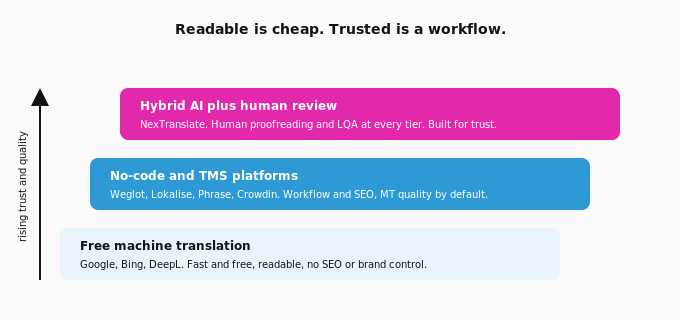
The website translation quality ladder. Free engines get you readable output; no-code and TMS platforms add workflow and SEO; a hybrid AI plus human model is built for trust.
The 10 best website translation services in 2026
The ranking runs from the most trustworthy end of the spectrum to the fastest and freest. Read the descriptions as fit, not verdict: the right service depends entirely on how much the accuracy of your translated site matters to your business.
1. NexTranslate, best for trust, accuracy, and conversion
Quick facts
| Model | Hybrid AI + Human |
|---|---|
| Pricing | Transparent, from $0.03/word, human review at every tier |
| Setup | Managed Service |
| Best for | Trusted, conversion-focused websites |
NexTranslate is the best choice for US teams that need their translated website to be trusted, not just readable. It combines AI drafting with human translation and review at every quality tier, so the speed of machine translation comes with the credibility of a human linguist behind it.
Where most tools stop at machine output, NexTranslate treats human review as the default rather than an upsell. Its website and app localization covers the full job: translation, multilingual SEO structure, layout and string-length checks against the real interface, terminology consistency through glossaries and translation memory, and an independent quality pass for anything high-stakes. For US companies in regulated or brand-sensitive spaces, that human-in-the-loop model is the point.
Pricing is transparent and per word, with human proofreading included at every tier rather than billed separately, which is unusual in this market. The published transparent per-word pricing runs from a light-touch tier for low-risk marketing pages up to a premium tier for legal, medical, and financial content. If you are still deciding what your site actually needs, the guide on the difference between translation and localization is a useful primer.
| Best for | SaaS and business websites where accuracy, brand voice, and international SEO drive real revenue. |
|---|---|
| Watch-outs | A managed, human-reviewed model is not the right fit if you only need instant, throwaway gist translation of a page. |
2. Google Translate, best free tool for instant gist
Quick facts
| Languages | 240+ |
|---|---|
| Pricing | Free (Cloud Translation API for scale) |
| Setup | Instant widget or API |
| Best for | Gist translation and internal use. |
Google Translate is the best free option when you need to understand a page fast or give visitors a rough machine rendering at no cost. It supports well over 100 languages, handles enormous volume instantly, and is the default reference point every other tool is measured against.
Its strength is reach and speed. For internal use, quick comprehension of a foreign site, or a low-stakes page where readable is good enough, nothing is faster or cheaper. The limits show the moment credibility matters: no human review, no brand voice control, inconsistent terminology across a site, and no real multilingual SEO structure when used as a page widget. Google itself retired its Website Translator widget years ago, which tells you it was never meant to be a production localization layer.
| Best for | Instant comprehension, internal use, and low-stakes gist translation. |
|---|---|
| Watch-outs | Not suitable as the public translation layer for a brand or conversion-focused website. |
3. Bing Translate, best free tool inside the Microsoft stack
Quick facts
| Languages | 130+ |
|---|---|
| Pricing | Free (Azure Translator API for scale) |
| Setup | Instant or API |
| Best for | Microsoft-stack teams. |
Bing Translate, powered by Microsoft Translator, is the best free machine option for teams already living in the Microsoft and Azure ecosystem. It offers comparable instant translation to Google across a wide language range and integrates cleanly with Office, Edge, and Azure services.
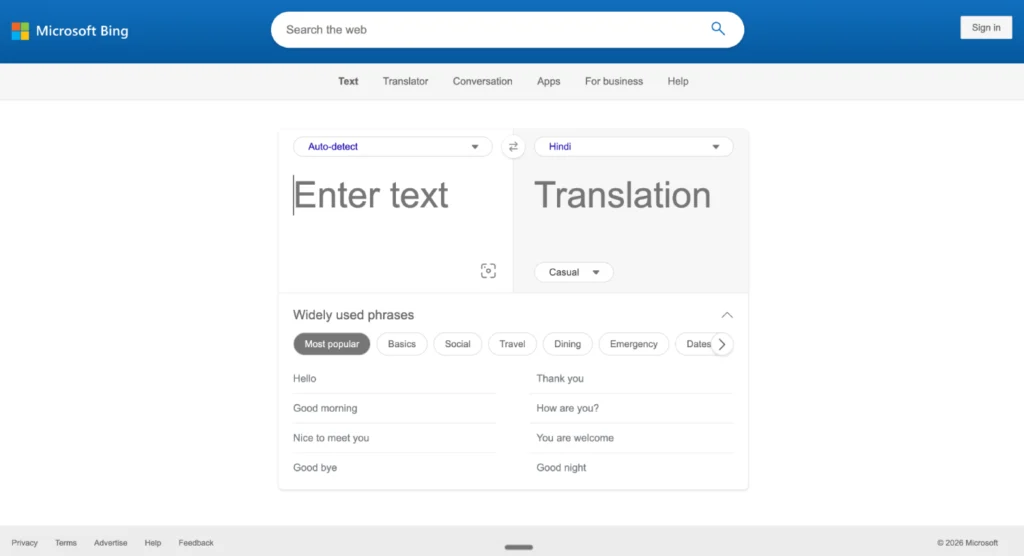
For US teams standardized on Microsoft tools, Bing Translate is the path of least resistance for quick translation inside documents, browsers, and internal workflows, and the underlying Azure Translator API is a reasonable building block for developers. As with any pure machine engine, the caveats are the same: no human accuracy layer, limited brand and terminology control, and no built-in multilingual SEO for a public site.
| Best for | Quick translation for Microsoft-centric teams and developer prototypes on Azure. |
|---|---|
| Watch-outs | Same trust ceiling as any machine-only engine for customer-facing content. |
4. Weglot, best no-code option for marketing sites
Quick facts
| Languages | 100+ |
|---|---|
| Pricing | Free tier, paid from about $15/month, scales with word count. |
| Setup | No-code CMS. |
| Best for | Marketing websites. |
Weglot is the best pick for marketing-led teams that want a multilingual website live quickly without touching code. It detects site content automatically, plugs into common CMS platforms like WordPress, Shopify, and Webflow in minutes, and handles the multilingual SEO basics such as translated URLs and hreflang out of the box.
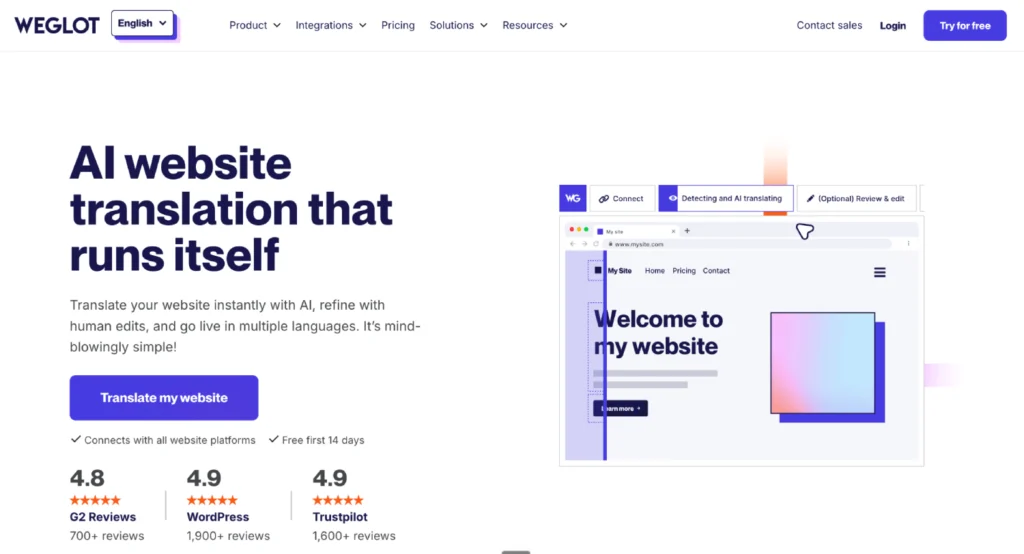
Its appeal is speed to launch and low technical lift. A small marketing team can go multilingual in an afternoon and get search-ready translated pages without an engineer. Translations default to machine output, with the option to edit manually or order professional translation, so quality depends on how much human review you layer on top. Pricing is subscription-based and scales with word volume and language count, which can climb on large or content-heavy sites.
| Best for | Marketing and CMS-based websites that need multilingual SEO fast with minimal engineering. |
|---|---|
| Watch-outs | Default machine quality and volume-based pricing mean costs and review needs grow with the size of your website. |
5. DeepL, best machine engine for European-language quality
Quick facts
| Languages | 30+ |
|---|---|
| Pricing | Free tier, DeepL Pro and API paid. |
| Setup | API or browser extension. |
| Best for | European-language drafts. |
DeepL is widely regarded as the best raw machine translation engine for quality, especially across major European languages. US teams expanding into German, French, Spanish, and similar markets often find its output noticeably more natural than other engines, and its API and Pro plans support integration into websites and workflows.
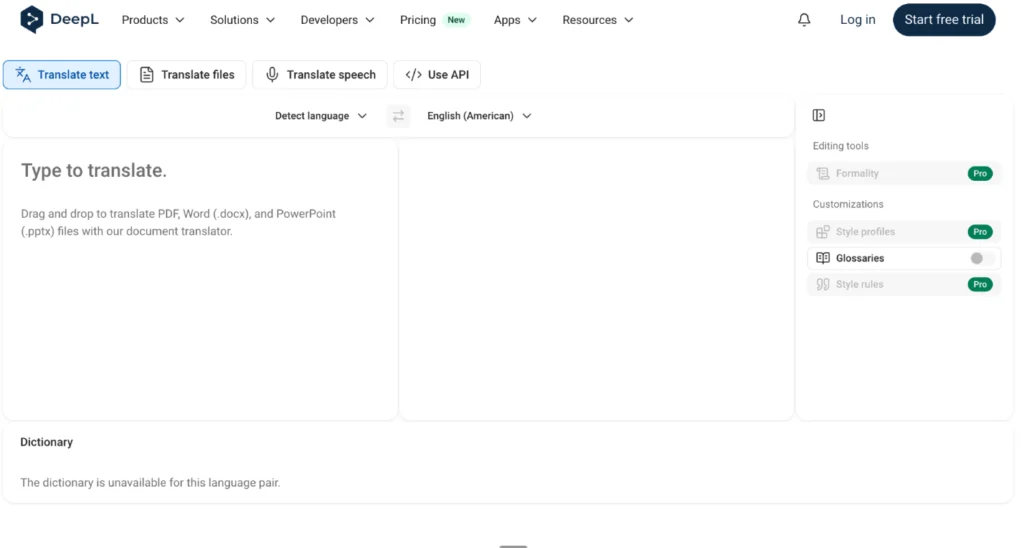
If your priority is the best possible machine baseline before human editing, DeepL is a strong starting point, and it pairs well with a post-editing step. Its language coverage is narrower than Google or Bing, and, like every pure engine, it does not provide human review, terminology governance, or website SEO structure on its own. It is best understood as a high-quality first draft, not a finished localization.
| Best for | High-quality machine drafts in European languages, ideally followed by human post-editing. |
|---|---|
| Watch-outs | Fewer languages than the larger translation engines, and still machine-generated output without a human review layer. |
6. Smartling, best enterprise TMS for large organizations
Quick facts
| Languages | 150+ |
|---|---|
| Pricing | Enterprise contract. |
| Setup | Proxy plus 50+ connectors. |
| Best for | Large enterprises at scale. |
Smartling is the best fit for large US enterprises that need a full translation management system with a proxy that translates a website without code changes. Its Global Delivery Network crawls and serves translated pages automatically, it offers a large library of CMS connectors, and it brings enterprise-grade compliance and a managed linguist network.
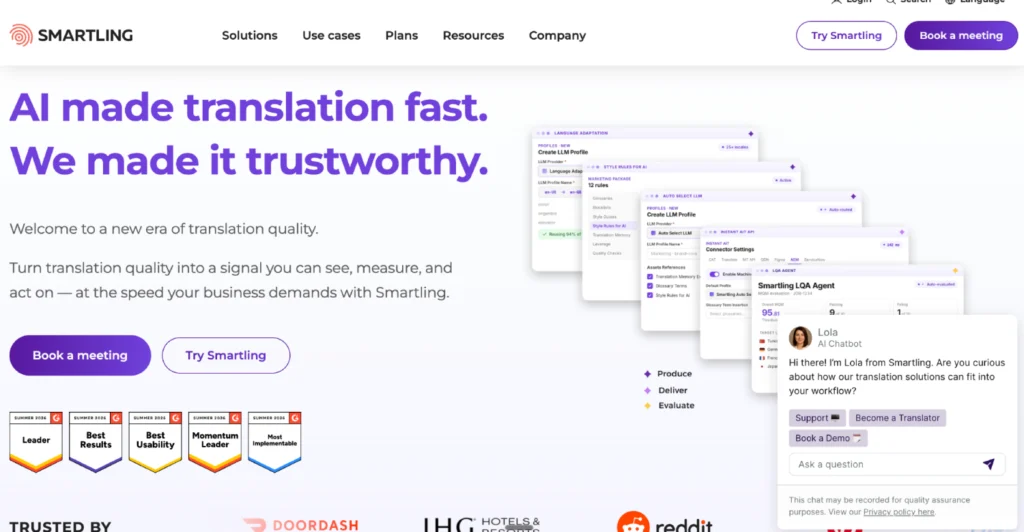
For Fortune 500-scale operations coordinating many languages, vendors, and content streams, Smartling delivers governance and automation that smaller tools cannot. That power comes with enterprise pricing and multi-week implementation, so it is generally overkill and over budget for small and mid-sized websites. It is a platform decision, not a plugin.
| Best for | Large enterprises needing automated, governed website translation at scale. |
|---|---|
| Watch-outs | Enterprise contracts and implementation timelines put it out of reach for smaller teams. |
7. Lokalise, best TMS for product and engineering teams
Quick facts
| Languages | Broad. |
|---|---|
| Pricing | Usage-based, from about $120/month. |
| Setup | Developer API and 60+ integrations. |
| Best for | Product and documentation teams. |
Lokalise is the best translation management platform for product-led teams that manage website, app, and documentation strings in one developer-friendly workspace. It is built around Git workflows, APIs, and design-tool integrations, and it scales cleanly as you add languages and content types.
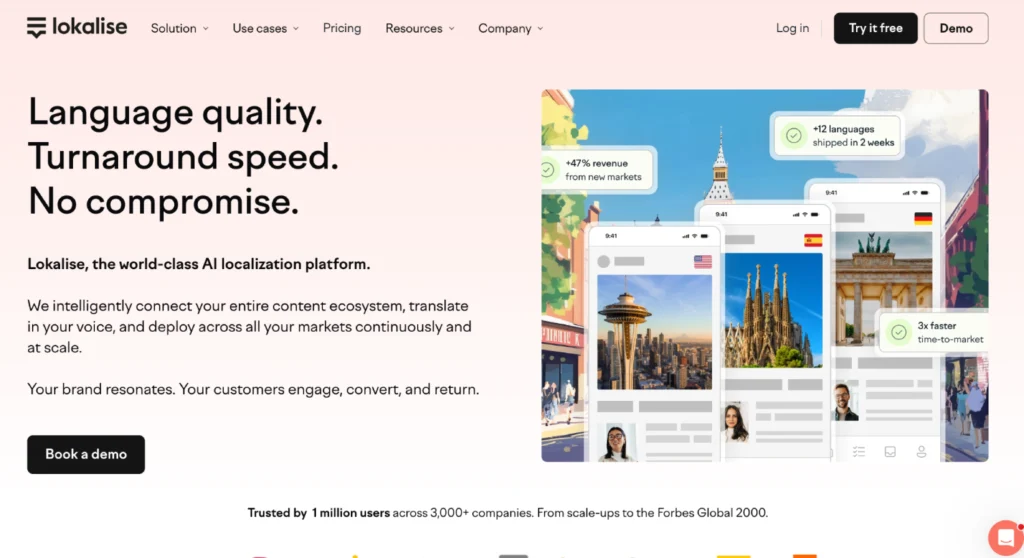
For teams treating localization as part of the development pipeline, Lokalise centralizes strings and keeps translated content in sync with releases. Website translation typically runs through developer setup via its CLI, SDK, or integrations rather than a no-code widget, so it rewards technical teams and asks more of non-technical ones. As a platform, its default output quality still depends on the human review you attach, which pairs naturally with a machine translation post-editing step for customer-facing pages.
| Best for | Product and engineering teams managing strings across web, app, and documentation. |
|---|---|
| Watch-outs | Developer-oriented setup makes it more complex than most marketing teams need for a website alone. |
8. Phrase, best for enterprise governance and orchestration
Quick facts
| Languages | Broad, with 30+ machine translation engines orchestrated. |
|---|---|
| Pricing | Enterprise tiers. |
| Setup | Platform with SSO. |
| Best for | Enterprise governance. |
Phrase is the best choice for enterprises that want localization governance, single sign-on, and AI translation orchestration in one platform. It combines a translation management system with automation and control features aimed at organizations that need auditability and standardized workflows across teams.
Like Smartling, Phrase sits at the enterprise end of the market, and it shines when localization is a cross-functional program rather than a single website project. Its depth is an advantage for large operations and a burden for small ones, and pricing reflects that positioning. For a growing US company scaling localization across many properties, it is a serious contender; for a single site, it is more platform than the job requires.
| Best for | Enterprises standardizing localization workflows with governance and AI orchestration. |
|---|---|
| Watch-outs | Enterprise-level complexity and cost are excessive for a straightforward website. |
9. Crowdin, best for developer-driven continuous localization
Quick facts
| Languages | Broad. |
|---|---|
| Pricing | Free tier plus usage-based paid plans. |
| Setup | Repository and CI/CD integration. |
| Best for | Developer-focused continuous localization. |
Crowdin is the best fit for developer teams that want to automate website and app localization directly inside their build pipeline. It integrates with repositories and CI/CD, supports a large ecosystem of connectors, and is well suited to continuous localization where translated strings ship alongside code. It overlaps in spirit with dedicated software UI translation work, since much of its value is in keeping product strings current.
For engineering-led organizations, Crowdin keeps localization close to the codebase and reduces manual handoffs. It is less approachable for marketing teams who just want a translated website without touching a repository, and, as with the other platforms, translation quality depends on whether you route content through machine output, community translators, or professional linguists with review.
| Best for | Developer teams automating localization through their repository and CI/CD. |
|---|---|
| Watch-outs | Repository-centric workflows are not well suited for non-technical website owners. |
10. ConveyThis, best budget no-code website translator
Quick facts
| Languages | 100+ |
|---|---|
| Pricing | Freemium, with paid plans starting from a low monthly rate. |
| Setup | No-code CMS. |
| Best for | Small and budget-conscious websites. |
ConveyThis is the best low-cost, no-code option for small websites that need to go multilingual quickly. It installs on common CMS platforms with minimal setup, auto-translates the site with machine output, offers a free tier for a single language, and lets you refine translations or order professional review as you grow.
For solo founders, small businesses, and low-budget sites, ConveyThis is an accessible entry point that covers the multilingual SEO basics and keeps the barrier to launch low. It occupies similar territory to Weglot at a friendlier starting price, with the same fundamental trade-off: the default is machine translation, so trust and brand quality depend on the human review you add on top.
| Best for | Small and budget-conscious websites that want a fast, affordable multilingual launch. |
|---|---|
| Watch-outs | Machine-default translation quality and lighter enterprise features limit its suitability for higher-stakes websites. |
Website translation services compared at a glance
The table below summarizes where each service fits. Note the trust column: it is the axis that most often decides whether a translated website performs, and it is exactly where the free engines and the human-reviewed models diverge.
| Service | Best for | Model | Human review | Languages | Pricing |
|---|---|---|---|---|---|
| NexTranslate | Trust, accuracy, conversion | Hybrid AI + human | Yes, every tier | Wide | From $0.03/word |
| Google Translate | Instant free gist | Machine only | No | 240+ | Free |
| Bing Translate | Microsoft-stack teams | Machine only | No | 130+ | Free / API |
| Weglot | No-code marketing sites | No-code + MT | Optional add-on | 100+ | From ~$15/mo |
| DeepL | European-language drafts | Machine only | No | 30+ | Free / Pro |
| Smartling | Enterprise at scale | Enterprise TMS | Managed network | 150+ | Enterprise |
| Lokalise | Product + docs teams | Developer TMS | Optional add-on | Broad | From ~$120/mo |
| Phrase | Enterprise governance | Enterprise TMS | Optional add-on | Broad | Enterprise |
| Crowdin | Developer continuous localization | Developer TMS | Optional add-on | Broad | Free + usage |
| ConveyThis | Budget no-code sites | No-code + MT | Optional add-on | 100+ | Freemium |
Ten website translation services compared. Language counts and pricing shift often, so treat these as categories, not quotes, and confirm current figures with each provider.
Website translation and SEO: the part most tools get wrong
Website translation only drives traffic if the translated pages are actually indexable and correctly signposted to search engines. The most common reason a translated site gets no organic traffic is not bad translation, it is missing multilingual SEO structure, and this is where the ten services differ most.
A translated page needs three things to rank in a new market. It needs its own indexable URL, usually a subdirectory like /es/ or a subdomain, rather than content swapped in place by a script that search engines never see as a separate page. It needs hreflang tags so Google serves the Spanish version to Spanish searchers and does not treat the language versions as duplicate content. And it needs localized metadata, titles, descriptions, and image alt text translated, not just the visible body copy.
This is the practical dividing line in the ranking above. Widget-style machine translation that overlays text on the fly often fails to create indexable pages at all, which is why free engines used as a public translation layer can leave your international SEO flat. No-code platforms like Weglot and ConveyThis handle the hreflang and subdirectory basics automatically. A human-reviewed service goes further, translating metadata with intent and keeping terminology consistent so the pages read as authoritative to both users and search engines.
If international search visibility is a goal rather than an afterthought, treat SEO structure as a hard requirement when you compare services, and confirm how each one handles URLs, hreflang, and metadata before you commit. A website and app localization approach that builds SEO in from the start avoids the expensive rework of retrofitting it later.
Five mistakes US teams make when choosing a service
The most expensive website translation mistakes happen at the selection stage, before a single word is translated. Avoiding these five is worth more than any feature comparison.
- Choosing on price alone: The default is machine translation, and machine output on a public brand site erodes trust and rankings unless a human reviews it.
- Ignoring multilingual SEO: A tool that only swaps text without creating indexable, hreflang-tagged pages will not rank, no matter how good the translation reads.
- Overbuying enterprise platforms: An enterprise TMS like Smartling or Phrase is powerful and wasted on a ten-page marketing site; a no-code tool is faster and cheaper for that job.
- Underestimating the setup lift: A developer-first platform like Lokalise or Crowdin asks a lot of a non-technical marketing team; match the tool to who will actually run it.
- Forgetting layout and string expansion: Interfaces designed only in English break when text expands 30 to 35 percent, so a service that reviews strings against the real layout matters more than raw translation speed.
How to choose the right website translation service
Choose by the stakes of your content, not by price alone. Match the service to how much the accuracy and credibility of your translated site affects revenue, compliance, and brand, and the shortlist narrows quickly.
A practical way to decide:
- If trust and conversion matter most: choose a hybrid AI plus human service like NexTranslate, where review and QA are built in.
- If you need a no-code marketing site live quickly: Weglot or ConveyThis get you multilingual and search-ready fast.
- If you are a product or engineering team: Lokalise or Crowdin keep localization inside the development workflow.
- If you are an enterprise coordinating many languages and vendors: Smartling or Phrase provide governance and automation.
- If you only need quick, low-stakes gist: Google Translate, Bing Translate, or DeepL do the job for free.
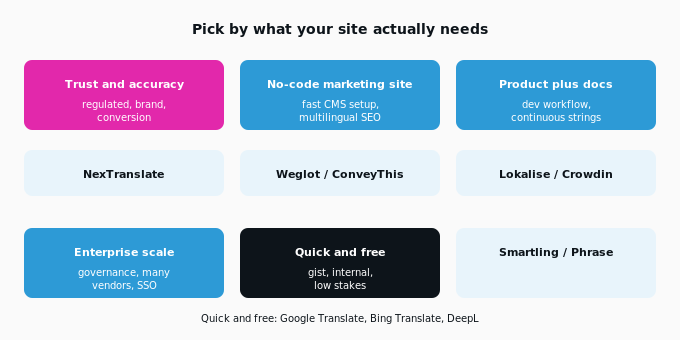
Match the content with the NEX Translation Matrix™. The free engines are the right answer for gist and internal use, and the wrong answer for a brand’s public, conversion-focused website.
Whatever you choose, the deciding question is the same: who is accountable for the accuracy of what goes live? If the answer is a machine, the content is readable at best. If the answer is a qualified human, backed by review, the content is trustworthy. That is the entire case for a translation and localization services partner over a raw engine, and it is why the ranking above leads with the human-reviewed option.
Frequently asked questions
What is the best website translation service in 2026?
For US teams where accuracy and brand trust matter, a hybrid AI plus human service such as NexTranslate is the best choice, because human review is included rather than optional. For instant, free gist translation, Google Translate, Bing Translate, and DeepL lead. For no-code marketing sites, Weglot and ConveyThis are the fastest to launch.
Is Google Translate good enough for a business website?
Google Translate is excellent for understanding a page or for low-stakes internal use, but it is not suited to a public business website. It provides no human review, no brand voice control, inconsistent terminology across pages, and no real multilingual SEO structure, all of which undermine trust and rankings on a customer-facing site.
What is the difference between free translation tools and a translation service?
Free tools like Google Translate, Bing Translate, and DeepL produce raw machine output instantly. A translation service adds human review, terminology control, multilingual SEO, layout adaptation, and quality assurance. The free tools make a page readable; a service makes it accurate, on-brand, and search-ready.
How do I know a website translation service is trustworthy?
Look for human review in the workflow, adherence to standards such as ISO 18587 for post-editing, transparent pricing, glossary and translation memory support, and independent quality assurance. A service that publishes how it reviews and scores translations is more credible than one that only promises fast machine output.
Does website translation affect SEO?
Yes, significantly. Proper website translation includes hreflang tags, indexable translated URLs, and localized metadata so search engines can rank each language version. Widget-style machine translation that swaps text on the fly often fails to create indexable pages, which is why translated content sometimes gets no organic traffic.
How much does professional website translation cost?
Costs vary by content volume, language, and quality level. Free machine tools like Google Translate and DeepL cost nothing but are unreviewed. No-code platforms such as Weglot start around $15 per month and scale with word count. Traditional professional human translation across the industry typically runs $0.10 to $0.30 per word. NexTranslate publishes transparent per-word pricing that starts lower, from $0.03 per word, because it blends AI drafting with human review, and proofreading is included at every tier rather than billed as a separate add-on that commonly raises the real cost by 20 to 30 percent.
Can I combine free machine translation with human review?
Yes, and it is often the smartest approach. Using a strong engine like DeepL for the first draft, then adding machine translation post-editing and a linguistic quality assurance pass, gives you machine speed with human trust. This hybrid model is exactly what the top-ranked services are built around.
What is the best free website translation tool?
For raw quality across major European languages, DeepL is widely considered the best free engine. For the widest language coverage and instant use, Google Translate leads with 240+ languages. For teams inside the Microsoft ecosystem, Bing Translate is the natural choice. All three are excellent for gist and internal use and none should be the unedited public layer of a brand website.
Should a small business use a free tool or a paid service?
It depends on what the page does. For a low-stakes informational site, a free or no-code tool is reasonable. The moment the website has to convert visitors, rank in search, or represent a brand in a regulated field, a human-reviewed service pays for itself by protecting trust and international SEO. A practical middle path is to start no-code, then add professional review on the pages that drive revenue.
Conclusion: match the tool to the trust you need
There is no single best website translation service, only the best one for the stakes of your content. If you need to understand a page or translate low-risk internal text, the free engines, Google Translate, Bing Translate, and DeepL, are all you need. If you are launching a marketing site quickly, a no-code tool will get you multilingual and search-ready. And if the accuracy, tone, and credibility of your translated website directly shape whether US-based and international customers trust and buy, a hybrid AI plus human service is the only category that clears the bar.
That is the thread running through this entire ranking. Readable is easy and cheap. Trusted is a workflow, and it is the one thing free machine translation cannot give you. If you want your translated website to earn trust rather than just occupy space in another language, request a quote and we will map the right approach to the content that actually carries risk.
Written by: Karuppusamy Arunachalam, NexTranslate
Published: July 2026 · Filed under Product & Technology
