

A campaign that took six weeks to write goes out to a translation vendor on a Thursday and comes back the following Monday, word-perfect and completely dead. The headline still scans. The call to action still means what it meant. Nothing is wrong with it, and nothing about it works.
That experience is what sends marketing teams looking for transcreation. Most vendor pages define it as creative translation and stop there, which is accurate and useless. It does not say which assets need it, what it costs, or why one launch can require three different workflows at once.
The practical answer is narrower than the marketing around it. Transcreation is slow, expensive, and correct for a small fraction of content. Translation is fast, cheap, and correct for most of it. Budget gets wasted by teams that pick one and apply it to everything they publish.
What is the difference between transcreation and translation?
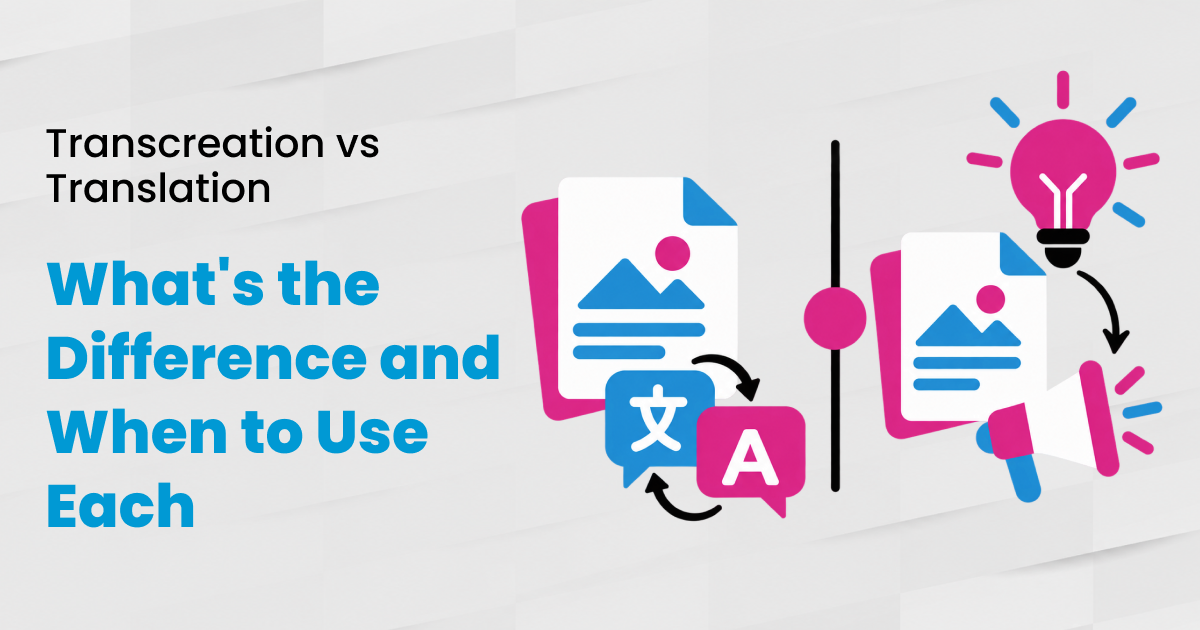
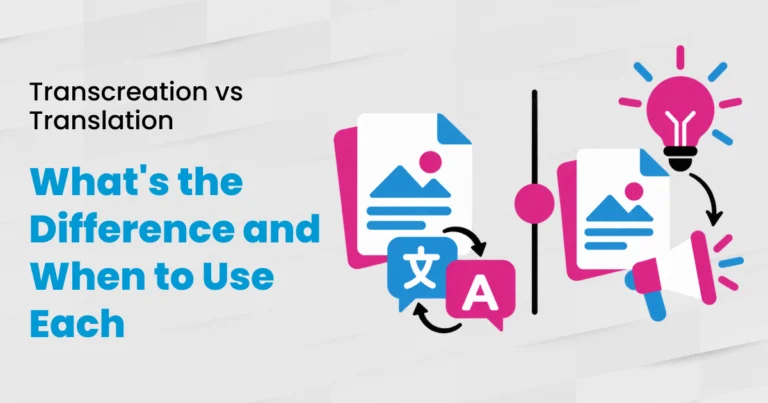
Translation carries an existing message into another language. Transcreation rebuilds the message so it produces the same effect on a new audience, and it is free to discard the original words to get there.
The difference shows up in what each workflow is accountable to. A translator is accountable to the source text, and the quality question is whether the target matches it. A transcreator is accountable to a creative brief, and the quality question is whether the target lands. That changes who does the work. Transcreators are copywriters who happen to be fluent in two languages, not linguists who happen to write well, and the two are not interchangeable hires.
It also changes the input. Translation starts with a finished source file. Transcreation starts with a brief covering intent, audience, tone and constraints, and the source copy becomes a reference rather than a specification. A useful test: if the review question is whether the output matches the original, the work is translation. If it is whether the output works, the work is transcreation.
Localization is the third option most teams skip
Localization sits between the two and solves most of the problems teams mistakenly budget transcreation for. It keeps the message intact while adapting everything around it: currency, date and number formats, units, legal wording, examples, imagery, and the length limits a translated string has to survive inside.
The cautionary tales repeated on every transcreation page are brand-naming problems. Mercedes-Benz first entered China under characters that read as rush to die. Coca-Cola’s early Chinese rendering read as bite the wax tadpole. Both are real, both are about a name, and neither explains why a SaaS product reads badly in German. The everyday failures are duller. A pricing page quoting only US dollars to a European buyer. A support article built around a US holiday. A button that breaks because the Finnish string is 40 percent longer than the English. Those are localization defects, and creative rewriting does not fix them.
Before approving a transcreation budget, work out whether the asset fails because the words are wrong or because the context around them is wrong. Interface strings and onboarding flows usually need website and app localization rather than a copywriter. Visibility in a new market is a third problem again, closer to multilingual SEO than to either workflow.
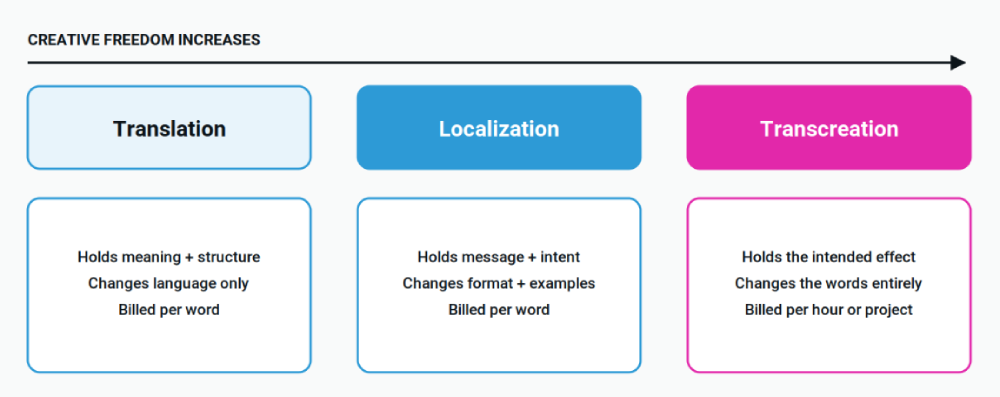
| Factor | Translation | Localization | Transcreation |
|---|---|---|---|
| Starts from | Source text | Source text plus locale rules | A creative brief |
| Who does it | Professional translator | Translator plus locale reviewer | Bilingual copywriter |
| Free to change | Wording only | Format, examples, references | Everything except the intent |
| Quality test | Does it match the source | Does it fit the market | Does it produce the same effect |
| Priced | Per word | Per word | Per hour or per project |
| Typical turnaround | 24 to 48 hours | 2 to 5 days | 1 to 3 weeks per market |
Turnaround figures assume a briefed, in-scope asset and exclude client review cycles.
When translation is enough
Translation is the right call whenever the reader’s job is to understand something rather than to feel something. That covers far more of a typical content library than most marketing teams assume.
Product documentation, knowledge base articles, release notes, terms of service, support macros and most interface strings belong here. This content is high volume, changes often, and is judged on accuracy rather than resonance. A reader looking for the rate limit on an API endpoint does not want a rewritten experience of finding it.
For this tier, machine translation post-editing (MTPE) does the job at a fraction of the cost of full human translation. ISO 18587 sets out what full post-editing has to deliver, which is what separates a defensible MTPE workflow from raw machine output with a spell check on top. Add a Translation Memory (TM) and an approved glossary and the cost drops further on every subsequent update, because the repeated content is never paid for twice.
The takeaway is a budget one. A team that transcreates its help center spends creative money where no reader is looking for creativity, and runs out before it reaches the homepage.
When transcreation is worth paying for
Professional transcreation services earn their cost on content where the wrong word costs a conversion rather than a support ticket. That is a short list, and it is worth being strict about what goes on it.
- Taglines, brand names and product names, a handful of words repeated for years
- Paid ad copy and email subject lines, where a hard character limit compresses the idea twice
- Homepage and landing page hero copy, where the reader decides in one sentence whether the product is for them
- Campaign concepts built on a pun, idiom, rhyme or cultural reference, which have no translated equivalent, only a replacement
- Video scripts and voiceover, where timing and lip-sync constrain wording as much as meaning
Two tests settle most borderline cases. The first is dependency: if the copy works because of wordplay, rhythm or a reference the target market does not share, translation cannot carry it and the choice is made. The second is leverage. A tagline running three years across six markets justifies several hours of copywriting per market. A blog post published once does not.
This is the content marketing and advertising teams should protect, and it is usually under five percent of what they ship. The rest is served by translation and localization services at a fraction of the cost and calendar time.
Route content per asset, never per campaign
Routing decisions belong at the asset level, not the project level. One product launch normally produces all three workflows at once, and teams that treat it as a single purchasing decision either overspend on documentation or underinvest in the copy that sells.
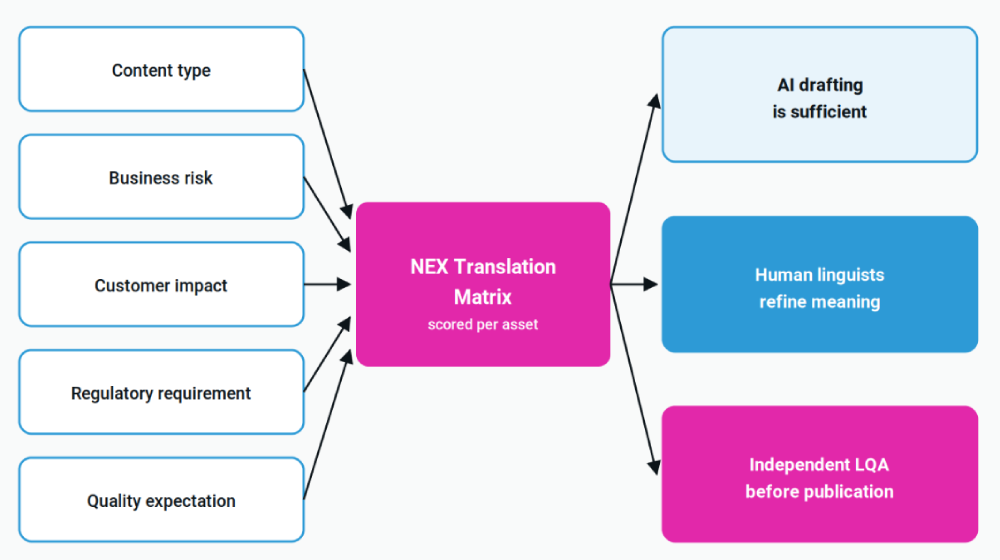
The NEX Translation Matrix™ exists to make that call repeatable. Five inputs are scored for each piece of content: content type, business risk, customer impact, regulatory requirement, and quality expectation. Those scores route the asset to one of three outcomes: AI drafting is sufficient, human linguists refine meaning, or an independent quality pass signs off before publication.
The rule that makes it work is stated explicitly, because it is the part teams get wrong. The matrix routes content, not projects. Routing runs per string or per document, never per job. One release produces all three outcomes simultaneously, and that is the expected result rather than a sign that the process has failed.
| Launch asset | Dominant input | Workflow |
|---|---|---|
| Homepage hero and tagline | Customer impact | Transcreation |
| Paid search and social ad copy | Customer impact | Transcreation |
| Launch email subject lines | Customer impact | Transcreation |
| Feature page body copy | Quality expectation | Localization |
| In-product onboarding strings | Quality expectation | Localization |
| Pricing and billing pages | Regulatory requirement | Localization plus review |
| Product documentation | Content type | Translation, MTPE |
| Release notes and changelog | Content type | Translation, MTPE |
| Terms of service updates | Regulatory requirement | Translation plus legal sign-off |
One launch, nine asset types, three workflows. Buying a single workflow for the whole launch is how budget lands in the wrong place.
What transcreation costs and why it is not priced per word
Transcreation is billed by the hour or by the project because output word count has no relationship to input word count. A seven-word tagline can absorb four hours and three rejected concepts, while a 900-word landing page can adapt in less.
Per-word pricing works when effort scales with volume, which is true of translation and localization and false of creative work. Standard translation buys cleanly at per-word rates: NexTranslate publishes a three-tier pricing model running from USD 0.03 per word for AI-assisted translation with human review, through USD 0.07 for native human translation with an editor pass, to USD 0.12 for specialized translation with an independent reviser. Human proofreading is included at every tier rather than billed separately, which is where most vendors add USD 0.02 to 0.05 per word.
Transcreation sits outside that structure and is quoted against the brief. What you buy is broader than the final copy: two or three creative options, a literal back translation of each, and a written rationale for the choices made. Comparing that quote to a per-word rate is a category error, like comparing a photographer’s day rate to the price of a stock image.
The budgeting consequence is simple. Transcreation cost scales with markets and concepts, not words. Cutting a tagline brief from six markets to three halves the cost. Cutting the tagline from twelve words to seven does not.
How a transcreation project actually runs
A transcreation project starts with a brief rather than a source file, and ends with an in-market review rather than a proofread. Skipping the brief is the most common reason transcreation comes back wrong and gets blamed on the linguist.
The brief carries more weight than the source copy
A workable brief states the emotional intent, the one thing the audience must remember, a do-not-translate list of brand terms that stay fixed globally, how much creative latitude the writer has, and the visual context the copy will live inside. Character limits, button widths and video timings belong here too. A writer who does not know the headline has to fit 34 characters will deliver something beautiful and unusable.
Back translation is a comprehension aid, not a quality test
The back translation exists so stakeholders who do not read the target language can understand what the copy now says. It is not a scoring mechanism. Judging transcreated copy by how closely its back translation matches the English is the most reliable way for an in-house reviewer to undo the work they just paid for, because divergence from the source is the point. The rationale, not the back translation, is where the quality argument lives.
Revisions go back to the copywriter, not to a translator
When in-market review raises an issue, the asset returns to the adaptation stage. Handing it to a translator to patch produces copy in two voices. For regulated markets, or any campaign where a claim carries legal exposure, an independent linguistic quality assurance (LQA) pass runs before publication, performed by someone who did not write the copy.
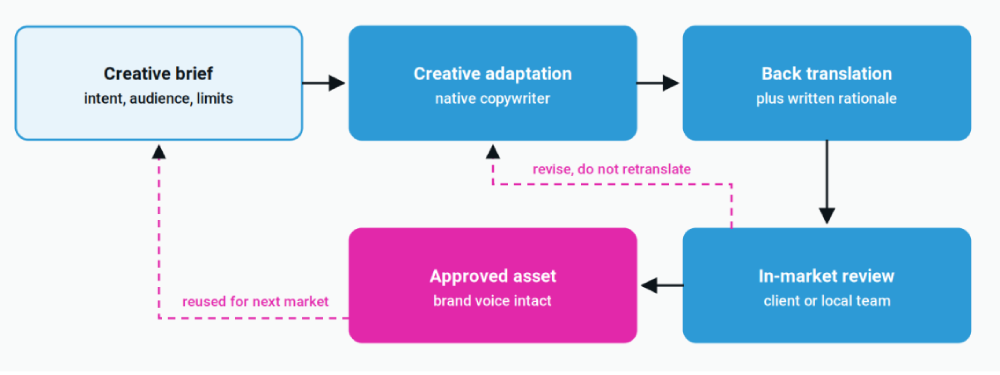
The second loop is what changes project economics. The brief, the do-not-translate list and the rationale from market one are reusable. Market one is expensive. Market four should not be, and if it is, the brief was never properly written down.
Frequently asked questions
Is transcreation just a more expensive word for translation?
No. They produce different deliverables from different inputs. Translation converts a finished source text and is judged against it. Transcreation works from a brief, is free to abandon the source wording, and delivers creative options with a back translation and a rationale. The price gap reflects a different scope of work, not a markup on the same work.
Do I need transcreation for my whole website?
Almost certainly not. For most SaaS sites, transcreation applies to the homepage hero, the tagline and campaign landing pages, a small share of total pages. Feature pages, documentation, pricing detail and legal content are better served by localization or translation. Transcreating a whole site means paying creative rates for content nobody reads creatively.
Can AI do transcreation?
AI drafts options quickly and is useful for generating variations a copywriter then edits, but it cannot own the output. Transcreation depends on judging how a phrase will land with a specific audience in a specific cultural moment, and on defending that judgment to a client. AI gives the workflow speed. The human decides what ships.
How is transcreation quality checked if it does not match the source?
Through the rationale and the in-market review, not comparison to the English. The copywriter documents why each choice was made, a native reviewer who was not involved in writing assesses whether the copy achieves the brief’s intent, and for regulated content an independent LQA pass checks claims and terminology. Back translation informs those reviewers, it does not score the work.
How long does transcreation take compared to translation?
Expect one to three weeks per market against 24 to 48 hours for standard translation. The gap is mostly review, not writing. Concept development, client feedback and in-market validation stretch the calendar, which is why transcreation belongs in the campaign schedule rather than after the English is signed off.
Conclusion: the decision is per asset, and most assets are not creative
The transcreation versus translation question is usually framed as a choice between two vendors or two budgets. It is neither. It is a routing decision made asset by asset, against how much the exact wording of a given piece determines whether it works.
Teams that get this right spend most of their language budget on translation and localization, where the volume lives, and concentrate creative spend on the handful of assets that carry the brand. Teams that get it wrong either flatten their campaigns by translating them or exhaust the budget transcreating a help center. The five inputs exist so the call gets made deliberately rather than by whoever is loudest in the launch meeting.
If you are mapping an upcoming launch and want a second opinion on which assets belong in which workflow, NexTranslate handles both sides of the line, from per-word translation through to creative adaptation for campaigns. Send the asset list and we will route and price it, or request a quote with the markets in scope.
Written by Karuppusamy Arunachalam, NexTranslate
Published September 2026 · Filed under Localization