




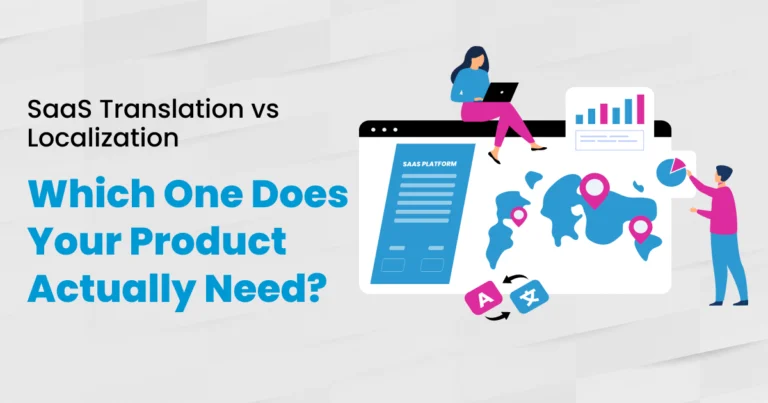
Most SaaS founders discover the difference between translation and localization the hard way. They translate their product into German, ship it, and watch conversion rates barely move. The interface is readable. The words are correct. But something feels off to German users. Dates display in the wrong format, prices show in US dollars, and the UI wraps awkwardly because German strings run 30 to 35 percent longer than English ones.
This is not a translation failure. It is a localization gap. And it is one of the most common and most expensive mistakes SaaS teams make when they start expanding internationally.
Translation and localization are related but distinct. Understanding the difference before you invest in either will save you from rebuilding work you thought was done.
What is translation?
Translation is the process of converting text from one language to another while preserving the original meaning. It is the linguistic layer of international expansion.
A professional translator takes a source string, a UI label, a help article, a marketing headline, and renders it accurately in the target language. The output is grammatically correct, contextually appropriate, and faithful to the original intent. Translation answers one question: does this text say the right thing in another language?
For SaaS products, translation typically covers:
- UI strings: buttons, labels, error messages, tooltips
- Help documentation and knowledge base articles
- Marketing copy: landing pages, ads, email sequences
- Onboarding flows and in-app guidance
Translation is a prerequisite. Without it, users in a new market cannot understand your product at all. But translation alone does not guarantee that users will feel comfortable using it.
What is localization?
Localization (l10n) is the broader process of adapting a product to meet the linguistic, cultural, and functional expectations of a specific market. Translation is a component of localization, but localization goes further.
A localized SaaS product does not just speak the user’s language. It behaves the way users in that market expect software to behave.
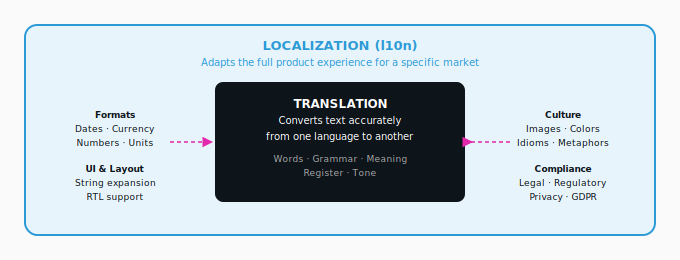
Localization contains translation and extends it with cultural adaptation, format localisation, UI flexibility, and compliance requirements.
The goal of localization is for a user in Tokyo or Sao Paulo or Berlin to feel that the product was built for them, not translated for them. That distinction matters for activation, retention, and word-of-mouth in each market.
The key differences for SaaS teams
For SaaS products, the distinction between translation and localization has direct product and engineering implications, not just content implications. Here is how the two differ across the dimensions that matter most to a product team:
| Dimension | Translation | Localization (l10n) |
|---|---|---|
| Scope | Text and language | Language, UX, culture, formats, compliance |
| Engineering impact | Low: string swap only | High: layouts, logic, locale configuration |
| Who owns it | Content or marketing team | Product, engineering, and content teams |
| When it runs | After copy is written | Throughout the product lifecycle |
| Output quality signal | Linguistic accuracy | Conversion and retention in each locale |
| Cost model | Per word | Per word plus project scope |
How translation and localization differ across the dimensions that drive SaaS go-to-market decisions. For teams shipping product updates frequently, continuous localization is the operating model that closes the gap between source-language releases and localized versions.
Which one does your SaaS product actually need?
The honest answer is: usually both, but in a specific order and at different stages.
Translation is the starting point. If you are testing whether a new market has demand before investing heavily, translating your key marketing pages and the core product UI is a reasonable first step. It removes the language barrier and lets you measure whether users engage at all.
Localization becomes critical once you are committing to a market. If free trial signups from Germany are converting at half the rate of US signups, the problem is rarely the translation quality. It is usually a localization gap: date formats that confuse users, prices in the wrong currency, or onboarding copy that references US-specific workflows. See how Astravue scaled localization across multiple regions using a hybrid AI plus human workflow.
FOUNDER INSIGHT
At NexTranslate, we’ve reviewed dozens of SaaS products entering new markets. The most common mistake we see is assuming that translation alone will drive adoption.
In reality, localization issues such as currency formats, date conventions, UI constraints, and culturally relevant messaging often have a greater impact on user trust and conversion than translation quality itself.
If users can read your product but still hesitate to activate, subscribe, or engage, the problem is often localization, not translation.
Karuppusamy Arunachalam, Founder, NexTranslate
Choosing the Right Approach by Expansion Stage
A practical guide to choosing between translation and localization based on where you are in your international expansion.
For SaaS teams expanding into international markets, NexTranslate’s translation and localization services cover both layers, with human-reviewed output at every quality tier.
Where machine translation fits in
Machine translation (MT) is fast and cheap. It is also the most common source of localization problems at SaaS scale.
MT engines translate accurately at the sentence level. They struggle with consistency across a product. The same UI element translated three different ways across onboarding, settings, and error messages. They also flatten brand voice, miss domain-specific terminology, and produce string length output that has not been reviewed against the actual UI layout.
Machine Translation Post-Editing (MTPE) is the workflow that closes this gap. A professional linguist reviews and edits the MT output, correcting errors, enforcing terminology consistency, and adjusting tone. MTPE is faster than pure human translation and more reliable than unreviewed MT output.
NexTranslate Hybrid AI + Human Workflow
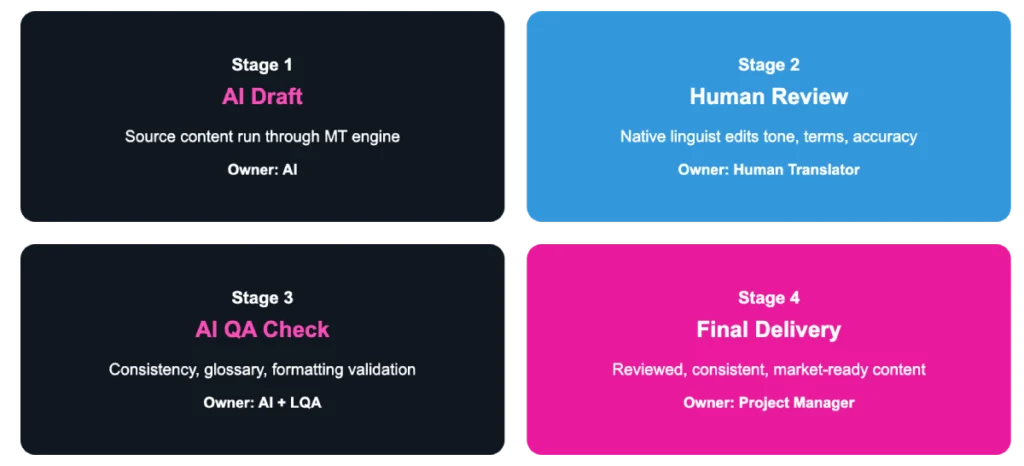
The NexTranslate four-stage hybrid workflow combines AI speed with human accuracy, delivering consistent, market-ready translations at scale.
For content where precision is non-negotiable, including legal terms, compliance copy, and investor-facing material, linguistic quality assurance (LQA) adds an independent review layer on top of the translation and editing process.
What this means for your localization budget
Localization costs vary significantly depending on content volume, target language, and the quality model you choose. NexTranslate’s transparent translation pricing covers three tiers designed for different content types: a light-touch tier for lower-risk marketing content, a professional tier for product documentation and app strings, and a premium tier for regulated or legally sensitive material. Human proofreading is included at every tier.
For SaaS companies going global, one important budget consideration: most translation vendors charge for proofreading separately, which adds 20 to 30 percent to the total project cost before you see a final deliverable. A hybrid AI plus human workflow lands between AI-only pricing and traditional agency rates, with predictable per-word pricing.
Frequently asked questions
Is localization just translation with extra steps?
No. Translation is one component of localization. Localization also includes adapting date, time, and number formats, adjusting UI layouts for string length expansion, ensuring cultural fit, and meeting local legal or compliance requirements. A product that is translated but not localized is readable but often does not convert well in new markets.
Do I need to localize my entire SaaS product before entering a new market?
Not necessarily. A common approach is to translate and localize the core user journey first: signup, onboarding, and the primary product workflow, before expanding to help documentation and secondary features. This lets you validate market demand without a full localization investment upfront.
What is the difference between i18n and l10n?
Internationalization (i18n) is the engineering work that makes localization possible: externalizing strings from code, supporting multiple character sets, designing layouts that flex for different text lengths. Localization (l10n) is the execution work: translating, adapting, and culturally fitting the product for a specific market. i18n is a one-time architectural decision. l10n is ongoing. For a deeper look at the engineering side, see our i18n best practices guide for SaaS product teams.
How do I know if my SaaS product needs localization or just translation?
If your product displays dates, currencies, numbers, or addresses to users, you need localization, not just translation. If your UI was designed only in English and has not been tested for string expansion in other languages, you need localization. If you are entering a market with specific compliance or regulatory requirements, you need localization.
What languages should a SaaS product prioritize for localization?
The most common starting point for B2B SaaS expansion in 2026 is Spanish, German, and either Brazilian Portuguese or French. Japanese tends to be a phase-two market. Higher lift, but strong LTV when the product is properly localized. The right answer depends on where your free trial signups or paid customer interest is already coming from.
Conclusion: Translation gets you readable. Localization gets you results.
Translation removes the language barrier. Localization removes the friction that stops users from converting, activating, and staying. Both matter, and the order in which you invest in them should reflect where you are in your international expansion.
If you are mapping out which markets to enter next and how to staff the localization work, the SaaS Localization in 2026 playbook is a practical starting point for thinking through language selection, quality models, and build vs. buy decisions.
At NexTranslate, we work with SaaS product and marketing teams to handle both the translation and the localization layer, with human review built into every tier and a workflow designed for teams that ship frequently. Not sure whether your product needs translation, localization, or both? Request a Free Localization Assessment and we’ll help you identify the right approach for your target markets before you invest in localization at scale.
Written by: Karuppusamy Arunachalam, NexTranslate
Published: June 2026 · Filed under Translation Services
