





Translation pricing is one of the most confusing parts of buying language services. A 5,000 word document gets quoted at $500 from one vendor and $2,400 from another, and the quotes look almost identical on paper. Buyers end up choosing on price, get burned on quality, and then conclude that translation is either too expensive or too unreliable to plan around.
The truth is that translation pricing follows a small set of rules, and once you understand them you can read any quote in under a minute and tell whether it is fair, padded, or dangerously cheap.
This guide breaks down what professional translation actually costs in 2026, what drives the price up or down, what to ignore in vendor quotes, and how to budget for translation at scale without overpaying or sacrificing accuracy.
The short answer: typical translation pricing in 2026
Most professional translation work in the global market falls inside these ranges:
- Pure human translation: $0.12 to $0.30 per source word, depending on language pair and domain
- AI plus human (hybrid or MTPE): $0.05 to $0.12 per source word
- Raw machine translation, unedited: $0.001 to $0.02 per word
- Specialized domains (legal, medical, financial, patents): $0.18 to $0.40 per word
- Certified translation for official documents: $25 to $50 per page, flat fee in many regions
- Project minimums: $50 to $150 per language for small jobs
- Rush surcharge: 20 to 50 percent on top of base rate for sub 48 hour turnaround
NexTranslate sits at the lower end of the global per word range because of its hybrid AI plus human workflow. Economy tier starts at $0.03 per word, Professional at $0.07, and Premium at $0.12. Full pricing is published transparently on the NexTranslate pricing page. More on how the three tiers compare below.
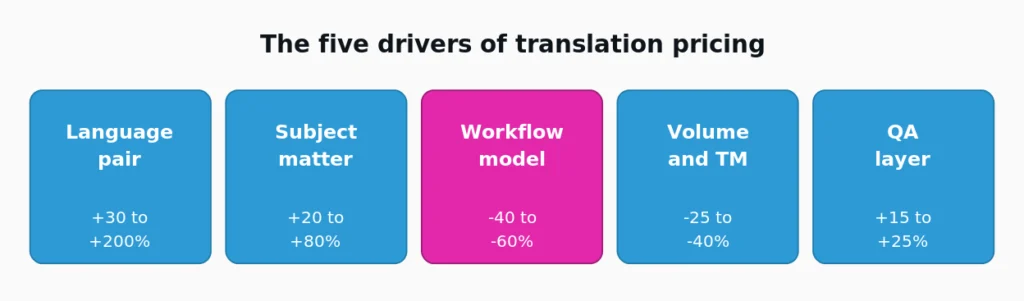
The five things that actually drive translation pricing
1. Language pair
English to Spanish, French, or German is the cheapest pair in the market because the linguist supply is large. English to Japanese, Korean, Arabic, or Finnish costs 30 to 60 percent more because qualified linguists are scarcer. English to Icelandic, Welsh, or Burmese can cost two to three times the baseline rate because the talent pool is small and turnaround is slower.
2. Subject matter
General business content is the baseline. Marketing content costs slightly more because tone and brand voice matter. Legal, medical, financial, and patent translation cost the most because they require subject matter experts, not just bilingual linguists. A pharmaceutical insert mistranslated is a regulatory event. Vendors price that risk in.
3. Workflow model
Three pricing tiers exist for the same source content:
Pure human translation: a qualified linguist drafts every word from scratch. AI plus human (hybrid or machine translation post-editing): an AI engine produces a draft, then a human linguist refines it for accuracy, tone, and terminology. Raw MT: AI translates with no human review.
Hybrid AI plus human costs 40 to 60 percent less than pure human while keeping publish-ready quality when the workflow is configured correctly. Raw MT is cheap and fast but is not safe for customer-facing content in most cases.
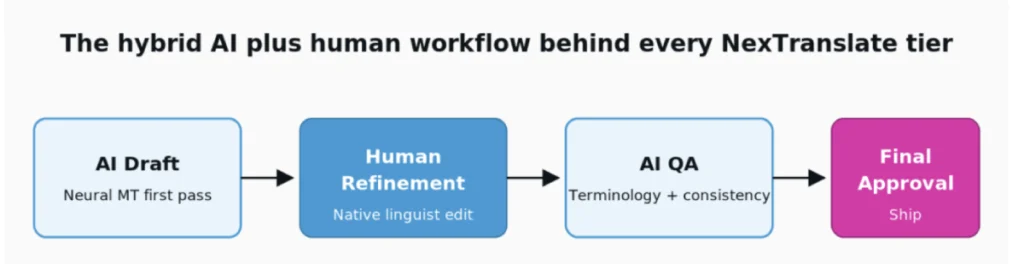
The four-stage hybrid workflow runs continuously across every NexTranslate tier.
4. Volume and translation memory
Translation memory stores every previously translated sentence and reuses it on repeats. Vendors apply tiered discounts: 100 percent matches get a 90 to 100 percent discount, fuzzy matches get 20 to 60 percent off. A team translating product UI with 30 percent repetition will pay 25 to 40 percent less per word over time than the headline rate suggests. Always ask whether translation memory is included and who owns it after the engagement ends.
5. Quality assurance layer
Independent linguistic quality assurance and proofreading typically add 15 to 25 percent to base translation cost. Vendors that exclude proofreading from the per word rate then charge an extra $0.02 to $0.05 per word at invoice time, which adds 30 to 40 percent to the headline price. Vendors like NexTranslate that bundle human proofreading into every tier price the work honestly on the first quote. Read the scope, not just the price.
Add-on costs that often surprise first-time buyers
- Project management fee, typically 10 to 20 percent on top of linguistic costs
- Desktop publishing (DTP) for InDesign, FrameMaker, or PDF formatting, $5 to $15 per page
- Engineering integration for CMS or TMS connectors, billed hourly at $100 to $200
- Terminology management and glossary setup, ranging from a flat $30 with NexTranslate to $500 to $2,500 with legacy agencies
- Style guide development, ranging from $50 with NexTranslate to $500 to $1,500 with legacy agencies
- Multimedia, including subtitling at $5 to $15 per video minute and voiceover at $25 to $75 per minute
These add-ons are legitimate and unavoidable for many projects, but they should be itemized in the quote, not folded into the per word rate. A vendor that refuses to break down their pricing is hiding either margin or scope risk.
What pure human translation actually costs and when to use it
Pure human translation is the right choice for three content types: legal documents where the translation has binding force, marketing flagship assets where brand voice is non-negotiable, and any content where a translation error has compliance or safety consequences. Expect $0.15 to $0.30 per source word for general content and $0.20 to $0.40 for specialized domains.
What MTPE actually costs and when to use it
Machine translation post-editing is the workhorse pricing tier for most modern translation work. A senior linguist reviews and rewrites AI output to the same quality bar as pure human translation, and the time saved gets passed on to the buyer.
MTPE comes in two tiers:
- Light post-editing: $0.04 to $0.07 per word. Used for internal content where readability matters more than fluency
- Full post-editing: $0.06 to $0.12 per word. Used for publish-ready content. Output is indistinguishable from pure human translation in most cases
Full MTPE delivers 90 to 95 percent of the quality of pure human translation at 50 to 60 percent of the cost. For SaaS product UI, knowledge bases, help documentation, and most marketing content, full MTPE is the right default in 2026. The full breakdown of where the hybrid model fits in a product release cycle is in the NexTranslate SaaS localization playbook.
How NexTranslate pricing compares
NexTranslate publishes a three-tier pricing model with human proofreading included at every tier, starting at $0.03 per word. Most translation agencies charge proofreading as a separate line item at $0.02 to $0.05 per word, which means the NexTranslate headline price is also the final price.
| Tier | Price / word | What’s included | Delivery | Best for |
|---|---|---|---|---|
| Economy | $0.03 | AI draft, human linguist review, basic proofreading | 24-48 hrs | Marketing blogs, social posts, internal comms, low-risk web pages |
| Professional | $0.07 | Native human translator, editor review for tone, human QC on terms and numbers | 24-48 hrs | Product docs, mobile apps, website localization, e-learning, knowledge base |
| Premium | $0.12 | Specialized native translator, independent reviser, QC expert, dedicated PM, glossary, custom SLAs | 24-72 hrs | Legal, healthcare, finance, enterprise software, government, investor decks |
Three transparent tiers, human proofreading included at every level.
What buyers consistently see when they move to NexTranslate
- Per word rates 30 to 50 percent below typical pure human translation, with no measurable drop in LQA scores
- Human proofreading bundled into every tier, saving 30 to 40 percent on total cost versus vendors that charge it separately
- Predictable add-on pricing: glossary creation at $30, style guide development at $50, DTP at $0.01 to $0.02 per word
- Confidentiality and NDA included at no cost, which legacy agencies sometimes invoice as a compliance line item
- Rush delivery surcharge held at 20 to 30 percent, below the 25 to 50 percent industry norm
- Volume and retainer pricing for ongoing SaaS UI, knowledge base, and product release work
- Itemized quotes that show base rate, TM leverage, project management, and any add-ons so there are no surprises at invoice time
How add-on pricing compares
| Add-on | NexTranslate | Industry typical |
|---|---|---|
| Human proofreading | Free Human Proofreading at every tier | $0.02 to $0.05 / word extra |
| Glossary creation | $30 flat | $500 to $2,500 |
| Style guide development | $50 flat | $500 to $1,500 |
| Desktop publishing (DTP) | $0.01 to $0.02 / word | $5 to $15 / page |
| Rush delivery (same day) | NIL | +25 to 50% |
| NDA / confidentiality | Free | Compliance line item |
The pricing is built around the assumption that quality at scale should not be a luxury tier. Hybrid AI plus human, configured correctly, makes professional translation affordable for product-led SaaS teams that need to ship in 5 to 15 languages without burning their localization budget on per word markups that no longer reflect the actual cost of doing the work.
How to budget for translation in 2026
For most B2B SaaS teams launching in a new language market, a defensible first-year budget at the NexTranslate Professional tier ($0.07 per word) looks like this:
- Initial product UI translation: 8,000 to 20,000 words at $0.07 per word, so $560 to $1,400 per language
- Marketing site translation: 5,000 to 15,000 words at $0.07 per word, so $350 to $1,050 per language
- Knowledge base and docs: 30,000 to 80,000 words at $0.03 to $0.07 per word, so $900 to $5,600 per language
- Ongoing string updates: budget 20 percent of initial UI volume per quarter, so $110 to $280 per language per quarter
- Project management overhead: included in NexTranslate tier pricing; budget 10 to 15 percent extra if benchmarking against legacy agencies
- LQA: included in Professional and Premium tiers at no extra line item
For a SaaS company launching in five languages at the Professional tier, the all-in first-year translation budget typically lands between $9,000 and $40,000, which is meaningfully below the $15,000 to $55,000 range that the same scope costs at legacy per word rates. Quotes far above this range are paying for legacy overhead. Quotes far below are skipping QA, using untrained linguists, or pushing raw MT into production.
For full service scope across the workflow, the translation and localization services page lays out what is included in each engagement type.
Frequently asked questions
How much does professional translation cost per word?
Professional human translation typically costs $0.12 to $0.30 per source word globally. Machine translation post-editing (MTPE), which delivers near-human quality at a lower cost, runs $0.05 to $0.12 per word. NexTranslate offers three tiers (Economy, Professional, Premium) starting at $0.03 per word with human proofreading included.
Why is translation pricing per word and not per page?
Per word pricing is the global standard because word count is consistent across formats, fonts, and languages, while page count varies wildly. A single PDF page can hold 200 words or 800 words. Per word pricing means the price reflects the actual work, not the layout. Certified translation is the exception and is often priced per page because it covers a standardized document type.
What is the cheapest type of professional translation?
Machine translation post-editing (MTPE) is the most cost-effective tier for publish-ready content. Full MTPE runs $0.05 to $0.12 per word and delivers near-human quality for most content types. NexTranslate Economy starts at $0.03 per word for AI-assisted translation with human review, suitable for low-risk content like marketing blogs, social posts, and internal communication.
Are there hidden fees in translation quotes?
Common add-ons that should be itemized include project management (10 to 20 percent), DTP and formatting ($5 to $15 per page), rush surcharges (20 to 50 percent), and engineering integration fees. A vendor that bundles everything into a single per word rate is either pricing on the high end to cover all add-ons or hiding scope that will surface as a change order later. NexTranslate publishes all add-on pricing transparently on its pricing page.
What is a fair translation budget for a SaaS company launching in five languages?
A SaaS company launching in five languages should budget $9,000 to $40,000 for first-year translation at the NexTranslate Professional tier covering product UI, marketing site, knowledge base, and ongoing string updates. Legacy agency pricing for the same scope typically runs $15,000 to $55,000.
Does NexTranslate charge extra for proofreading?
No. Human proofreading is included at every NexTranslate tier (Economy, Professional, Premium) at no additional cost. Most translation companies charge an extra $0.02 to $0.05 per word for proofreading, which can add 30 to 40 percent to total project cost. NexTranslate prices the headline rate as the final rate.
Conclusion: pay for the work, not the markup
Translation pricing is not opaque once you know what the five drivers are: language pair, subject matter, workflow tier, volume and translation memory leverage, and the quality assurance layer. Quotes that itemize these inputs are honest. Quotes that hide them behind a single per word rate are usually pricing for the vendor, not the work.
NexTranslate prices the hybrid AI plus human workflow transparently across three tiers, with human proofreading bundled into every plan and add-ons published openly rather than billed at invoice time. The result is publish-ready quality at rates that fit a real SaaS localization budget.
See the full pricing breakdown, review the translation and localization service scope, or request a custom quote for an itemized estimate with per word rate, TM leverage, project management, and QA broken out separately.
Written by: Karuppusamy Arunachalam, NexTranslate
Published: May 2026 · Filed under Translation Services
