




A studio ships in nine languages. Three months later the Simplified Chinese review score is sitting well below the English one, and the complaints are not about the combat, the pacing, or the price. They are about the text. Menu labels run past their buttons. A recurring character speaks in three different registers across the same quest line. A joke that landed in English reads as a mistranslation.
Almost none of that is a translator problem. It is a production problem that surfaced as a translation problem, and by the time it is visible in a review thread the cheapest window to fix it has already closed.
The global game localization services market is on track to reach roughly $1.52 billion in 2026, growing at about 8 percent a year, and Asia Pacific alone accounted for around 38 percent of that revenue in 2025. Studios are spending more on localization than ever. The ones getting a return are the ones treating it as a production discipline with its own milestones, not as a purchase order raised near the end of the schedule.
What game localization services actually cover
Game localization services cover the entire player-facing text and audio surface of a title, not just dialogue. That means user interface strings, menus, system and error messages, quest and tutorial text, achievement names, voiceover scripts, subtitles, store listings, patch notes, age rating and compliance copy, and the in-build testing that verifies all of it renders correctly on every target device.
Each of those asset types has a different tolerance for error and a different economics. Patch notes and store metadata are high-volume and low-risk. Character dialogue and marketing beats carry the brand. Legal text carries exposure. Treating them as one undifferentiated word count is the fastest way to overspend on the parts that do not matter and underspend on the parts that do. NexTranslate structures game localization services around that split, and the wider industry-specific localization guide sets out the same logic across other regulated and creative sectors.
| Asset type | Volume | Risk if wrong | Sensible workflow |
|---|---|---|---|
| UI strings, menus, system messages | High | Truncation, broken layout | AI draft plus human review, then in-build LQA |
| Quest, tutorial and narrative text | High | Lost immersion, tone drift | Native human translation with locked glossary |
| Character dialogue and humor | Medium | Player mockery, review damage | Transcreation with character voice brief |
| Voiceover scripts and subtitles | Medium | Desync, timing overruns | Human translation with timing constraints |
| Store listings, patch notes, metadata | High | Weak discovery, low install rate | AI draft plus human proofreading |
| EULA, privacy, age rating copy | Low | Store rejection, legal exposure | Specialist human translation with QC |
Not every string in a game deserves the same workflow. Match the tier to the risk, not to the word count.
Why localization breaks after the build is locked
Most visible localization defects are introduced during engineering, not during translation. Hardcoded strings, sentences assembled by concatenation, fixed-width UI containers, and translation files delivered without screenshots or context all guarantee defects that no linguist can prevent.
Internationalization (i18n) is the engineering work that makes a game translatable in the first place: externalizing every player-facing string into resource files, supporting Unicode and right-to-left scripts, avoiding string concatenation so grammar and gender agreement stay intact, and building UI containers that expand. German runs roughly 30 percent longer than English on average. Russian and Finnish can run longer still. A button sized to fit “Save” will not fit “Speichern”.
Pseudo-localization is the cheapest test in the entire pipeline. Replace every string with a padded, accented, non-Latin variant before a single word is bought, then play the build. Every truncated label, every square-box glyph, every string that never appears in the resource file shows up immediately, at a point in production where fixing it costs almost nothing.
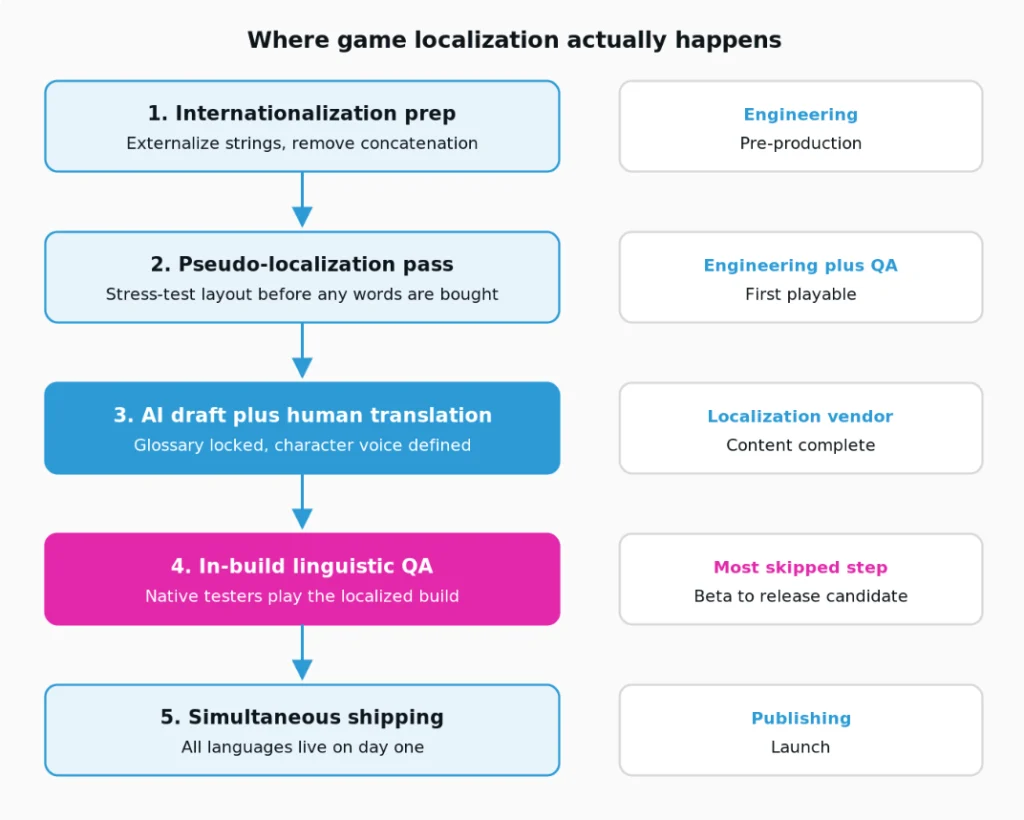
The five stages of a working game localization pipeline. Stage four is the one studios skip, and it is the one that decides review sentiment.
The practical takeaway is a schedule change, not a budget change. Move internationalization into pre-production and pseudo-localization into first playable. Both are engineering tasks with no vendor dependency, and both remove the defect classes that translation cannot fix.
Which languages to ship first, and in what order
Simplified Chinese, Japanese, and Korean now compete directly with FIGS (French, Italian, German, Spanish) for first-wave priority, and for many titles Simplified Chinese is the single highest-value pair. Asia Pacific represented roughly 38 percent of game localization revenue in 2025, and that share is growing faster than the North American share.
The sequencing question matters more than the list. Shipping all launch languages simultaneously rather than staggering them has been associated with an average Day 1 global revenue uplift of around 28 percent, because the launch window is when wishlists convert, streamers cover the title, and store algorithms decide how much visibility it earns. A language added six weeks after launch arrives after that window has closed.
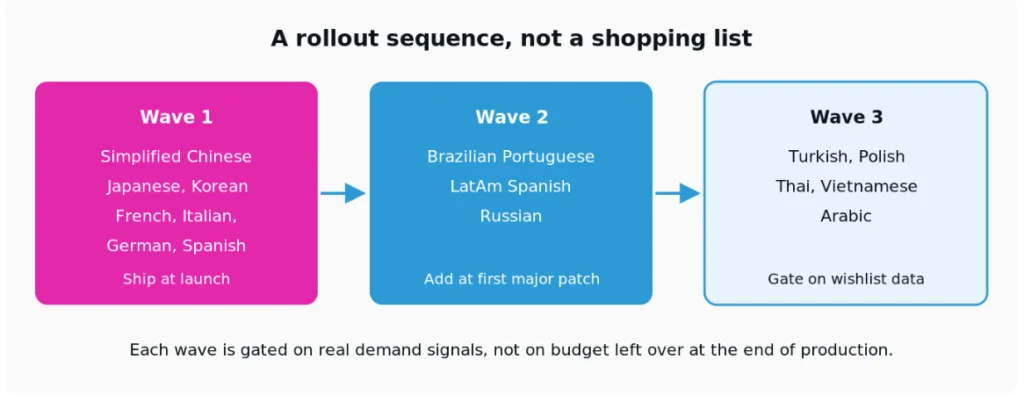
A defensible rollout sequence. Wave 1 ships at launch, later waves are gated on wishlist and traffic data from the regions themselves.
Cost varies more across these languages than most studios budget for. Simplified Chinese often prices close to FIGS rates, while Japanese and Korean typically sit meaningfully higher because the linguist pool is smaller and the quality bar in those markets is unforgiving. Budget by language, not by an average per-word rate applied uniformly across the set.
What game LQA catches that translation review cannot
Linguistic Quality Assurance (LQA) is testing performed on translated text inside the running build, and it is the only place where truncation, wrong-context strings, subtitle desync, and voice timing errors become visible. A translator reviewing a spreadsheet of strings cannot see that “Fire” was translated as the element rather than the verb, because the spreadsheet does not show the button it sits on.
Game LQA has three distinct components, and studios that buy only one usually buy the wrong one:
Linguistic testing: accuracy, terminology consistency, register, and character voice inside gameplay context.
Functional testing: truncation, overlap, encoding failures, broken variables, subtitle and audio sync.
Cultural testing: imagery, gestures, symbols, humor, and content that triggers regional age rating or regulatory issues.
Mature LQA programmes classify every finding using a severity framework such as MQM or DQF, which separates critical defects from cosmetic ones and produces a measurable quality score per language rather than a subjective verdict. That matters commercially, because it lets a producer decide which languages are ship-ready and which need another pass. The mechanics of how LQA severity models classify errors are worth understanding before commissioning a first round.
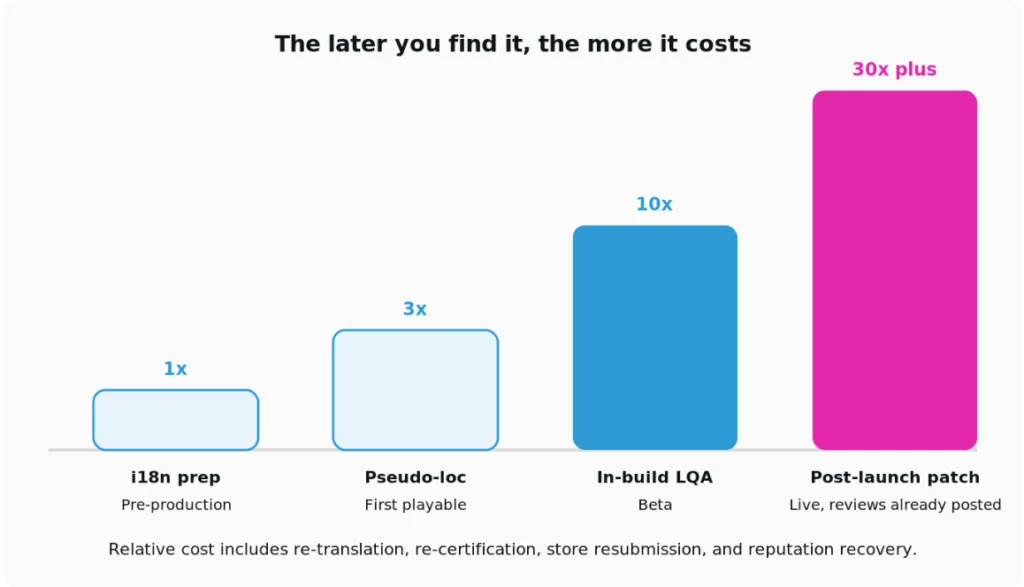
The relative cost of fixing a localization defect by the stage it is found. Post-launch fixes carry store resubmission and reputation cost on top of re-translation.
Budget LQA as a percentage of the translation spend from the outset, typically 10 to 20 percent, and schedule it against a playable localized build rather than against a delivery date.
How AI plus human translation works for high-volume game assets
AI drafting is genuinely effective on high-volume, low-variance game text and genuinely unreliable on anything carrying tone, humor, or character. Around one in five games released on Steam in 2025 used generative AI somewhere in production, a sharp year-on-year increase, so the question is no longer whether to use it but where to stop. Machine Translation Post-Editing (MTPE) is the disciplined version of that workflow: machine output is post-edited by a native linguist to a defined quality target, following the process laid out in ISO 18587.
The dividing line is fairly clean in practice. Patch notes, store metadata, achievement lists, knowledge base articles, and repetitive system messages respond well to a machine draft with human post-editing, especially when a Translation Memory (TM) and a locked glossary are feeding the engine. Character dialogue, marketing beats, quest writing, and anything comedic does not.
That second category needs transcreation, where a linguist rewrites for effect rather than translating for equivalence. A pun that works in English almost never survives a literal rendering, and players notice. The most visible recent example is a critically acclaimed 2025 release whose Simplified Chinese reviews skewed negative on localization quality alone while the English reception was strong. Nothing about the game changed between those two audiences except the words.
A Translation Management System (TMS) connected to the studio’s build pipeline is what makes this repeatable across live-service content. Strings flow out on a cadence, translations flow back, the memory grows, and per-word cost on recurring content falls with every release cycle.
What game localization costs and what drives the number
Game localization is priced per word, with the rate set by language pair, asset type, and how much human review the content requires. NexTranslate publishes transparent per-word pricing starting at $0.03 per word with human proofreading included at every tier, which removes the separate proofreading line item that most providers add at $0.02 to $0.05 per word.
Five factors move the number more than anything else:
| Cost driver | Effect on rate | What a studio can control |
|---|---|---|
| Language pair | Japanese and Korean price well above FIGS | Sequence languages by expected revenue, not vanity |
| Asset type | Narrative and transcreation cost most | Route low-risk assets to a lighter tier |
| Context provided | Poor context adds query and rework cycles | Ship screenshots, character briefs, glossary upfront |
| Turnaround | Rush work adds 20 to 30 percent | Lock the loc schedule against the build calendar |
| Repetition and TM reuse | Reduces effective rate over time | Invest in translation memory from title one |
The two levers with the largest effect, context quality and turnaround, cost a studio nothing but planning.
The number worth modelling is not cost per word. It is cost per language against the revenue that language is forecast to return, including the LQA pass. A market that cannot carry the fully loaded cost of shipping well in that language is a market to defer, not a market to ship badly into.
Frequently asked questions
What is game localization?
Game localization is the process of adapting a game’s text, audio, imagery, and cultural references so that it feels native to players in a target market. It covers UI strings, narrative content, voiceover, subtitles, store assets, and compliance copy, and it includes testing the translated content inside the running build.
How is game localization different from game translation?
Translation converts text from one language to another. Localization adapts the whole player experience, including humor, cultural references, date and currency formats, regional compliance requirements, and UI layout. A game can be fully translated and still feel foreign to the player if it has not been localized.
When should a studio start localization?
During pre-production, not near launch. Internationalization work such as externalizing strings and building expandable UI containers has to happen before translation begins. Running a pseudo-localization pass at first playable catches most layout and encoding defects at the point they are cheapest to fix.
Which languages should a game launch in first?
For most titles the first wave is Simplified Chinese, Japanese, Korean, and FIGS, meaning French, Italian, German, and Spanish. Brazilian Portuguese, Latin American Spanish, and Russian usually follow at the first major patch. Later waves should be gated on regional wishlist and traffic data rather than assumption.
Is AI translation good enough for games?
For high-volume, low-variance content such as patch notes, store metadata, and system messages, an AI draft with human post-editing produces reliable results at a lower cost. For character dialogue, humor, and marketing copy it does not. Those assets need native human translators or transcreation specialists working from a character voice brief.
How much does game localization cost?
Rates depend on language pair, asset type, and the level of human review required. NexTranslate rates start at $0.03 per word with human proofreading included at every tier, with narrative and transcreation work priced higher than repetitive UI and metadata content. Linguistic QA is usually budgeted at 10 to 20 percent of the translation spend.
What is LQA in game development?
Linguistic Quality Assurance is testing performed by native linguists playing the localized build. It has three parts: linguistic testing for accuracy and character voice, functional testing for truncation and encoding, and cultural testing for regionally sensitive content. Findings are classified by severity so producers can decide which languages are ship-ready.
Conclusion: localization is a production decision, not a launch line item
Studios that reach players in every market are not the ones spending the most per word. They are the ones who decided in pre-production that the game would be translatable, tested that assumption with pseudo-localization before buying any words, sequenced languages against real demand data, and scheduled linguistic QA against a playable build rather than against a spreadsheet.
Every one of those decisions is made before a vendor is engaged. That is the genuinely useful point here, and it holds regardless of who does the translating.
When the words do get bought, the workflow should match the risk profile of the asset. NexTranslate combines AI drafting with native human linguists across studio-side localization workflows, from UI strings and patch notes through narrative transcreation and in-build LQA, on a three-tier pricing model with human proofreading included at every level. If a launch window is being planned now, request a project quote and we will scope it by asset type and language rather than by a single blended rate.
Written by: Karuppusamy Arunachalam, NexTranslate
Published July 2026 · Filed under Industry Use Cases
