





A study of prescription labels translated into Spanish at US pharmacies found an error rate of roughly 50 percent once incomplete translations were counted alongside outright mistakes. Phrases like “take with food”, “apply topically” and “for 7 days” were left in English entirely. Nobody in that chain approved a bad translation. The process simply had no step where a second qualified person read the output against the source.
That is the shape of most medical translation failures. It is rarely one dramatic mistranslation. It is a missing review layer, an unlocked glossary, or a document that got routed into a general-purpose workflow because nobody classified it as high-risk before the work started.
This guide covers what regulators actually require, what the three ISO standards buyers keep conflating do and do not certify, how to tier medical content by risk before pricing it, and where machine translation is safe in a healthcare workflow. For the cross-sector view of how compliance requirements differ by vertical, the industry-specific localization guide covers the same terrain across legal, finance, gaming and SaaS.
What makes medical translation different from every other kind
Medical translation is the only content category where a linguistic error becomes a clinical event. In every other vertical a bad translation costs conversions, rankings or credibility. In healthcare it can change a dose, delay a diagnosis, or invalidate a regulatory submission that took two years to assemble.
Three properties compound the risk. Terminology is not negotiable, because “mild dementia” rendered as “light dementia” is not a stylistic preference, it is a different clinical statement. The content is legally binding, because instructions for use are part of the device under EU law, not marketing collateral attached to it. And distribution is wide and effectively irreversible, because printed labeling and submitted dossiers cannot be quietly corrected the way a web page can.
The practical consequence is simple. Treat every medical document as a controlled document from the moment it enters the translation queue, not from the moment somebody notices it is going to a regulator.
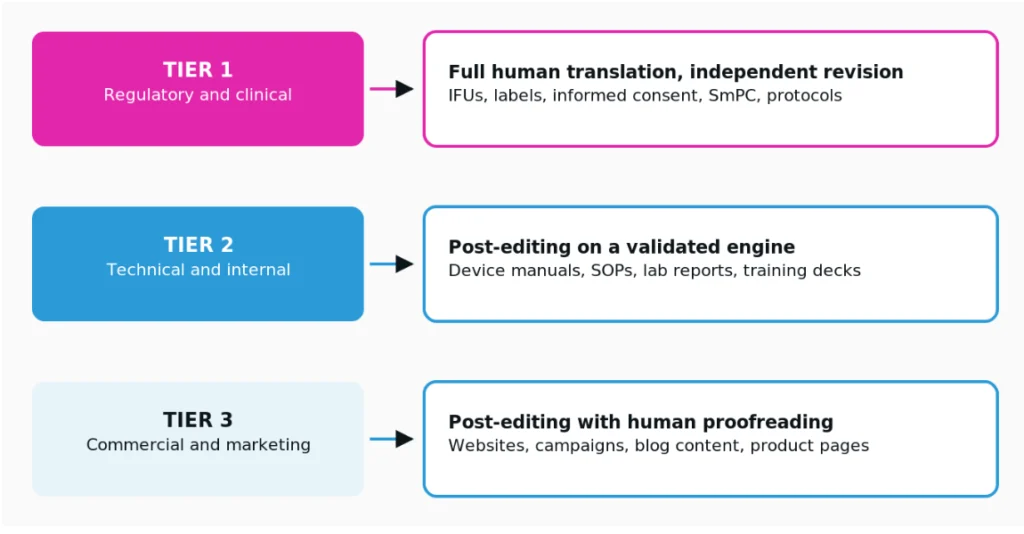
Medical content splits into three risk tiers. The tier decides the workflow, and the workflow decides the cost.
What regulators actually require
Under the EU Medical Device Regulation (MDR) and the In Vitro Diagnostic Regulation (IVDR), the manufacturer carries the obligation to translate labels, instructions for use, safety information and specified clinical and regulatory documents into the official language of every market where the device is placed. Translation is the manufacturer’s responsibility, not the distributor’s, and not the notified body’s.
MDR goes further than a language list. It sets an accuracy and clarity standard tied to the intended user, and IVDR is explicit that content must be understandable to people who are not medical professionals. As the European database on medical devices (EUDAMED) rolls out and notified body scrutiny tightens through 2026, translated material is increasingly treated as checkable evidence rather than a formality at the end of the file.
In the United States the drivers are different but the effect is the same. HIPAA governs how patient data moves through any vendor that touches it, which rules out consumer translation tools for anything containing protected health information. Section 1557 of the Affordable Care Act obliges covered entities to provide meaningful language access. Individual EU member states then layer their own national language requirements on top of MDR, which is why a device cleared for the EU is not automatically cleared to ship into every EU market.
Build a language matrix per market before scoping any translation work: which documents, which languages, which national exceptions. Teams that ship into healthcare and legal and compliance translation territory at the same time usually find the two matrices share more requirements than they expect.
The three standards buyers keep confusing
ISO 13485 qualifies your translation supplier as a device-grade external provider. ISO 17100 sets translator competence and mandates revision by a second independent linguist. ISO 18587 governs post-editing of machine translation output. None of the three certifies any individual translation.
The distinction matters commercially. A vendor holding only ISO 13485 has a quality management system and traceable records, which is genuinely useful, but the standard sets no translator qualification requirement, no mandatory revision step and no bilingual review. A vendor holding only ISO 17100 has translator competence and the second-linguist step, but not necessarily the device-grade record keeping a notified body will want to see. For regulated medical work you want both, plus ISO 18587 if any part of the content is going through a machine-first workflow.
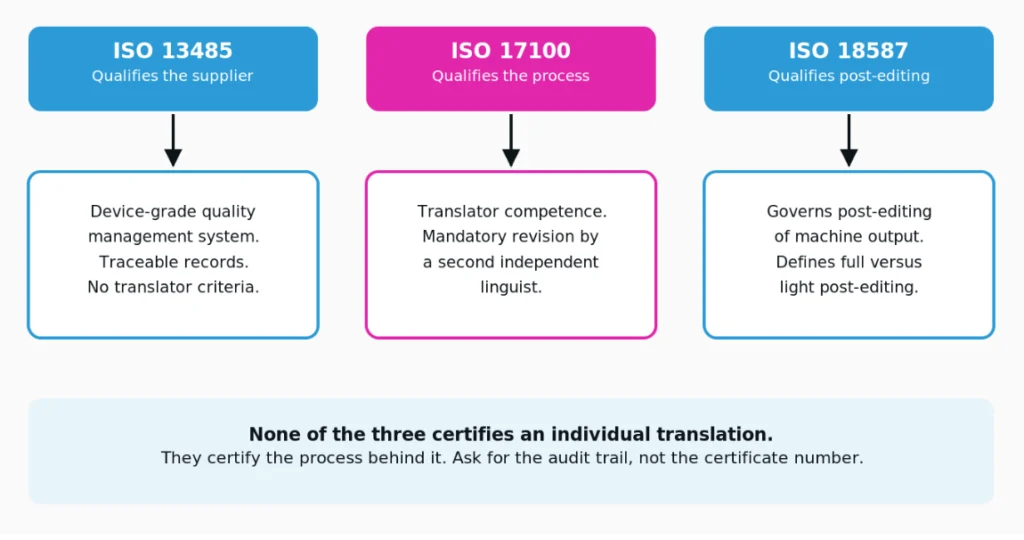
Each standard governs a different layer. Certification tells you a system exists; the audit trail tells you it ran on your content.
Risk-tier your documents before you price them
Pricing medical translation as a single per-word rate across an entire content set is the most common scoping mistake, and it fails in both directions. It overpays for internal training decks and underprotects informed consent forms. Tier the content first, then attach a workflow, then attach a price.
| Content Type | Regulatory Driver | Workflow | Review Layers |
|---|---|---|---|
| Informed consent forms | ICH E6(R3), ethics committee | Full human translation | Forward, revision, back-translation, reconciliation |
| IFUs and device labeling | EU MDR Annex I | Full human translation | Translator, independent reviser, QC expert |
| SmPC and package leaflets | EMA QRD templates | Full human translation | Translator, reviser, regulatory reviewer |
| Clinical study protocols | ICH E6(R3), sponsor SOPs | Full human translation | Translator, reviser, sponsor sign-off |
| Patient app and portal copy | Section 1557, MDR if in scope | Full human translation | Translator, in-context review |
| Device manuals and SOPs | ISO 13485 record keeping | Post-editing, validated engine | Post-editor, terminology QC |
| Lab reports, internal training | Internal QMS | Post-editing | Post-editor, sampled LQA |
| Healthcare marketing and web | Advertising and promo codes | Post-editing plus proofreading | Post-editor, proofreader |
Tier the content, then attach the workflow. Cost follows the review layers, not the word count.
This is also why a flat vendor rate card is worth checking against the tier map. NexTranslate keeps published per-word pricing with human proofreading included at every tier, which means the jump between tiers reflects added review layers rather than a proofreading line item reappearing as a surcharge.
Where AI belongs in a medical workflow, and where it does not
Machine translation is safe in medical work under three conditions: the engine is primed with your approved terminology, the output is post-edited by a linguist with life sciences competence, and the document sits below the regulatory line. It is not safe as a shortcut on anything a patient reads in order to make a decision about their own care.
Generic engines are the specific risk. Research comparing machine output across language pairs for healthcare information found accuracy varied sharply by language, and that mistranslations in some pairs were more likely to carry clinically significant consequences than in others. A general engine has no memory of your termbase, no concept of your regulatory context, and no way to flag the strings it is least confident about. The failure modes are covered in more depth in this breakdown of where AI-only translation falls short.
A controlled machine translation post-editing (MTPE) workflow solves most of this. Translation Memory (TM) and an approved termbase constrain the engine, ISO 18587 defines whether the post-edit is full or light, and the post-editor is a qualified linguist rather than a proofreader. The useful question is never “AI or human”. It is which document, which engine, and which review layers.
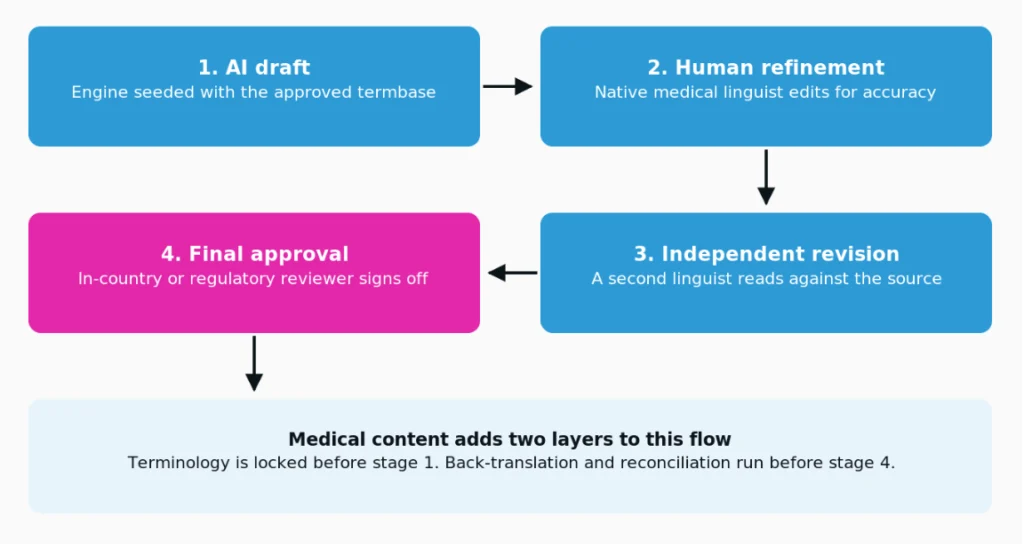
The four-stage hybrid workflow. Medical content adds a terminology lock at the front and a reconciliation step before approval.
The review layers that catch what a single translator misses
Single-pass translation catches typos. It does not catch meaning drift. Every high-risk medical document needs at least one qualified linguist who did not produce the translation to read it against the source, and the highest-risk documents need more than that.
For informed consent forms and other patient-decision content, the standard pattern is a four-step loop. A forward translation is produced from a source master with terminology already locked. A second linguist revises it independently. A third linguist, working blind to the original English, renders the target text back into English. Discrepancies between the back-translation and the source are then reconciled, documented, and closed out with a certificate of translation accuracy.
Back-translation is widely misunderstood as a quality score. It is not one. A back-translation that reads well proves very little, because a fluent translator can smooth over an error on the way back. What the loop actually does is surface meaning drift so a human has to make a documented decision about it. That decision record is what an auditor reads two years later. Structured linguistic quality assurance (LQA) using an error typology such as MQM sits alongside this and turns “it reads fine” into a countable, comparable result.
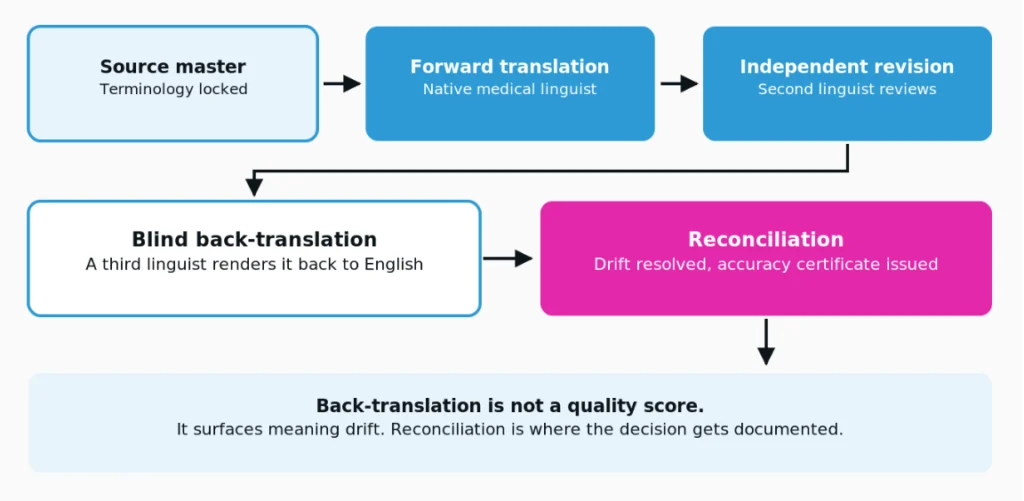
The back-translation and reconciliation loop for informed consent. The value is in the documented decision, not the second English text.
Terminology management is what makes accuracy repeatable
A glossary approved before the first word is translated is the highest-leverage step in any medical localization program. It converts a subjective review into a checkable one, and it is the only mechanism that keeps a hundred documents consistent with each other rather than each one individually defensible.
The termbase should be built from the source of truth for the market, not invented in-flight: EMA QRD standard terms for European submissions, the sponsor’s own controlled vocabulary for clinical work, and the device’s registered trade and common names exactly as filed. It needs version control, because a notified body reviewer who finds the same component named two different ways across two documents in the same file will ask which one is correct, and “both” is not an answer.
Where a Translation Management System (TMS) earns its cost is here. Not in shaving days off turnaround, but in making terminology enforcement automatic and the audit trail complete without anyone having to reconstruct it later.
What to ask a medical translation vendor before you sign
Certifications tell you a supplier has a system. Five questions tell you whether that system will actually hold on your content.
- Which linguists will touch this content, and what is their documented clinical or life sciences background?
- Is the revision step performed by a second independent linguist, or is it the same person rereading their own work?
- How is the termbase built, approved and version-controlled across releases and across languages?
- What evidence is produced as a deliverable: a certificate of accuracy, a QA report, an error typology score, or nothing?
- What happens when a regulator queries one specific string two years from now? Who can reconstruct that decision, and from what record?
A vendor that answers all five without hedging is running a real process. NexTranslate structures its medical translation services around exactly this: native linguists with healthcare and life sciences backgrounds, an independent second review on every project, client-specific glossaries maintained across long-running programs, and certified translations suitable for regulatory submission. The underlying philosophy is that AI gives the workflow speed and humans give it trust, and in medical content the trust layer is not optional at any tier.
Frequently asked questions
What qualifies someone to translate medical documents?
A medical translator needs native fluency in the target language plus documented subject-matter competence in healthcare or life sciences. ISO 17100 sets the baseline for translator qualification and requires an independent second linguist to revise the work. For regulated device or clinical content, ask for the individual linguist’s background, not just the agency’s certification.
Is machine translation allowed for medical content?
It depends entirely on the document. Machine translation with qualified human post-editing is appropriate for internal SOPs, training material and lower-risk technical documentation when the engine is constrained by an approved termbase. It is not appropriate for informed consent forms, instructions for use, labeling, or anything a patient uses to make a care decision. Those require full human translation with independent revision.
Do medical translations need to be certified?
Regulatory submissions, ethics committee filings and many official healthcare uses require a certified translation, meaning a signed statement of accuracy from the provider. Internal documentation usually does not. Confirm the requirement with the receiving authority before scoping, because certification changes both the workflow and the price.
What is back-translation and when is it required?
Back-translation is the practice of having a third linguist, blind to the original source, render the translated text back into the source language so discrepancies can be reconciled and documented. It is standard for informed consent forms, patient-reported outcome instruments and clinical trial material. It is unnecessary overhead for marketing content.
How much do medical translation services cost?
Cost tracks the review layers, not just the word count. Regulated medical content sits at the top tier because it carries a specialized native translator, an independent reviser, a quality control expert and terminology management. NexTranslate publishes transparent per-word pricing across three tiers with human proofreading included at each one, so the difference between tiers reflects added review rather than unbundled line items.
How long does medical translation take?
Standard turnaround for most medical documentation runs 24 to 72 hours depending on volume and tier. Documents requiring back-translation and reconciliation take longer because the loop involves three separate linguists in sequence. Build that into the submission timeline rather than compressing the review step to hit a date.
Conclusion: accuracy is a process, not a promise
Every vendor in this category claims accuracy. The claim is unfalsifiable on its own, which is why it is worth almost nothing during a selection process. What is falsifiable is the process: who translated it, who independently revised it, what terminology governed it, what evidence was produced, and whether any of that can be reconstructed when a notified body asks about one sentence in one leaflet.
Teams that get medical translation right do the classification work upfront. They tier the content, match each tier to a workflow, lock terminology before translation starts, and treat the audit trail as a deliverable rather than an afterthought. The documents that need four review layers get four. The ones that do not are not paying for them.
If you are scoping medical or life sciences content for a new market, we can map your document set against the risk tiers and show you which parts genuinely need full human translation and which can move faster. Request a scoped quote and we will come back with a tier-by-tier breakdown rather than a single blended rate.
Written by Karuppusamy Arunachalam, NexTranslate
Published August 2026 · Filed under Industry Use Cases
