

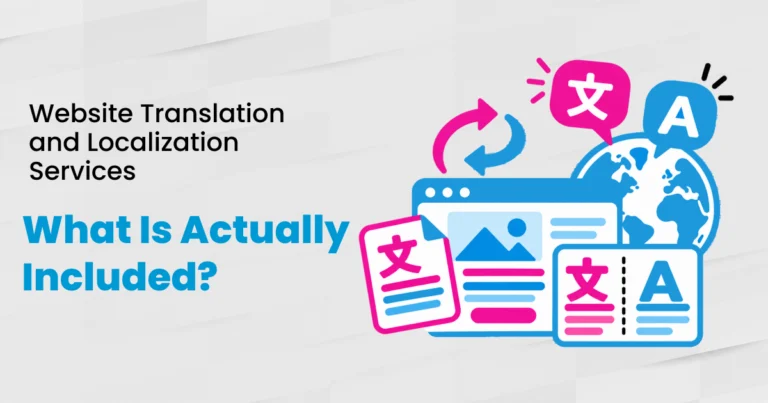
Two quotes for “website localization” from two providers can look almost identical on the front page. Same headline services. Similar per-word rates. Similar language coverage. Then the invoices arrive and the second provider added a line for in-context testing, a line for local keyword research, a line for image localization, and a rush fee for updates. The buyer thought they were comparing apples to apples. They were not.
Website translation and localization services vary widely in what a provider actually includes as part of the base price. Some pieces are standard almost everywhere. Others are quietly moved to a separate line item, or left out entirely and billed on invoice. Knowing which is which before you sign is the single most useful thing a buyer can do.
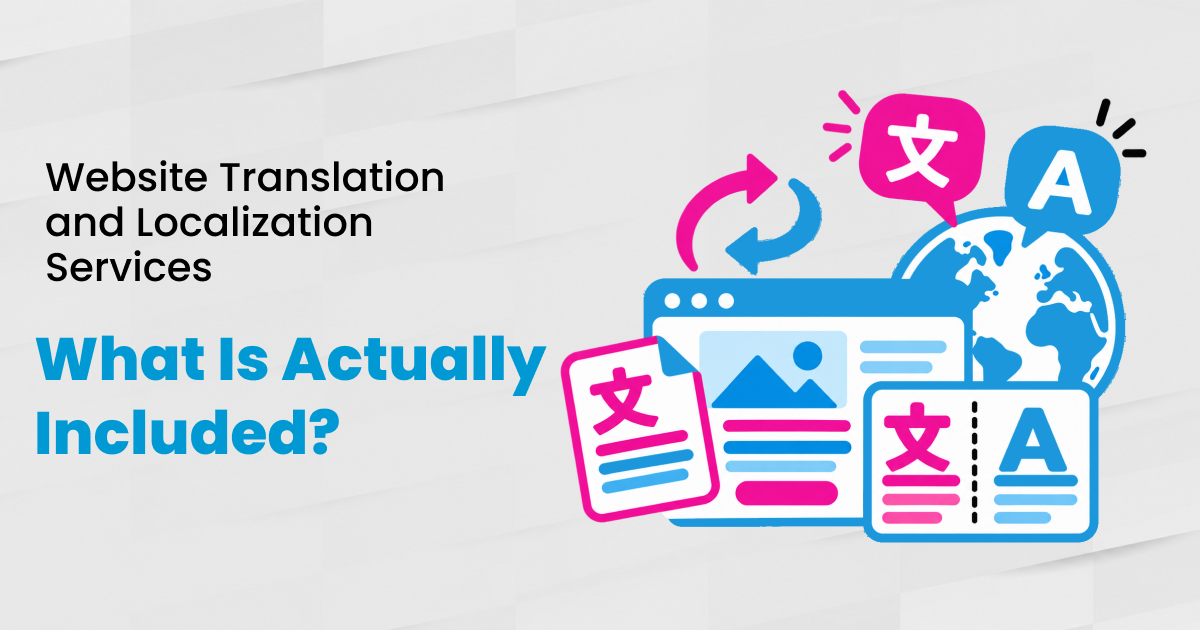
This guide covers exactly what is inside a professional website translation and localization services engagement. Ten deliverable categories, an “included as standard vs often extra” table, the process, the cost drivers, the questions to ask, and the red flags to watch for.
QUICK ANSWER
Website translation and localization services usually include translating all visible and hidden website content, adapting it for local culture and formats, localizing SEO elements, testing the translated site, and keeping translations updated. Transcreation of campaigns, multimedia localization, development work, and ongoing SEO management are often priced separately.
Website translation vs website localization: a quick refresher
Translation converts words from one language to another. Localization adapts the whole experience for a market. Both are usually needed. Confusing the two is how buyers end up with sites that read correctly but do not convert.
A US e-commerce store expanding to Germany illustrates the difference. Translation covers the product descriptions, category pages, and checkout copy. Localization covers everything else: euros instead of dollars, dates in DD.MM.YYYY, sizes in EU rather than US, SEPA and Klarna as payment options, and cookie banners that meet GDPR. A translated site would ship in German. A localized site would feel to a German buyer like it was built for them.
For a deeper explanation, see our complete Website Translation Services guide (2026). This post assumes you already know translation and localization are different and focuses on what a professional service actually delivers.
What is included in website translation and localization services
Ten deliverable categories make up a complete website translation and localization services engagement. Each section below lists the specific items a professional provider covers, and one line on why it matters.
1. Project scoping and content audit
The first stage of any real engagement. A content audit inventories every page on your site, counts source words, flags priority pages (homepage, top product or service pages, pricing, checkout), and identifies file formats and CMS integration needs. The scoping stage produces the timeline, the itemized quote, and the language and market list.
Included as standard with any serious provider. If a quote arrives before this step, the provider is guessing.
2. Translation of all website content
Everything the user reads on your site needs translation. Visible content: page copy, navigation and menus, buttons and CTAs, forms and error messages, product or service pages, blog posts, and legal pages such as privacy policy, terms of service, and cookie notices. Hidden content: UI strings, popups, checkout flow copy, transactional emails, and chatbot scripts. A professional workflow uses an AI first-pass translation refined by a native linguist for accuracy and brand voice.
3. Cultural adaptation and transcreation
Beyond word-for-word translation, cultural adaptation adjusts tone of voice, idioms, humor, examples, and references so the content feels native. Basic cultural adaptation is included as standard. Full transcreation, which rewrites campaigns, taglines, and headlines creatively for a new market, is usually a separate line item because it requires a marketing-specialist linguist rather than a general translator.
4. Format and regional localization
Currencies, date and time formats, number formats, units of measurement (metric vs imperial), addresses, phone number formats, time zones, sizes, and local payment methods. This category is small in word count but touches every locale. Missing any of it produces a site that reads correctly but breaks the user experience at the exact moment they try to convert.
5. Visual and multimedia localization
Text inside images, infographics, icons, colors and symbols with cultural meaning, video subtitles, and dubbed voiceover. Downloadable PDFs and marketing collateral also fall here. Often only partially included. Static image text and basic subtitle work may be standard. Video dubbing and heavy design work in a translated language are typically extra.
6. Multilingual SEO localization
Local keyword research per language and market (not literal keyword translation), translated meta titles and descriptions, headings, URL slugs, image alt text, hreflang tags, and multilingual XML sitemaps. Every page a search engine or AI Overview evaluates has translated SEO fields, not auto-generated ones.
7. Technical and CMS localization
CMS integration for platforms such as WordPress, Shopify, Webflow, or headless setups. File format handling for XLIFF, JSON, PO, HTML, and Markdown. Language switcher setup. URL structure decisions. Right-to-left layout support for Arabic and Hebrew. Text expansion handling for languages that run longer than English. Internationalization (i18n) checks on the source code, when engineering has not already externalized strings.
8. Linguistic assets: glossary, style guide, and translation memory
A glossary defines how product names, feature names, and industry terms are translated in each locale. A style guide sets tone, voice, and formatting. Translation memory is a database of every phrase already translated, reused automatically on repeat content. All three are built once and lower cost on every future project. Ask directly: do you get to keep them if you change providers?
9. Quality assurance and testing
Linguistic quality assurance covers accuracy, grammar, and terminology. In-context review checks the translated content on the live or staging site rather than in a spreadsheet. Functional testing verifies forms, links, and checkout still work. Layout and display checks catch text expansion breaks. Cross-browser and mobile checks close the loop. A serious provider articulates each QA layer in writing before the project starts.
10. Ongoing updates and continuous localization
New pages, blog posts, product updates, and pricing refreshes all create new source content after launch. A working translation program defines how updates flow into every locale, on what cadence, and at what cost. Subscription or retainer models are the most predictable option. Pay-per-update works for lower-volume sites.
Optional visual: an infographic showing the 10 deliverable categories as icons in a 2×5 grid. Alt text: “Ten deliverable categories in a professional website translation and localization services engagement.”
Included as standard vs often charged extra
The table below is the single most useful reference for comparing two quotes. Column two lists what almost every professional provider covers as standard. Column three lists what commonly moves to a separate line item, or shows up as an upcharge later. Practice varies by provider, so always ask for an itemized quote and confirm each row against your actual proposal.
| Service element | Usually included | Often extra or varies |
|---|---|---|
| Page copy translation | Included as standard | |
| UI strings and forms | Included as standard | |
| Proofreading and linguistic QA | Included with most professional providers | Often billed separately by cheaper vendors |
| Basic cultural adaptation | Included as standard | |
| Metadata and SEO fields translation | Usually included | Sometimes billed as an SEO add-on |
| Full transcreation of campaigns | Almost always separate | |
| Local keyword research | Usually a separate SEO service | |
| hreflang and technical SEO setup | Often extra, depending on scope | |
| Images with embedded text | Basic image text translation may be included | Full image redesign is usually extra |
| Video subtitles and voiceover | Subtitles sometimes included | Voiceover and dubbing almost always extra |
| Development or CMS setup | Extra, unless the provider offers a proxy | |
| In-context and functional testing | Included with professional providers | Skipped by cheaper vendors |
| Glossary and translation memory | Included, but ask if you own them | Access fees may apply on cheaper plans |
| Ongoing updates after launch | Priced per update or on a retainer | |
| Rush turnaround | Extra, usually 20 to 30 percent | |
| Certified translation of legal or medical documents | Extra, requires specialist linguists |
The single best thing a buyer can do is ask for an itemized quote and match each row against this table. If a provider will not itemize, that is a red flag on its own.
How the website localization process works
A six-step process runs under every professional engagement. This is the summary version. For the detailed 8-step website translation process, with a diagram, see the pillar guide.
- Discovery and scoping. Content audit, language and market selection, timeline, itemized quote.
- Content extraction. Pull source strings out of the CMS in a translator-friendly format (XLIFF, JSON, HTML) via connector or API.
- Translation and adaptation. AI first pass, native linguist review, terminology enforced by glossary, brand voice enforced by style guide.
- Review and QA. Linguistic, functional, and layout QA. In-context review on the staging site.
- SEO and technical setup. hreflang, translated meta, multilingual sitemap, URL structure, language switcher.
- Launch and ongoing updates. Publish, monitor per-locale metrics, and route new content into translation on a defined cadence.
What affects the cost of website translation and localization services?
The exact price varies by provider and scope. Rather than repeat the full cost breakdown from the pillar, here are the factors that actually move the number on your quote.
- Word count. The base multiplier. Larger sites cost more.
- Number of languages. Each additional language multiplies word cost, though volume discounts often kick in at three or more languages.
- Language pair rarity. Common pairs (English to Spanish, French, German) are the lowest. Rare pairs run 30 to 50 percent higher.
- Content complexity and industry. Legal, medical, and financial content requires specialist linguists and usually costs more.
- Scope. Translation only is cheaper than full localization with cultural, technical, and SEO layers.
- Multimedia. Video, voiceover, and heavy design work in a translated language are usually separate line items.
- Technical setup. CMS connector configuration, proxy setup, and integration work are often one-time fees.
- Turnaround. Standard turnaround is included; rush delivery is usually 20 to 30 percent more.
- Ongoing updates. Retainer, subscription, or per-word update pricing.
NexTranslate’s transparent three-tier pricing includes translation, proofreading, and QA at proofreading-only pricing, which removes two of the most common surprise line items. For the full pillar guide cost drivers section, see the linked article.
Not sure what your website actually needs?
Get a clear, itemized quote from NexTranslate. Translation, proofreading, and QA at proofreading-only pricing across 60+ languages, with a dedicated project manager.
Questions to ask before you sign a website localization quote
Send these nine questions to any provider before signing. The quality of the answers tells you more than the price does.
- Which pages, file types, and hidden content are included? Should list every content type: page copy, UI strings, forms, PDFs, images, emails, chatbot.
- Is proofreading and QA included in the base price, or is it a separate step? If separate, this is where surprise line items usually appear.
- Do you use native linguists with industry experience? Answer should name the industries and roughly how many linguists in your language pair.
- Is multilingual SEO included: metadata translation, hreflang, local keyword research? Any “yes” that does not specify the elements is a soft yes.
- Do you test the translated site in context, or only review the source strings? Providers that skip in-context review ship translations that break the UI.
- Who owns the glossary and translation memory after the project ends? If the provider owns them, switching providers gets expensive.
- How are updates and new content handled and priced? Retainer, subscription, per-word, or per-project. Get the answer in writing.
- What is the turnaround time on the initial project, and is rush delivery extra? Get both the standard and rush numbers.
- How is our data kept secure and confidential? Should reference an NDA policy and standard security practices.
Red flags when choosing a localization provider
A short list of warning signs. Any one of them warrants a follow-up question. Two or more should push the provider off the shortlist.
- Raw machine translation output presented as “professional translation” with no linguist review.
- No QA step described in the workflow, or QA described only as “our translators are careful”.
- Vague per-page pricing without a scope of what a page includes.
- No plan for content updates after launch.
- No in-context review offered, only source-string review.
- You do not get to keep your glossary and translation memory.
- Turnaround promises that sound too fast without an explanation of how they hit them (usually skipping QA).
Website localization scope checklist
Copy the checklist below into your quote-comparison spreadsheet. Mark each item as Included, Extra, or Not needed for each provider you evaluate. If more than three items land in Extra, the base quote is understating the real cost.
- Content audit and scoping
- Page copy translation
- UI strings, forms, error messages
- Basic cultural adaptation
- Full transcreation of campaigns
- Currency, date, and format localization
- Image text and multimedia localization
- Multilingual SEO fields
- hreflang and local keyword research
- CMS integration and file handling
- Glossary, style guide, translation memory ownership
- Linguistic, functional, in-context QA
- Ongoing update plan and pricing
What is included with NexTranslate website translation and localization services
Mapping our offer against the ten categories above:
- AI first-pass translation refined by native linguists for accuracy and brand voice.
- Translation, proofreading, and QA included in the base price at proofreading-only pricing.
- 60+ languages with certified linguists and domain specialists.
- Related services in one workflow: website and app localization, software UI translation, marketing transcreation, machine translation post-editing, and linguistic QA.
- 24/7 turnaround with a dedicated project manager on every account.
- Industries served: SaaS, e-commerce, healthcare, legal, and fintech, with subject-matter linguists in each.
- Clear itemized quotes with no hidden proofreading or QA charges.
Frequently asked questions
What is included in website translation and localization services?
Standard scope covers content translation (visible and hidden), cultural adaptation, format localization (currency, dates, units), SEO field translation, technical and CMS integration, glossary and translation memory, linguistic and functional QA, and a plan for ongoing updates. Full transcreation, heavy multimedia work, and ongoing SEO management are often separate line items.
What is the difference between website translation and website localization?
Translation converts words. Localization adapts the full experience: language, culture, formats, visuals, UX, SEO, and compliance. For business-critical pages such as homepage, product pages, pricing, and checkout, you need localization. For blog and support content, translation with light cultural adaptation is usually enough.
Is SEO included in website localization services?
Basic multilingual SEO (translating meta titles, descriptions, alt text, and setting hreflang) is included by most professional providers. Local keyword research, competitor analysis in-market, and ongoing search performance management are usually a separate SEO service. Ask the provider to itemize which SEO elements are inside the localization quote and which are outside.
Do localization services include images and videos?
Partially. Static image text translation and basic subtitle work are often included. Full image redesign, video voiceover, and dubbing in the translated language are almost always priced separately because they require design or production specialists rather than translators.
How much do website translation and localization services cost?
Cost depends on content volume, number of languages, scope, and technical setup. Hybrid AI plus human workflows in 2026 typically run $0.07 to $0.12 per source word. Full human translation runs $0.15 to $0.25 per word. See NexTranslate’s pricing page for per-word rates by tier.
How long does it take to localize a website?
A small site (10-20 pages) takes 5 to 10 business days in one language with a hybrid workflow. A medium site (50-100 pages) takes 3 to 6 weeks. A large or e-commerce site takes 8 to 14 weeks for the first wave, then continuous sync for updates.
Can you localize WordPress and Shopify websites?
Yes. Both platforms have native connectors and translation plugins that extract source strings, receive translations back, and publish them into the right locale. NexTranslate integrates with WordPress, Shopify, Webflow, and headless CMS platforms.
How are website updates handled after launch?
A continuous localization workflow connects the CMS to the translation platform via webhooks. New source content is automatically sent for translation on a defined cadence, then merged back into the site. Pricing is typically on retainer or per-word. Define this before launch to avoid the “translations drift out of date” trap.
Conclusion
The value of website translation and localization services is not in the per-word rate on the front page of a quote. It is in what the quote actually covers. A cheaper provider that itemizes proofreading, QA, image work, and updates as extras usually ends up more expensive than a full-scope provider whose headline number looks higher.
Ask for an itemized quote. Match it against the “Included vs Often Extra” table. Send the nine questions. Watch for the red flags. Every hour spent on that comparison saves months of surprise line items and translated content that never converts.
At NexTranslate, we offer translation and localization services with clear itemized quotes, translation and proofreading and QA at proofreading-only pricing, and a dedicated project manager on every account. To scope your project, contact our team.
Get your website localization quote
Send us your site URL and target languages. We will come back with an itemized quote that covers translation, proofreading, and QA at proofreading-only pricing.
Written by Karuppusamy Arunachalam, Founder, NexTranslate
Last updated [October 2026] · Filed under Translation Services