Website Translation Services: The Complete Guide to Translating Your Website for Global Markets in 2026

Everything a growth, product, or marketing team needs to translate a website properly in 2026: definitions, the technical foundation, multilingual SEO, quality control, timelines, cost drivers, and how to choose a provider.
Website translation services guide for global markets in 2026

Most website translation projects fail quietly. The pages get translated, the language switcher goes live, and then nothing happens. Traffic from the new market stays flat. Conversion rates in the localized version run a fraction of the original. Support tickets arrive complaining that a button label makes no sense or that a date format looks wrong. Six months later someone asks why the German site is not pulling its weight, and the honest answer is that it was never really localized. It was translated, word for word, and shipped.

The gap between those two outcomes is the entire subject of this guide. Translating a website is not the same as running its text through a translation engine. A website is a product. It has navigation, forms, error states, metadata, legal copy, transactional emails, and a search-engine footprint, all of which have to work in each language a visitor speaks. Get that right and a localized site earns trust, ranks in local search, and converts at rates that justify the investment many times over. Get it wrong and the translated pages become dead weight that dilutes the brand and confuses the people they were meant to win.

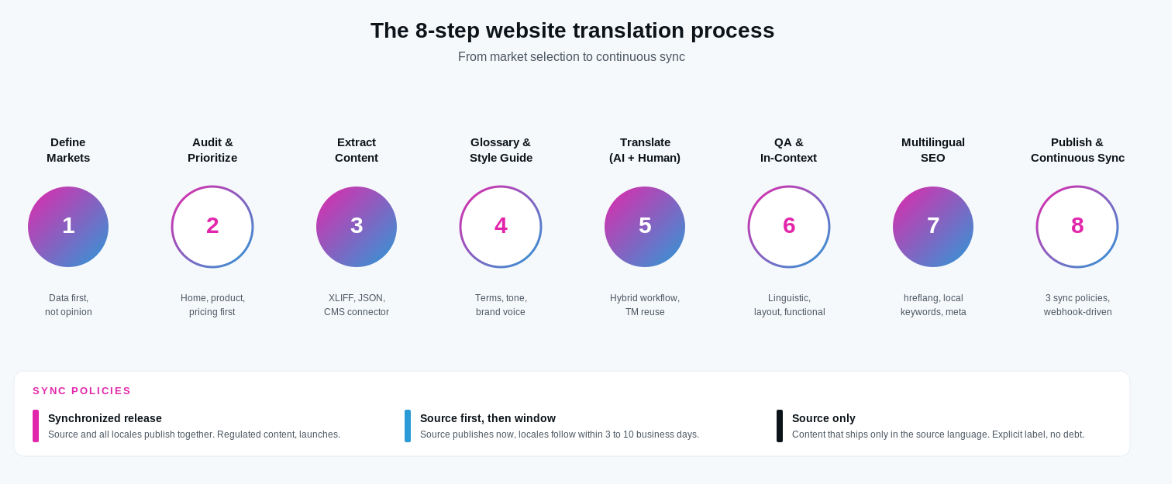
The website localization process, end to end

1. Scope & Audit

languages, risk, surfaces

2. Internationalize

i18n, Unicode, layout

3. Files & TMS

JSON, XLIFF, memory

6. LQA Review

scored quality check

5. Human Post-Edit

MTPE, ISO 18587

4. AI Draft

fast first pass

7. In-context QA

layout, truncation

8. Launch

hreflang, metadata

9. Continuous Loc.

always-on sync

This is the complete reference for doing it right in 2026. It is written for the people who actually own this decision: SaaS founders weighing global expansion, heads of product shipping in new languages, localization and internationalization leads designing the workflow, and marketing leaders who have to make the translated pages rank and convert. The guide is deliberately vendor-neutral in its advice. Where NexTranslate fits, it is named plainly, but the frameworks here apply no matter who does the work. Read it start to finish for a full mental model, or jump to the section that matches the decision in front of you.

Two forces make 2026 a genuinely different moment for this work than even a couple of years ago. The first is that machine translation crossed a quality threshold that makes the hybrid model, machine draft plus human refinement, both cheaper and better than either extreme on its own, which changes the economics of localizing a large site. The second is that discovery itself moved. Buyers increasingly find products through AI assistants and answer engines that read and recommend in the user’s own language, so a monolingual site is now invisible to a whole new layer of demand, not just to local search. Those two shifts are why this guide spends as much time on workflow, quality, and findability as it does on the act of translation. The words are the easy part. Making them work, in every market, current with your product, and visible to both search engines and AI, is the real job.

Most website translation projects fail quietly. The pages get translated, the language switcher goes live, and then nothing happens. Traffic from the new market stays flat. Conversion rates in the localized version run a fraction of the original. Support tickets arrive complaining that a button label makes no sense or that a date format looks wrong. Six months later someone asks why the German site is not pulling its weight, and the honest answer is that it was never really localized. It was translated, word for word, and shipped.

The gap between those two outcomes is the entire subject of this guide. Translating a website is not the same as running its text through a translation engine. A website is a product. It has navigation, forms, error states, metadata, legal copy, transactional emails, and a search-engine footprint, all of which have to work in each language a visitor speaks. Get that right and a localized site earns trust, ranks in local search, and converts at rates that justify the investment many times over. Get it wrong and the translated pages become dead weight that dilutes the brand and confuses the people they were meant to win.

The website localization process, end to end

1. Scope & Audit

languages, risk, surfaces

2. Internationalize

i18n, Unicode, layout

3. Files & TMS

JSON, XLIFF, memory

6. LQA Review

scored quality check

5. Human Post-Edit

MTPE, ISO 18587

4. AI Draft

fast first pass

7. In-context QA

layout, truncation

8. Launch

hreflang, metadata

9. Continuous Loc.

always-on sync

This is the complete reference for doing it right in 2026. It is written for the people who actually own this decision: SaaS founders weighing global expansion, heads of product shipping in new languages, localization and internationalization leads designing the workflow, and marketing leaders who have to make the translated pages rank and convert. The guide is deliberately vendor-neutral in its advice. Where NexTranslate fits, it is named plainly, but the frameworks here apply no matter who does the work. Read it start to finish for a full mental model, or jump to the section that matches the decision in front of you.

Two forces make 2026 a genuinely different moment for this work than even a couple of years ago. The first is that machine translation crossed a quality threshold that makes the hybrid model, machine draft plus human refinement, both cheaper and better than either extreme on its own, which changes the economics of localizing a large site. The second is that discovery itself moved. Buyers increasingly find products through AI assistants and answer engines that read and recommend in the user’s own language, so a monolingual site is now invisible to a whole new layer of demand, not just to local search. Those two shifts are why this guide spends as much time on workflow, quality, and findability as it does on the act of translation. The words are the easy part. Making them work, in every market, current with your product, and visible to both search engines and AI, is the real job.

1. Translation, localization, transcreation, and internationalization: the four words that decide everything

These four terms describe four different jobs, and confusing them is the single most common reason website translation projects underdeliver. Translation converts text from one language to another. Localization adapts the whole experience, including the text, to feel native in a specific market. Transcreation recreates a message so it lands emotionally, even when that means departing from the literal words. Internationalization is the engineering work that makes all of the above possible without rebuilding the product each time.

Treating these as interchangeable leads teams to buy translation when they needed localization, or to skip internationalization and then discover that their codebase cannot hold a translated string longer than the English one. The distinctions are not academic. Each one maps to a different budget line, a different specialist, and a different point in the project timeline.

Translation: the literal layer

Translation is the accurate rendering of meaning from a source language into a target language. It is necessary and it is never sufficient on its own for a website. A competent translation of your pricing page will be grammatically correct and factually faithful, and it can still fail to convert because it ignores how the local market thinks about money, risk, and commitment. Translation answers the question “what does this say.” It does not answer “does this work here.”

Localization: the experience layer

Localization adapts content, design, formatting, and functionality so the entire experience feels native to a target market. That includes the obvious text, but also date and number formats, currencies, units of measurement, address fields, name order, color associations, imagery, legal disclosures, payment methods, and the direction the page reads in. A localized Japanese site is not an English site with Japanese words pasted in. It respects the conventions a Japanese visitor expects without thinking about them, which is exactly why it builds trust. When NexTranslate talks about adapting the user experience rather than swapping text, this is the layer being described.

Transcreation: the emotional layer

Transcreation recreates the intent, tone, and emotional effect of a message in a new language, even when a literal translation would be technically correct. It matters most for taglines, campaign copy, hero headlines, and anything where persuasion outranks precision. A clever play on words in English usually means nothing translated literally, so a transcreator writes a new line that produces the same feeling for the local audience. This is craft work performed by linguists who are also copywriters, and it is why teams running paid campaigns into new markets invest in content and marketing transcreation rather than asking a translator to be funny on command.

Internationalization: the engineering layer

Internationalization, abbreviated i18n because there are eighteen letters between the first i and the last n, is the engineering practice of building a product so it can support multiple languages and regions without code changes for each one. It is done before localization, usually by developers, and skipping it is the most expensive mistake on this list. Internationalization covers externalizing every user-facing string into resource files, supporting Unicode so every script renders, allowing text to expand or contract, handling right-to-left layouts, and making dates, numbers, and currencies locale-aware. A product that was never internationalized cannot be cleanly localized. The translation work backs up against hardcoded strings, broken layouts, and database fields that truncate accented characters.

Term What it changes Who does it When
Translation The words Translators Per content batch
Localization The whole experience Linguists, designers, QA Per market
Transcreation The emotional effect Copywriting linguists Campaigns, brand copy
Internationalization (i18n) The codebase Developers Once, before launch

The practical takeaway is sequencing. Internationalize the product once, early. Then localize per market, lean on translation for the high-volume low-risk text, and reserve transcreation for the copy that has to persuade. A team that buys these in the wrong order pays for the same work twice.

2. Why website translation is a growth lever, not a checkbox, in 2026

Website translation directly drives revenue because most buyers will not purchase in a language they do not read. This is not a soft preference. CSA Research has repeatedly found that around 76 percent of online shoppers prefer to buy products with information in their own language, and roughly 40 percent say they will never buy from a website that is only available in a foreign language. When the majority of a market self-selects out of an English-only funnel, the cost of staying monolingual is the market itself.

The compounding reason this matters more in 2026 than it did even two years ago is that discovery has changed. Buyers no longer arrive only through a blue link on a search results page. They arrive through AI assistants that summarize and recommend, through answer engines that quote a source directly, and through local-language search where your English pages simply do not appear. A website that exists in one language is invisible to all of those new front doors in every market that does not speak it.

The conversion math

Localized websites convert better because trust and clarity rise together. Industry analyses commonly cite a meaningful lift in conversion when a non-English market is served in its own language compared with an English-only experience, often in the range of a 1.5 times improvement. The exact multiplier depends on the market, the category, and how well the localization was done, but the direction is consistent across studies. People complete purchases when the checkout, the guarantee, and the fine print are in a language they trust. They abandon when they have to translate the refund policy in their head.

There is a second-order effect that teams underestimate. Localized content lowers support load. When onboarding, help articles, and error messages speak the user’s language, fewer tickets get filed, fewer deals stall on a confused buyer, and customer success spends less time untangling misunderstandings that were really translation gaps. The return on localization shows up in conversion, but it also shows up in retention and in the cost of serving each new market.

The AI-discovery shift

AI answer engines now decide which sources to cite based on how clearly a page answers a question, and they do this language by language. A page that states a definition cleanly, in the user’s language, is far more likely to be surfaced inside an AI-generated answer than one that buries the point. This is the practical meaning of answer engine optimization. Translating your highest-intent pages into a market’s language is no longer only about ranking in that market’s Google. It is about being eligible to be quoted by the assistant the buyer asked instead of searching.

The downside risk of doing it badly

Bad translation does not just fail to help; it actively damages the brand and can create legal exposure. A visible language error on a pricing page or a hero headline signals carelessness, and a buyer who sees one obvious mistake assumes there are others they cannot see, which is corrosive to trust in exactly the markets you spent money to enter. In regulated categories the risk is sharper. A mistranslated medical instruction, an inaccurate financial disclosure, or a contract term that drifted in translation can carry real liability, not just embarrassment. This asymmetry, where good translation quietly compounds and bad translation loudly destroys, is the reason quality cannot be the line item that gets cut to hit a budget. The cheapest translation is rarely the lowest total cost once the cost of redoing it, and of the trust lost in the meantime, is counted.

The strategic conclusion is that website translation has moved from a late-stage internationalization chore to an early growth decision. The companies treating it as a checkbox are leaving the conversion lift, the support savings, and the AI visibility on the table. The ones treating it as a lever are deciding, deliberately, which markets to enter and how deeply to localize for each.

3. What actually needs translating on a website (it is more than the pages)

A website is far more than its visible page copy, and a translation scope that only counts body text will miss a third of what a visitor actually reads. The full surface includes interface text, content, SEO metadata, legal and trust copy, transactional messages, media, and the long tail of microcopy that shapes the experience. Scoping all of it up front is the difference between a coherent localized site and one with English error messages popping up in the middle of a German checkout.

Interface and microcopy

Navigation labels, buttons, form fields, placeholder text, tooltips, validation and error messages, empty states, and confirmation dialogs all carry meaning and all need translating. Microcopy is easy to forget because it lives in the code rather than the CMS, which is exactly why so many half-localized sites show a translated homepage and an English “something went wrong” when a form fails. For product interfaces specifically, this is the domain of software UI translation, where string length, context, and placeholder variables matter as much as the words.

Content pages

Homepage, product and feature pages, pricing, about, blog and resource articles, help documentation, and landing pages make up the body of most sites. These are the pages teams think of first, and they vary widely in risk. A blog post can tolerate a faster, lighter workflow. A pricing page or a feature comparison cannot, because an error there directly costs a sale. Scope these by intent and risk, not by treating every page as equal.

SEO metadata

Title tags, meta descriptions, image alt text, URL slugs, Open Graph tags, and structured data all need to be localized, and not by literal translation. Keywords do not translate. The phrase a French buyer types is rarely the literal French rendering of the English keyword, so metadata has to be rewritten around real local search demand. A site that translates its visible copy but leaves English metadata, or machine-translates its title tags, throws away most of the organic upside it just paid for.

Legal, trust, and transactional copy

Terms of service, privacy policy, cookie notices, return and shipping policies, warranties, and disclosures often carry regulatory weight that varies by jurisdiction. These are high-risk and frequently require specialist review rather than general translation. Alongside them sit the transactional messages that fall outside the CMS entirely: order confirmations, password resets, receipts, shipping notifications, and the automated emails a system sends. An untranslated transactional email is the most common crack in an otherwise localized experience, and it arrives at the exact moment a customer is deciding whether to trust you.

Media and dynamic content

Video subtitles and voiceovers, images that contain embedded text, infographics, PDFs, and downloadable assets all carry language. So does user-generated and dynamic content like reviews, ratings, and personalized recommendations, which a static translation pass will never catch. Deciding how to handle dynamic content, whether through on-the-fly machine translation with disclosure, selective human translation, or leaving it in the original with clear labeling, is a real scoping decision that should be made on purpose rather than by omission.

Surface Examples Typical Risk Suggested Handling
Interface / Microcopy Buttons, errors, tooltips Medium Human review, in-context
Content Pages Homepage, features, blog Low to high Tier by intent
SEO Metadata Titles, slugs, alt text High for growth Rewrite to local search
Legal / Trust Terms, privacy, returns High Specialist review
Transactional Receipts, resets, emails High Human, do not skip
Media / Dynamic Subtitles, reviews Varies Decide policy upfront

4. The three ways to translate a website: machine, human, and hybrid

There are three core approaches to website translation, and in 2026 the right answer for almost every business is a hybrid of the first two. Pure machine translation is fast and cheap and unreliable on anything that matters. Pure human translation is accurate and slow and expensive at scale. The hybrid model, where machine translation produces a first draft and human linguists refine and verify it, captures most of the speed and cost advantage of automation while keeping the accuracy and cultural judgment only people provide. This is the workflow that defines modern localization, and it is the model NexTranslate is built around.

Machine translation alone

Raw machine translation, with no human in the loop, is appropriate only for low-risk, high-volume, low-visibility content where occasional errors carry no cost. Think internal knowledge bases or the long tail of user reviews where gist is enough. The danger is using it on customer-facing pages. Search engines detect unedited machine translation with high accuracy and treat it as a low-quality signal that can suppress rankings across every language version of a site, not just the offending one. And the errors machine translation makes are often the confident, fluent kind that read fine and mean the wrong thing, which is exactly the kind a non-speaker on your team will never catch.

Human translation alone

Traditional human translation, with no machine assistance, delivers the highest ceiling on quality and the highest cost and slowest turnaround. For a small volume of extremely high-stakes content, a sworn legal contract, a regulated medical claim, it can be the right call. For a full website with thousands of strings that change every sprint, pure human translation does not scale. The cost is prohibitive and the turnaround cannot keep pace with a product that ships weekly. Most teams that start here end up rationing translation, which means large parts of the site stay monolingual by default.

The hybrid model: AI draft plus human refinement

The hybrid approach uses machine translation to produce a fast first draft, then routes that draft through trained human linguists who edit for accuracy, tone, terminology, and cultural fit. This is what the industry calls machine translation post-editing, and it is governed by a recognized international standard, ISO 18587, which defines what full post-editing involves. The result is human-quality output at a fraction of the time and cost of translating from scratch, because the machine handles the literal heavy lifting and the human applies judgment where judgment is required.

The hybrid localization workflow

AI Draft

fast first pass

Human

refinement

AI-assisted

QA check

Final

approval

The reason the hybrid model wins is that it matches effort to risk along a single pipeline. Low-risk content can move through with a lighter human touch. High-stakes content gets a second linguist and a dedicated quality pass. The same workflow flexes across the whole site instead of forcing an all-or-nothing choice between cheap-and-risky and accurate-and-slow. It also keeps a human accountable for the final output, which matters both for quality and for the simple fact that an AI cannot be responsible for a mistranslated medical instruction or a misstated contract term.

Approach Speed Cost Best for
Machine only Instant Lowest Internal, low-risk, high-volume
Human only Slow Highest Small-volume, high-stakes legal/medical
Hybrid (AI + human) Fast Moderate Almost every customer-facing website

5. Choosing your languages and markets: a prioritization framework

Translate the markets where the evidence already points, not the ones that sound impressive. The most reliable way to choose languages is to look at where demand is leaking through despite the language barrier, then weigh that demand against the cost and difficulty of serving each market well. Spreading a fixed budget thinly across ten languages almost always loses to localizing two or three markets deeply.

Start with the data you already have. Your analytics show which countries and language settings are visiting despite an English-only site, where they bounce, and where they convert anyway. Your sales pipeline shows where deals stall on a language objection. Search demand tools show the real volume of local-language queries in your category. Together these point at markets where you are already earning interest you cannot yet capture.

The factors that should drive the decision

  • Existing demand. Traffic, signups, and trials already coming from a market with no localized experience are the strongest signal that translating it will pay off.
  • Market size and spending power. A large addressable market with the budget for your category justifies deeper investment than a small one, even if raw traffic looks similar.
  • Competitive whitespace. Markets where competitors have not localized well are easier to win and rank in than crowded ones.
  • Cost and complexity to serve. Some markets need localized payment methods, regulatory compliance, or local support, not just translated pages. Factor the full cost, not only the words.
  • Linguistic reach per language. A few languages unlock disproportionate reach. Spanish spans much of Latin America and large US populations; Arabic spans many markets but requires right-to-left engineering.

Which markets to localize first

Existing demand

Localize first

high demand, low effort

Plan & invest

high demand, high effort

Quick wins

low demand, easy to serve

Deprioritize

low demand, hard to serve

Cost & complexity to serve

Be careful with the languages that look like one decision but are several. Spanish for Spain is not Spanish for Mexico is not Spanish for Argentina, and the dialect variance is large enough that a single neutral Spanish often satisfies no one fully. Portuguese for Brazil differs meaningfully from Portuguese for Portugal. Decide early whether a market warrants a dedicated locale or whether a regional standard is acceptable, because that choice changes the word count, the translator pool, and the ongoing maintenance.

A sound sequencing strategy is to launch a beachhead market, prove the localization converts and the workflow holds, then expand to adjacent markets that share a language or a region. Companies that take this approach build a repeatable localization muscle before they scale it. The detailed version of this market-entry logic for software companies is laid out in the NexTranslate SaaS localization playbook, which is worth reading alongside this section if global expansion is the immediate goal.

For software businesses specifically, the order in which you internationalize the product and the order in which you enter markets should be planned together. The SaaS localization playbook covers how to sequence language launches against product readiness so the engineering and go-to-market work reinforce each other instead of colliding.

6. The technical foundation: i18n, file formats, and the TMS

Sustainable website translation runs on a technical foundation of internationalized code, structured translation files, and a translation management system that connects the two. Without that foundation, every translation cycle becomes a manual copy-and-paste exercise that breaks under the weight of a real release cadence. The teams that translate well in 2026 have invested in plumbing, not just words.

Internationalize before you localize

Internationalization, abbreviated i18n, is the prerequisite for everything else. It means externalizing all user-facing strings out of the code and into resource files, adopting Unicode so every script from Arabic to Chinese renders correctly, designing layouts that tolerate text expansion of thirty percent or more when English becomes German, supporting right-to-left languages structurally rather than as an afterthought, and making every date, number, and currency locale-aware. A product that skipped this work cannot be localized cleanly. The translation backs up against hardcoded strings, truncated database fields, and layouts that shatter when a label gets longer.

The file formats that carry translation

Translation moves through structured files, not documents. The common formats include JSON and YAML for web and app strings, XLIFF as the interchange standard built specifically for translation, gettext PO files, RESX for some application frameworks, plus HTML and Markdown for content. A capable localization partner works directly in these formats so translation drops back into the build without a developer reformatting anything by hand. The NexTranslate website and app localization service explicitly supports JSON, XML, XLIFF, YAML, RESX, PO, HTML, and Markdown, which is the practical baseline to expect from any provider serving product teams.

When evaluating a provider, confirm they work in your actual files. A vendor that only accepts pasted text or word processor documents will force your engineers into a reformatting loop on every cycle. The website and app localization workflow is designed around developer file formats and integrations precisely so the localization step does not become a manual bottleneck.

The translation management system

A translation management system, abbreviated TMS, is the platform that stores your strings, tracks what has and has not been translated, holds your translation memory and glossaries, and routes content to linguists and back. It is the difference between a process you can scale and a spreadsheet that collapses. The TMS connects to your CMS, your code repository, or your app through integrations and APIs, so new or changed content flows out for translation automatically and finished translations flow back without anyone emailing files around. This connective layer is what makes the multilingual content management discipline possible across a site with thousands of strings and a weekly release cycle.

Two assets the TMS maintains deserve special attention because they compound in value over time. Translation memory, abbreviated TM, is a database of every segment you have already translated, so identical and similar content is reused rather than retranslated, which cuts both cost and turnaround on everything after the first project. A glossary, sometimes paired with a style guide, locks in approved terminology so your product name, feature names, and key terms render consistently in every language. Skipping these assets is a false economy; they pay for themselves the second time a sentence appears.

7. Multilingual SEO and hreflang: getting found in every market

Translating your pages is only half of getting found abroad; the other half is multilingual SEO, the technical and content work that tells search engines which language version to show which user. Roughly three quarters of websites targeting international audiences have hreflang implementation errors, and those errors directly fragment rankings. A site can translate every page perfectly and still lose the organic traffic it was chasing because the search engine cannot tell its language versions apart.

URL structure: choose it deliberately

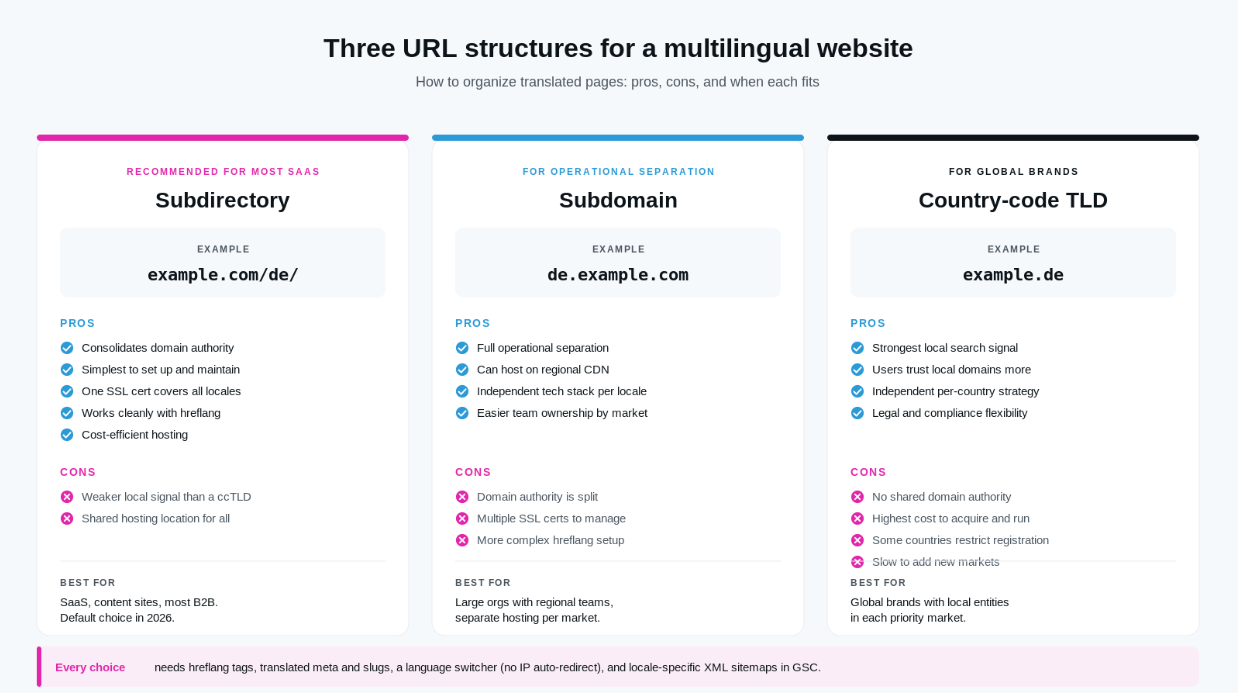
Your URL structure determines how authority flows across language versions and how strong a geotargeting signal you send. There are three main options and the choice has long-term consequences. Country-code top-level domains, like example.de or example.fr, send the strongest country signal but split your domain authority across separate sites and cost more to maintain. Subdirectories, like example.com/de/ or example.com/fr/, keep all authority on one domain and are the option most SEO practitioners recommend for consolidating ranking strength. Subdomains, like de.example.com, sit in between and are generally the weakest of the three for SEO. For most companies expanding into language markets rather than distinct legal entities per country, subdirectories are the safe default.

URL Structure Geo Signal Authority Maintenance
ccTLD (example.de) Strongest Split per site Highest
Subdirectory (/de/) Moderate Consolidated Lowest
Subdomain (de.example) Weak Partly split Moderate

Hreflang: the tag that prevents self-sabotage

Hreflang annotations tell search engines which language and regional version of a page to serve to which user, and they prevent your translated pages from competing with each other or being flagged as duplicate content. Each language version of a page references every other version, including itself, with a tag that names the language and optionally the region. The most common failures are missing return tags where version A points to B but B does not point back, wrong or invented language and country codes, and pointing hreflang at URLs that redirect or no longer exist. Because three quarters of international sites get this wrong, getting it right is a genuine competitive advantage rather than mere table stakes.

Localize keywords, do not translate them

Keyword research must be redone in each target language because people do not search for the literal translation of your English keywords. The term a German buyer types may be an entirely different concept from the word-for-word German rendering of your English phrase, and sometimes the highest-volume local query is an English loanword the market has adopted. Translating your metadata literally produces titles and descriptions that target phrases no one searches. Real multilingual SEO researches local demand from scratch, then writes metadata and on-page copy around the queries that actually exist in that market. This is also where unedited machine translation does the most damage, because search engines treat it as a low-quality signal that can drag down rankings across all language versions at once.

Set realistic timelines for international organic growth

Organic traffic from a new language market follows a predictable curve, and expecting results too soon is how good programs get killed prematurely. Typically there is minimal traffic for the first two to three months while pages are indexed and hreflang is processed, gradual growth from months three to nine as pages accumulate ranking signals, and compounding growth from months nine to eighteen as local authority builds. Meaningful return on a competitive international market usually lands around the twelve to eighteen month mark with sustained content investment. Localization is a compounding asset, not a switch, and the timeline should be communicated to leadership before the project starts, not after the first flat month.

Translate, transcreate, or create content locally

Not all content should be handled the same way in a new market, and choosing the right mode per content type is a multilingual content decision in its own right. Some content translates directly because the meaning is the value, like product documentation and help articles. Some content needs transcreation because the persuasion is the value, like campaign copy and high-intent landing pages. And some content should be created fresh for the market, because the topics a local audience searches for, and the examples that resonate with them, may not exist in your source-language library at all. A blog that ranks in the United States may target questions no one asks in Japan. Mature localization programs blend all three modes rather than forcing every page through a single pipeline, and they let local keyword research, not the source site’s structure, decide what gets translated, what gets transcreated, and what gets written from scratch.

8. Quality control: how good translation is actually guaranteed

Translation quality is not a matter of trust; it is produced by a defined process with review steps, measurable checks, and reusable linguistic assets. The disciplines that produce it are post-editing, linguistic quality assurance, in-context review, and the translation memory and glossary management that keep quality consistent over time. A provider that cannot describe its quality process concretely does not have one.

Machine translation post-editing (MTPE)

Machine translation post-editing, abbreviated MTPE, is the disciplined human revision of machine-translated output, and it is the engine of the hybrid model. A trained linguist edits the machine draft for accuracy, fluency, terminology, and tone, working to the international standard ISO 18587 that defines full post-editing. Done well, machine translation post-editing delivers quality indistinguishable from translation done from scratch, at lower cost and faster turnaround, because the linguist corrects rather than composes. The key is that the human is editing toward a quality bar, not merely skimming for obvious errors.

Linguistic quality assurance (LQA)

Linguistic quality assurance, abbreviated LQA, is a structured evaluation of translated content against defined quality criteria, scoring errors by type and severity rather than relying on a reviewer’s gut feeling. Linguistic quality assurance catches accuracy errors, mistranslations, terminology inconsistencies, grammar and style issues, and locale-specific formatting problems, and it produces a measurable quality score that can be tracked over time. For regulated or high-stakes content, LQA is not optional; it is the documented evidence that the translation met a standard. For everything else, it is how a localization program proves it is improving rather than hoping it is.

In-context QA: catching what the words miss

In-context quality assurance checks how translated text behaves inside the actual interface, not just on the page of strings. A translation can be linguistically perfect and still break the layout, overflow a button, collide with a fixed-width element, or render a variable in the wrong place. In-context review puts a linguist in front of the rendered product to verify spacing, truncation, encoding, line breaks, and that dynamic content assembles into a grammatical sentence. This is the step that separates a site that was translated from one that was localized, and it is especially important for languages that expand text length or read right to left.

Translation memory and glossary management

Consistency at scale comes from translation memory and glossaries, the linguistic assets that ensure the same term is translated the same way everywhere, every time. Translation memory reuses previously approved translations, which lowers cost and accelerates turnaround while keeping phrasing consistent across the site. A glossary locks approved terminology, your brand name, product names, and key domain terms, so they never drift between pages or between languages. These assets are why the second and third translation projects with a good partner are cheaper and faster than the first, and why a site translated without them slowly becomes internally inconsistent as different translators make different word choices.

One point of context that ties this section to a broader capability: the same human-in-the-loop evaluation discipline that powers translation quality also underpins formal AI evaluation services, where multilingual model output is benchmarked and reviewed by people. The skill set is the same. Quality is a process run by trained humans against a defined standard, whether the thing being judged is a translated page or an AI system’s multilingual output.

9. The workflow, timeline, and team: what a real project looks like

A website translation project moves through a predictable sequence: scope and prepare, set up the technical pipeline, translate and refine, review in context, launch, and then maintain continuously. The timeline ranges from about four to six weeks for a straightforward marketing site to three to six months for a complex platform with thousands of strings and regulated content. The single biggest predictor of how smoothly it goes is how much internationalization and preparation happened before the first word was translated.

The phases

  • Scope and audit. Inventory every translatable surface, decide languages, classify content by risk, and confirm what is in and out of scope. Underscoping here is the most common source of mid-project surprises.
  • Technical setup. Internationalize the product if needed, export strings into the right file formats, connect the TMS to the CMS or repository, and build the glossary and any existing translation memory.
  • Translation and post-editing. Run content through the hybrid pipeline, matching effort to risk, with machine draft and human refinement for most pages and a heavier human workflow for high-stakes copy.
  • Review and in-context QA. Linguistic quality assurance on the content and in-context checks on the rendered interface, fixing layout, truncation, and dynamic-content issues before anyone sees them.
  • Launch. Publish with hreflang in place, the language switcher working, metadata localized, and analytics segmented so you can measure each market separately from day one.
  • Maintain. Keep every language version synchronized as the source changes, which is the part most teams underestimate and which continuous localization exists to solve.

Why continuous localization replaced one-time projects

A website is not static, so its translation cannot be a one-time event. Every new feature, price change, blog post, and edited paragraph creates a translation gap the moment it ships, and on a one-time model those gaps accumulate until the localized site is visibly behind the original. Continuous localization solves this with an always-on pipeline: when source content changes, the changed segments flow automatically to translation and back, keeping every language version current without a manual project each time. For any team shipping weekly, this is the only model that holds.

The roles involved span more functions than teams expect. A localization or project lead owns the workflow. Developers handle internationalization and the integration. Linguists and post-editors do the translation and review. A reviewer or in-country expert validates market fit. Marketing owns the multilingual SEO and the local-language keyword work. On the provider side, a good partner supplies the linguists, the quality process, and often a dedicated project manager for higher tiers, which is why the heaviest projects benefit from a managed service rather than a self-serve tool alone.

10. What website translation costs and what drives the price

Website translation is usually priced per word, with rates that scale to the level of human involvement and specialization the content requires, and the all-in cost depends on far more than the rate. The headline number is the per-word rate, but the factors that actually determine your total are word count after translation-memory reuse, language pairs, content complexity and risk, turnaround speed, and whether proofreading and project management are included or billed separately.

The factors that move the price

  • Volume and reuse. Total word count drives base cost, but translation memory reuse can cut the effective count substantially on everything after the first project.
  • Language pair. Common pairs cost less than rare ones, where the translator pool is smaller and rates rise accordingly.
  • Content complexity and risk. Marketing copy, legal contracts, and medical content sit at very different price points because they demand different specialists and review depth.
  • Turnaround. Standard delivery costs less than rush or same-day work, which typically carries a premium of twenty to thirty percent.
  • What is included. Whether proofreading, quality assurance, and project management are bundled or charged as add-ons changes the real total more than the advertised rate does.

What drives your total translation cost

1. Volume & TM reuse

words billed after memory

2. Language pair

common vs rare

3. Content complexity

marketing to legal/medical

4. Turnaround speed

standard vs rush (+20–30%)

5. What is included

review, QA, PM bundled?

Total Cost

of translation

(rate × scope)

Watch the hidden cost of separate proofreading

The line item that most distorts vendor comparisons is proofreading. Many providers advertise a low per-word rate and then bill proofreading separately, often an extra two to five cents per word, which can raise the true cost by thirty to forty percent over the quoted figure. NexTranslate publishes transparent translation pricing that includes human proofreading at every tier rather than charging for it on top, which is the practical reason to compare all-in quotes rather than headline rates. When you evaluate providers, normalize every quote to include review, or the cheapest-looking option frequently turns out to be the most expensive.

As a rough orientation rather than a quote, web and app content commonly falls in the range of a few cents per word for lighter, lower-risk pages up to the low double digits per word for specialized, high-stakes material that needs a specialist translator, an independent reviser, and a dedicated quality pass. The right tier depends on the content, not on a single blanket rate. To price a specific site, the fastest path is to get a quote against your actual word count, languages, and content mix.

Project pricing versus a retainer

How you buy matters as much as the rate, because a website that changes constantly is not a one-time purchase. Two structures dominate. Project pricing suits a defined, bounded job: localize this set of pages into these languages, once. A subscription or retainer suits an ongoing relationship where new and changed content flows continuously and is translated as it appears, often at preferential rates because the volume is predictable and the translation memory keeps growing. For any team on a regular release cadence, a retainer aligned to continuous localization is usually both cheaper per word and far less operational overhead than re-scoping a project every quarter. The mistake is buying project pricing for what is really an ongoing need, then absorbing the hidden cost of language versions falling behind between projects. Decide which structure fits your actual content velocity, and price against that rather than against a single snapshot of words.

11. Cultural adaptation and design: localizing beyond language

A correctly translated page can still feel foreign, untrustworthy, or even offensive if the design and cultural cues were not adapted alongside the words. Cultural adaptation covers everything a visitor reads without reading text: color, imagery, layout direction, formatting conventions, payment and trust signals, and the social norms a market brings to a buying decision. This is the part of localization that separates a site that was merely translated from one that genuinely belongs in its market, and it is the part automated tools cannot touch.

Visual and design localization

Imagery, icons, and color carry meaning that varies sharply across cultures, and the wrong choice undermines trust before a single word is read. A photograph that feels aspirational in one market can feel exclusionary or irrelevant in another. Colors carry associations that flip between regions; the same hue can signal celebration in one culture and mourning in another. Icons and gestures are not universal, and a hand sign that reads as approval in one place is an insult somewhere else. Design localization means reviewing the visual layer market by market, not assuming a single creative direction travels everywhere. For brands where the creative is the product, this work overlaps with content and marketing transcreation, because the image and the headline have to land together.

Layout, length, and direction

Text length and reading direction change the layout itself, not just the content inside it. German and Finnish routinely run thirty percent longer than English, so buttons, navigation, and fixed-width components have to tolerate expansion without breaking. Some Asian scripts run shorter and denser. Right-to-left languages like Arabic and Hebrew mirror the entire interface, including navigation, icons, and progress flows, which is a structural design task rather than a translation one. A layout that was built around English line lengths will crack the moment a longer language fills it, which is exactly why in-context review exists and why internationalization has to anticipate expansion from the start.

Formats, payments, and trust signals

Dates, numbers, addresses, currencies, payment methods, and trust markers all have to match local expectation, and getting them wrong reads as carelessness at the worst possible moment. A date written month-first confuses most of the world outside the United States. A price in the wrong currency, or with the symbol in the wrong position, makes a buyer hesitate. Address forms that assume a US state field break in countries that do not have them. Payment methods matter enormously; a market that pays by local bank transfer or a regional wallet will abandon a checkout that only offers cards. Trust signals are cultural too, from the badges a market recognizes to the kind of social proof that persuades. For commerce specifically, this is why e-commerce and retail localization extends all the way into the checkout, not just the product pages.

None of this is visible in a word count, which is why teams that scope only the text are surprised by it later. Building cultural adaptation into the plan, ideally with an in-country reviewer validating the result, is what turns a translated site into a local one. The e-commerce and retail and technology and SaaS sectors each carry their own conventions, and a partner who has worked in your vertical will flag the cultural details a generalist misses.

12. Measuring success: analytics and KPIs for a multilingual site

You cannot manage a localization program you do not measure, and measuring it requires setting up analytics to track each language version as its own segment before launch, not after. The point of website translation is business outcomes in specific markets, so the metrics that matter are the per-market versions of the metrics you already care about: organic traffic, conversion rate, revenue, and engagement, each broken out by language and region rather than blended into a single global number.

Instrument each market separately

Segment your analytics by language and country from day one so each localized version can be judged on its own performance. A blended global conversion rate hides the truth that one market is thriving and another is failing. Configure your analytics to report organic sessions, conversion rate, and revenue per locale, tag the language version on key events, and set up search-performance tracking per market so you can see impressions, clicks, and average position for each language separately. Without this segmentation, the localized site is a black box, and a black box cannot be optimized.

The KPIs that tell you it is working

  • Organic traffic per market. Rising indexed pages and impressions in the local language confirm the SEO foundation is taking hold, usually on the twelve to eighteen month curve described earlier.
  • Conversion rate by locale. The clearest signal of localization quality. A localized market converting near or above the source language means the experience earned trust.
  • Revenue and pipeline per market. The outcome that justifies the investment, and the number to report to leadership against the cost of entering each market.
  • Engagement and bounce by language. High bounce or thin engagement on a localized version often points at a quality or cultural-fit problem the conversion number has not yet exposed.
  • Support load per market. Falling tickets and fewer language-related questions show the localization is reducing friction, a return that does not show up in conversion alone.

Treat the first ninety days as a learning window rather than a verdict. Early on you are checking that pages are indexing, hreflang is processing, the language switcher works, and conversions are being attributed correctly. The real performance read comes later as organic authority compounds. The discipline that makes this work is the same one behind continuous localization: keep the language versions current, keep measuring each market on its own terms, and reinvest in the markets that prove out while fixing or pausing the ones that do not. A localization program run this way becomes a repeatable engine for entering markets, which is the entire point of building it properly in the first place.

13. Common website translation mistakes and how to avoid them

Most failed website translations fail for a small set of recurring, avoidable reasons. Knowing them in advance is the cheapest quality control available, because every one of these is far easier to prevent in planning than to fix after launch.

Mistake 1: translating instead of localizing

The most common error is treating the project as a text swap and ignoring formats, currencies, imagery, cultural context, and trust signals. The fix is to scope localization, not translation, from the start, and to budget for the experience layer rather than only the words.

Mistake 2: shipping raw machine translation on customer-facing pages

Publishing unedited machine output to save money invites confident, fluent errors and a search-engine quality penalty that can suppress rankings across the whole site. The fix is the hybrid model: keep the machine speed, add human post-editing on anything a customer or a search engine will see.

Mistake 3: forgetting the non-page surfaces

Translating the visible pages while leaving error messages, transactional emails, metadata, and legal copy in the source language produces a half-localized experience that breaks trust at the worst moments. The fix is a complete scope audit that counts every translatable surface before work begins.

Mistake 4: botching hreflang and international SEO

With three quarters of international sites carrying hreflang errors, a flawed implementation fragments rankings and wastes the translation investment. The fix is to treat technical SEO as part of the launch, validate hreflang, choose the URL structure deliberately, and research keywords natively rather than translating them.

Mistake 5: treating translation as one-and-done

Launching localized versions and never updating them lets the language versions drift behind the source until they actively mislead. The fix is continuous localization, an always-on pipeline that keeps every version synchronized as the source changes.

Mistake 6: skipping the linguistic assets

Running projects without translation memory or a glossary means paying to retranslate repeated content and watching terminology drift between pages. The fix is to build these assets on the first project so every subsequent one is cheaper, faster, and more consistent.

14. How to choose a website translation provider

Choose a provider on the strength of its quality process, its technical fit with your stack, and the transparency of its pricing, not on the headline per-word rate. The right partner depends on what you are translating and how often, but a consistent set of questions separates capable providers from risky ones across every category.

The questions that matter

  • What is your quality process, concretely? Look for a defined post-editing standard, structured linguistic quality assurance, and in-context review, not a vague promise of native translators.
  • Do you work in our file formats and integrate with our stack? JSON, XLIFF, YAML, and direct CMS or repository integration are the baseline for product teams. Pasting text is a red flag.
  • Is proofreading included or billed separately? Normalize every quote to all-in cost. A low rate with separate proofreading is often the most expensive option.
  • Do you support continuous localization? For any team shipping regularly, an always-on pipeline is essential and a project-only model will fall behind.
  • Do you manage translation memory and glossaries? These assets lower long-term cost and protect consistency, and a serious partner maintains them as a matter of course.
  • Can you handle our high-stakes content? If you have legal, medical, or financial pages, confirm specialist linguists and a documented quality trail, not generalist translators.

Matching the model to your need

There are three broad provider models, and the trade-off is depth versus self-service. A pure machine translation tool is cheapest and fastest and unsuitable for customer-facing quality alone. A self-serve localization platform gives product teams control over the pipeline but leaves the linguistic quality to whoever you staff it with. A full-stack partner that combines a platform with managed human services handles both the workflow and the quality, which is the model that fits most companies serious about global growth. NexTranslate sits in this last category, pairing translation and localization services with a platform and a managed quality process across technology and SaaS localization and other verticals.

Red flags to walk away from

A few signals reliably predict a painful engagement. A provider that cannot describe its quality process beyond saying it uses native speakers does not have a process. One that only accepts pasted text or word-processor documents will turn every release into a reformatting chore for your engineers. A quote that looks dramatically cheaper than the others usually has proofreading, project management, or revisions stripped out, and those costs reappear later. A vendor that cannot explain how it handles translation memory and glossaries will retranslate the same content repeatedly and let terminology drift. And a partner with no answer for continuous localization is fine for a brochure site and wrong for a living product. None of these are subtle once you know to ask, which is why the questions above matter more than the sales deck.

The honest guidance is to match the model to the stakes. A small marketing site entering one adjacent market can start lighter. A SaaS product entering several regulated markets with a weekly release cadence needs the full stack: internationalization support, continuous localization, structured quality assurance, and specialists for the high-risk content. Buying too little for a high-stakes expansion is how teams end up redoing the work, and redone work is always more expensive than work done once. The reverse is also true; buying a heavyweight managed program for a single static landing page is overkill. Right-sizing the provider to the actual stakes, content velocity, and risk profile is the decision, and it is worth more than shaving a cent off the per-word rate.

Frequently Asked Questions

Website translation converts your text from one language to another. Website localization adapts the entire experience, including text, formatting, currencies, imagery, legal copy, and functionality, so the site feels native to a specific market. Translation is one part of localization. For a customer-facing website, localization is what actually builds trust and converts, because visitors respond to the whole experience, not only the words.

Website translation is usually priced per word, and the all-in cost depends on word count after translation-memory reuse, the language pairs, content complexity and risk, turnaround speed, and whether proofreading and project management are included. Lighter, low-risk pages cost a few cents per word; specialized high-stakes content costs more because it needs specialist linguists and deeper review. Always compare all-in quotes, because a low rate with proofreading billed separately is often the most expensive option.

Raw machine translation is fine for internal, low-risk, high-volume content, but it is risky on customer-facing pages. It produces confident, fluent errors that non-speakers miss, and search engines detect unedited machine translation and can suppress rankings across every language version of your site. The reliable approach is the hybrid model, where machine translation produces a first draft and human linguists refine it through post-editing.

Hreflang is an annotation that tells search engines which language or regional version of a page to show which user. If your site has more than one language version, you need it, because it prevents your translated pages from competing with each other or being flagged as duplicate content. About three quarters of international sites implement hreflang incorrectly, so getting it right is a real advantage, not just table stakes.

A straightforward marketing site can be localized in roughly four to six weeks. A complex platform with thousands of strings and regulated content can take three to six months for the initial launch. Separately, organic traffic from a new market builds over twelve to eighteen months, so the translation timeline and the SEO results timeline are different things and should both be set with leadership in advance.

Start with your highest-intent, highest-value pages, typically the homepage, core product and pricing pages, and the top converting paths, rather than localizing everything at once. Prioritize by intent and risk: high-stakes commercial and legal pages need a deeper human workflow, while lower-risk blog and help content can move through a faster, lighter pipeline. This focuses budget where it returns the most and lets you prove the localization converts before scaling it.

Machine translation post-editing, or MTPE, is the disciplined human revision of machine-translated output to a defined quality standard, ISO 18587 for full post-editing. Regular machine translation is the raw, unedited machine output. The difference is the trained linguist who edits the draft for accuracy, terminology, tone, and cultural fit, which is what makes the output safe for customer-facing use while keeping the speed and cost advantage of automation.

If your website rarely changes, a one-time project can work. If you ship features, prices, or content regularly, you need continuous localization, an always-on pipeline that translates changed content automatically as the source updates. Without it, your language versions drift behind the original until they mislead users. Any team on a weekly or agile release cadence should plan for continuous localization from the start.

Start with the markets where the evidence already points rather than the ones that sound impressive. Look at which countries and language settings already visit your English-only site, where deals stall on a language objection, and where local-language search demand is strong in your category. Weigh that demand against the cost and complexity of serving each market well, then localize two or three markets deeply rather than spreading the budget thinly across ten. Launch a beachhead market, prove it converts, then expand to adjacent markets that share a language or region.

Properly localized content with correct hreflang is not duplicate content, because hreflang tells search engines the pages are language variants of each other rather than copies competing for the same ranking. The real SEO risks are unedited machine translation, which search engines detect and can penalize across all your language versions, and broken or missing hreflang, which fragments rankings. Human-refined translation with valid hreflang and natively researched keywords is a ranking asset, not a liability.

Conclusion: translate the experience, not just the text

The companies that win new markets in 2026 are not the ones that translated the most words. They are the ones that localized the right experiences deeply, built the technical foundation to keep those experiences current, and treated multilingual SEO and quality control as part of the work rather than an afterthought. Website translation done as a text swap produces dead pages. Website translation done as market adaptation produces trust, rankings, conversions, and a repeatable way to enter the next market faster than the last.

The throughline of this guide is that almost every part of the job rewards matching effort to risk. Internationalize once. Localize the markets the evidence points to. Use the hybrid model so machine speed and human judgment each do what they are good at. Bundle quality into the process and measure it. Keep the language versions synchronized. And compare providers on their quality process and all-in transparency, not on a headline rate. None of this requires translating everything; it requires translating the right things, well, and keeping them current.

If you are scoping a website translation or localization project and want a realistic, all-inclusive estimate against your actual content, languages, and release cadence, NexTranslate can help. Start by reviewing the website and app localization approach, see the all-in tiers on the transparent translation pricing page, and when you are ready, get a quote built around the markets you are actually entering.

Table of Contents