





Most SaaS marketing teams pick their next localization language the same way: they look at population size, guess at growth potential, or copy whatever a competitor just launched. Then they spend three months and a meaningful chunk of budget translating a website into a language that generates almost no revenue.
This is not a translation quality problem. It is a sequencing problem. Companies that treat language selection as a data exercise, not a guess, consistently outperform companies that localize by intuition, because they are spending the first dollar of a new market on a market that has already shown it wants the product.
Here is a repeatable framework for deciding which languages to localize first, what data to pull before making the call, and how to sequence the rollout so each new language earns its own budget.
Why translating into every language first is the wrong starting point
Localizing broadly before validating demand wastes budget on markets that were never going to convert. Language selection should follow evidence of demand, not aspiration.
CSA Research has repeatedly found that a large share of online buyers, often cited around 76 percent, prefer to buy products with information in their own language, and roughly 40 percent will not buy from an English-only site at all. Those numbers get used to justify localizing into as many languages as possible. That is a misread. The finding is not “translate everywhere.” It is “once a market shows buying intent, the language barrier is what is stopping conversion.” The demand has to exist first.
The practical takeaway: only commit full localization budget to markets where you already have a demand signal, whether that is organic traffic, inbound trial signups, or existing revenue from users toggling their browser to English.
The four data signals that should drive language prioritization
Four signals should decide which language comes next: existing traffic and signups, existing revenue and conversion rate, competitive whitespace, and the cost and complexity to serve that market. Weigh all four together, not just the biggest one.
Introducing the NEX Framework™
The four signals discussed below can be simplified into a practical decision-making model that marketing and localization teams can use before entering any new market. We call it the NEX Framework™. Rather than choosing languages based on instinct, the framework helps teams prioritize markets using three business questions.
• N – Need: Validate market demand using traffic, search demand, existing customers, and inbound interest. Ask: Is this market already asking for our product?
• E – Economics: Evaluate revenue potential, conversion rates, average contract value, and expected ROI. Ask: Will localization generate meaningful business value?
• X – eXecution: Assess operational readiness, localization complexity, compliance requirements, customer support, and time to launch. Ask: Can we successfully serve this market?
The NEX Framework™ helps companies prioritize languages based on business evidence instead of assumptions. The four data signals explored below naturally fit into these three pillars, creating a repeatable methodology that teams can use for every new market expansion decision.
Four signals should decide which language comes next: existing traffic and signups, existing revenue and conversion rate, competitive whitespace, and the cost and complexity to serve that market. Weigh all four together, not just the biggest one.
1. Existing organic and paid traffic by country
Pull the geography report in GA4 before you pull a language list from a market research deck. If Brazil, Mexico, and Spain are already sending meaningful sessions to an English-only site, that is a market telling you it wants in, using a browser translate button as a workaround.
2. Revenue, trial-to-paid conversion, and win rate by market
Traffic without revenue is a curiosity, not a business case. Segment CRM and billing data by signup country and compare conversion rate and average contract value against your overall baseline. A smaller market converting at twice your average rate can outrank a bigger market converting at half of it.
3. Competitive whitespace in that language
Search the category’s core keywords in the target language and see who already ranks and who is running paid campaigns. A market where every competitor already has a localized site is a harder, more expensive market to win than one where nobody has bothered to translate past the homepage.
4. Cost and complexity to serve the market
Language is only one part of market readiness. Local payment methods, support hours, data residency requirements, and currency display all add cost. A market with strong traffic but expensive compliance requirements may still rank below a smaller, simpler market.
| Signal | Primary Data Source | What It Tells You |
|---|---|---|
| Traffic & Signups | GA4 geography report, sign-up form country field | Where demand already exists without localization |
| Revenue & Conversion | CRM and billing data by market | Which markets convert well once they arrive |
| Competitive Whitespace | SERP analysis, ad library by language | How expensive the market will be to win |
| Cost to Serve | Payments, support, compliance review | Whether the market is operationally ready |
The four signals to pull before ranking any language candidate. No single signal should decide the call alone.
A three-tier framework for sequencing language launches
Group every candidate market into one of three tiers based on how much evidence already exists, then match the localization investment to the tier.
Tier 1, Core, covers languages tied to markets with validated revenue today. These get full human translation across the website, product, and support content, because the business case is already proven. Tier 2, Growth, covers markets with a strong signal, meaningful traffic or inbound interest, but no revenue history yet. These get human translation on the highest-traffic pages first, with lighter review on lower-priority content. Tier 3, Coverage, covers speculative markets worth testing cheaply before committing further.
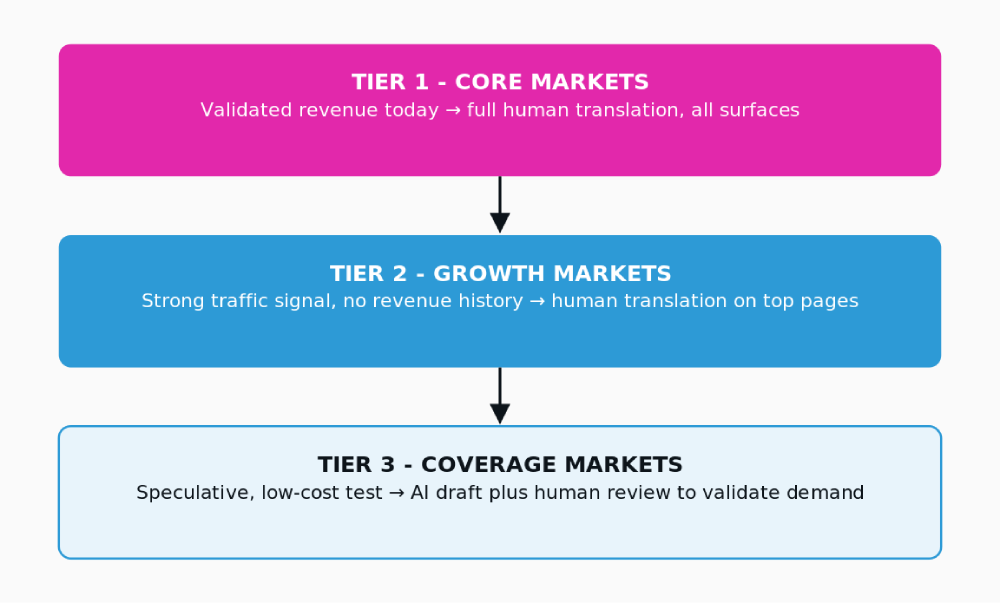
A three-tier approach to sequencing language launches, matching investment to evidence.
Tier 3 is where speed and cost matter more than polish. Testing a coverage market with an AI-assisted draft and a human linguist pass, the approach behind NexTranslate’s Economy tier pricing, keeps the cost of validating a new market low enough that a wrong guess does not sting. If the market responds, move it into Tier 2 with a fuller human translation pass.
How to score and rank candidate languages
Turn the four signals into a single weighted score so language decisions do not come down to whoever argues loudest in the planning meeting.
A simple starting formula: score each candidate market from 1 to 10 on traffic, revenue conversion, competitive whitespace, and cost to serve, then weight them (traffic 30 percent, conversion 35 percent, whitespace 20 percent, cost to serve 15 percent, with cost to serve scored so that lower complexity earns a higher number). The table below shows the method applied to five illustrative markets. Replace the scores with your own GA4 and CRM numbers before using this to make a real decision.
| Language Market | Traffic (30%) | Conversion (35%) | Whitespace (20%) | Cost to Serve (15%) | Weighted Score |
|---|---|---|---|---|---|
| German (DE) | 8 | 7 | 6 | 7 | 7.15 |
| Spanish (LatAm) | 9 | 6 | 7 | 8 | 7.35 |
| Japanese (JP) | 6 | 8 | 5 | 5 | 6.35 |
| Portuguese (BR) | 7 | 7 | 8 | 7 | 7.20 |
| French (FR) | 5 | 5 | 4 | 8 | 5.35 |
Illustrative scoring only. Substitute real GA4, CRM, and SERP data for your own markets before ranking.
Common language prioritization mistakes marketing teams make
Four mistakes account for most wasted localization budget: chasing population instead of revenue, ignoring dialect variance, localizing the product before the marketing site, and treating a launch as a one-time project.
- Chasing population size over ARPU. A market of 200 million people spending little per user can underperform a market of 20 million spending five times as much.
- Ignoring dialect variance. SaaS companies expanding into Latin America often underestimate Spanish dialect variance, treating Mexican, Argentine, and Iberian Spanish as interchangeable when pricing, payment terms, and even product terminology shift by region.
- Localizing the product before the marketing site. The homepage and pricing page are usually the highest-traffic, fastest-payback surfaces to localize, not the in-app settings menu nobody sees until after signup.
- Treating localization as a one-time launch. Product copy, help docs, and marketing pages change weekly. A framework for choosing the first language is only half the job; the other half is keeping that language current as the product ships new features.
For a deeper look at keeping translated content current after launch, see the NexTranslate guide on continuous localization for SaaS product teams.
What to localize first once a language is chosen
Sequence content by revenue proximity, not by what feels most complete. The marketing website converts new visitors immediately, the product interface retains the users you already acquired, and support content protects revenue after the sale.
- Marketing website and pricing page. Fastest path to new revenue in the new market, and the easiest surface to measure with a geography-segmented conversion report.
- Core product UI and onboarding flow. Localized signup and onboarding reduces early churn for users who already found you.
- Help center and support macros. Prevents a localized front door from dumping non-English speakers into an English-only support queue.
NexTranslate’s website and app localization and software UI translation services are built around that same sequence, so SaaS teams can localize the highest-payback surface first instead of the whole product at once.
Frequently asked questions
How many languages should a SaaS company localize into first?
Most SaaS companies should start with one to three languages, chosen from markets that already show traffic and revenue signal without localization. Adding more than three at once splits budget too thin to localize any of them well.
What data should marketing teams pull before choosing a localization language?
Pull GA4 geography and traffic data, CRM revenue and conversion by signup country, a competitive scan of who already ranks in that language, and an estimate of the operational cost to serve the market, including payments and support.
Should localization decisions be made by country or by language?
By language first, then refined by country or dialect. Spanish, Portuguese, and French each cover multiple countries with different terminology, currency, and buying behavior, so a language decision still requires a dialect and locale decision underneath it.
How long does it take to validate a new language market?
Most teams see enough conversion and engagement data within 60 to 90 days of localizing the marketing website to decide whether a Tier 3 coverage market deserves promotion to Tier 2 or Tier 1.
Is machine translation enough to test a new market?
Machine translation with a human review pass is enough for an initial coverage-tier test. It is not enough for pricing pages, contracts, or any content where an error creates legal or financial risk, which is why even entry-level localization plans typically include a human proofreading step.
Conclusion: Let demand data choose your languages, not intuition
The companies that get the best return from localization are not the ones that guess best. They are the ones that let traffic, revenue, and conversion data make the call, then match the investment to how much evidence they actually have.
That is the model behind how NexTranslate structures translation and localization services for growing SaaS companies: light-touch coverage for speculative markets, full human translation for proven ones, and pricing that scales with the risk of the content. Teams supporting the Technology & SaaS industry can pull the four signals above into a working scorecard this week, without waiting on a market research report. If it’s time to size a specific market, get a quote and NexTranslate’s team can help sequence the rollout tier by tier.
Written by: Karuppusamy Arunachalam, NexTranslate
Published: June 2026 · Filed under Global Expansion
