




A single mistranslated clause in a supplier contract once cost a manufacturer $71 million, after a court ruled that the translated version, not the original, governed the dispute. Legal document translation carries a different risk profile than a marketing blog or a product FAQ. A missed nuance in a data processing agreement, an incorrectly rendered indemnity clause, or a filing that lacks the right certification stamp can trigger rejected applications, voided contracts, regulatory fines, or years of litigation.
SaaS companies expanding into new markets run into this risk earlier than they expect. Terms of service, privacy policies, data processing agreements, employment contracts, and compliance filings all need translation the moment a company hires its first employee abroad or signs its first international customer. Most teams treat these documents the way they treat marketing copy: fast, cheap, and machine-assisted. That approach works for a blog post. It does not work for a document a regulator or a court will read literally.
This post breaks down the seven compliance risks that show up most often in legal document translation, why each one happens, and what a defensible translation process looks like for contracts, filings, and regulatory content.
1. Loss of Legal Precision in Terms of Art
Legal terms like force majeure, indemnity, and liquidated damages carry precise meanings that shift by jurisdiction, and a literal translation can quietly change what a contract actually obligates a party to do.
Close to 20 percent of errors found in translated legal documents trace back to misapplied legal terminology rather than simple vocabulary mistakes. A phrase like “reasonable efforts” carries a specific evidentiary bar in US contract law that has no exact equivalent in French or German commercial law. When a translator substitutes the nearest synonym instead of the jurisdiction-correct term, a court can end up interpreting the clause differently than the original drafter intended.
The fix: use translators with legal-domain training in both the source and target legal systems, not just fluency in both languages. General linguists, even skilled ones, rarely carry this domain knowledge.
2. Jurisdiction Mismatch Between Legal Systems
A contract translated by a linguist trained in common law concepts can misfire badly when the destination jurisdiction runs on civil law, because the two systems do not share the same structural assumptions about contracts, evidence, or liability.
Common law relies on precedent and exhaustive contractual language to cover every contingency. Civil law systems lean on codified statutes, so an over-specified common law contract can read as redundant, or even suspicious, to a civil law court, while an under-specified civil law contract translated for a common law jurisdiction can leave gaps a court will not fill in on its own. AI models trained mostly on common law text compound this problem, defaulting to common law framing regardless of the target jurisdiction.
The fix: confirm which legal system governs the destination document before translation starts, and route the work to a linguist who has practiced inside that system, not just one who speaks the language natively.
3. Machine Translation Used on Binding Content
General-purpose machine translation tools are not built for binding legal content, and running a contract, NDA, or compliance filing through one without qualified human review is one of the fastest ways to create an unenforceable document.
A 2024 technical review by the World Intellectual Property Organization found that 12 to 15 percent of international patent applications it examined contained terminology errors serious enough to affect claim scope, at an average correction cost of $80,000 to $240,000 per filing. Contracts and compliance filings see similar-quality mistakes without the review layer patent offices apply. Machine Translation Post-Editing (MTPE) closes part of this gap for lower-risk content, but ISO 18587, the international standard for post-editing machine translation output, assumes post-editors are reviewing non-critical material, not legally binding documents. That makes light MTPE the wrong process for anything that will be signed or filed.
The fix: reserve machine-assisted workflows for internal or low-risk content, and require certified human translation, with independent review, for anything that will be signed, filed, or submitted to a regulator.
4. Confidentiality and Data Protection Failures
Uploading contracts, personal data, or regulated content into a public or unauthorized AI tool for translation can itself constitute a compliance violation, independent of whether the translation is any good.
Processing personal data through unvetted AI tools can trigger General Data Protection Regulation (GDPR) penalties of up to €20 million or 4 percent of global annual turnover, whichever is higher. Data processing agreements, GDPR documentation, and internal HR files typically contain exactly the personal data categories the regulation exists to protect. A translation workflow that lacks encrypted transfer, a signed NDA, and a documented chain of custody creates a data protection exposure before a single sentence gets mistranslated.
The fix: confirm the translation provider works under NDA, uses encrypted delivery, and does not train third-party AI models on submitted documents.
5. Formatting and Certification Requirements Not Met
A legal translation can be linguistically accurate and still get rejected outright if it is missing a certificate of accuracy, a notarization, or the specific formatting a court or agency requires.
Roughly 7 percent of legal translation errors are formatting related, and formatting mistakes are disproportionately likely to cause outright rejection rather than a request for correction. Immigration filings show this clearly: US Citizenship and Immigration Services rejected close to 14 percent of applications in 2023 due to translation deficiencies, and many of those tied back to missing certification rather than translation quality itself. In major commercial centers, a rejected filing can cost $50,000 to $500,000 per week in delay, depending on the transaction.
The fix: confirm certification requirements (notarized, sworn, certified, apostilled) with the receiving court or agency before translation starts, not after submission.
6. Inconsistent Terminology Across Related Documents
When a contract, its amendments, and related compliance filings are translated by different linguists without a shared glossary, the same term can end up rendered three different ways across documents that are supposed to say the same thing.
This shows up often with SaaS companies that translate a master services agreement once, then translate country-specific addenda or renewals separately over the following years. Terminology drift is not a stylistic issue in legal content. If “personal data” is translated one way in the master agreement and a slightly different way in the data processing agreement that references it, that inconsistency can become an argument in a dispute.
The fix: maintain a locked glossary and Translation Memory (TM) for every ongoing legal relationship, so recurring terms are translated identically no matter who does the work or when. NexTranslate’s broader translation and localization services apply this same glossary discipline across every document type, not just legal filings.
7. No Audit Trail for Quality Assurance
A translation might be accurate, but if the review process behind it was not documented, it is hard to defend that accuracy later if a dispute or regulatory audit calls it into question.
Regulated industries increasingly expect translated documents to be traceable: who translated it, who reviewed it, what changed between drafts, and what checks ran before delivery. This is the same governance standard companies already apply to financial audits. Without it, a translation is defensible only as long as no one asks how it was produced. Linguistic Quality Assurance (LQA) processes exist specifically to create this record.
The fix: require a documented review trail, ideally through structured LQA, for any translated content that could end up in front of a regulator, auditor, or court.
The Seven Compliance Risks at a Glance
| Risk | Why It Happens | How to Avoid It |
|---|---|---|
| Loss of legal precision | Terms of art vary by jurisdiction. | Use translators trained in the relevant legal system. |
| Jurisdiction mismatch | Common law and civil law frameworks are conflated. | Match linguists to the destination legal system. |
| Unreviewed machine translation | MTPE is used on binding legal content. | Route contracts and filings to certified human translation. |
| Confidentiality and data exposure | Personal or sensitive data is processed through open AI tools. | Use NDA-bound, encrypted translation workflows. |
| Formatting and certification gaps | Missing stamps, certificates, or notarization requirements. | Confirm certification requirements before filing. |
| Inconsistent terminology | No shared glossary across related legal documents. | Maintain a locked glossary and translation memory. |
| No audit trail | Quality assurance steps are not documented. | Perform linguistic QA with a documented review process. |
A quick-reference map from risk to root cause to fix. Details for each risk are covered above.
What a Defensible Legal Translation Process Looks Like
A defensible legal translation process runs binding content through four checkpoints: an AI-assisted first draft, a legal-trained human translator, an independent QC or LQA review, and certified or notarized delivery.
Each checkpoint closes a specific gap from the list above. The AI draft speeds up the first pass without replacing human judgment. The legal-trained translator restores precision and jurisdiction fit. The independent review catches what a single linguist misses and creates the audit trail regulators expect. Certification and notarization satisfy the formatting rules a court or agency will check first, before it ever reads the content.
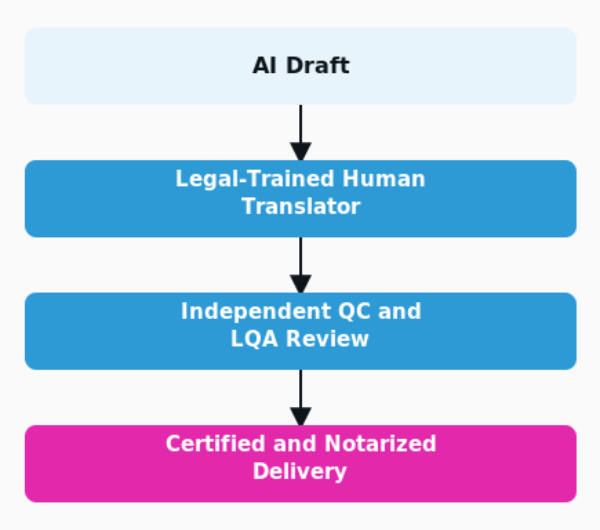
The four-checkpoint workflow behind a defensible legal translation, from AI draft to certified delivery.
This is close to how NexTranslate structures its Premium tier for legal, healthcare, and finance content: a specialized native translator, an independent reviser, and a dedicated QC expert on every file, at transparent translation pricing with no separate proofreading charge.
Frequently Asked Questions
What is legal document translation compliance risk?
It is the risk that a translated contract, filing, or regulated document fails to hold up because of terminology errors, jurisdiction mismatches, missing certification, or an undocumented review process. The result can be a rejected filing, an unenforceable clause, or a regulatory fine.
Is machine translation acceptable for legal documents?
Only for low-risk, non-binding content. Binding contracts, filings, and compliance documents need certified human translation with independent review, since machine translation on its own cannot guarantee jurisdiction-correct terminology or a defensible audit trail.
What is the difference between certified and notarized legal translation?
A certified translation includes a signed statement of accuracy from the translator or agency. A notarized translation adds a notary public’s verification of that signature. Courts and government agencies specify which one they require, and the two are not interchangeable.
How much can legal translation errors cost?
Costs vary widely by document type and market. Patent filing corrections have averaged $80,000 to $240,000 per filing, and delayed transactions in major commercial centers have cost $50,000 to $500,000 per week. Contract disputes tied to mistranslation have run into the tens of millions.
How is legal translation different from standard business translation?
Legal translation requires linguists trained in the relevant legal systems, strict terminology consistency, formal certification, and a documented QA trail. Standard business translation, such as marketing copy, prioritizes tone and readability over jurisdiction-specific precision.
Conclusion: Compliance Risk in Legal Translation Is a Process Problem
None of the seven risks above come down to a single bad translator. They come down to a process that skips a checkpoint: no jurisdiction match, no independent review, no glossary, no documented QA trail. Fixing the process fixes the risk.
For contracts, filings, and compliance content that will be signed, submitted, or read by a regulator, that process is worth building in from the start rather than patching after a rejected filing or a disputed clause. NexTranslate’s legal document translation services combine legal-trained linguists, jurisdiction-matched review, and certified delivery in one workflow. Teams evaluating a provider for their next filing or contract cycle can request a quote to see how the process applies to their specific documents.
Written by: Karuppusamy Arunachalam, NexTranslate
Published: June 2026 · Filed under Industry Use Cases
