




The Complete Guide to Industry-Specific Localization: Compliance, Accuracy, and Market Fit by Sector

A SaaS company translates its investor deck and its onboarding emails through the same workflow, and only one of those documents costs anyone money when a phrase lands wrong. That is the mistake most growing companies make with global content: they treat translation as a single service instead of a spectrum of risk. A marketing headline that reads slightly off in Portuguese costs a click. A mistranslated liability clause in a customer contract costs a lawsuit.
The service level a company needs depends entirely on what the content is and who is regulating it, not on how the company happens to be organized internally. Legal filings, clinical trial documents, and financial disclosures carry legal exposure. Marketing copy, help center articles, and internal wikis carry reputational risk but rarely legal risk. Treating both categories the same way either overspends on content that did not need it or underspends on content that absolutely did.
This guide breaks down six sectors, legal, healthcare, finance, e-commerce, technology, and gaming, and shows what accuracy, compliance, and market fit actually require for industry-specific localization services. It closes with a practical framework for matching any piece of content to the right review depth, so localization budget goes where the risk actually lives.
Why Industry Context Changes What “Good” Translation Means
“Good” translation is not a fixed quality bar. It shifts depending on what happens if the translation is wrong, who reads it, and which regulator might ask to see it later.
A blog post that reads slightly awkward in French still converts a reader. A patient instruction leaflet that reads slightly awkward in French can lead to a dosing error. Both pass a basic fluency check. Only one of them meets the bar its industry actually requires. Compliance standards compound this. Healthcare content answers to HIPAA and equivalent regional frameworks. Financial content answers to reporting and disclosure rules that vary by jurisdiction. Legal content answers to the enforceability of the underlying document itself, so a translation error is not just a quality issue, it is a contract issue.
Before scoping a localization project, the first question is not “how many words” but “what is this content, and what breaks if it is wrong.”
How Translation Risk Differs by Sector
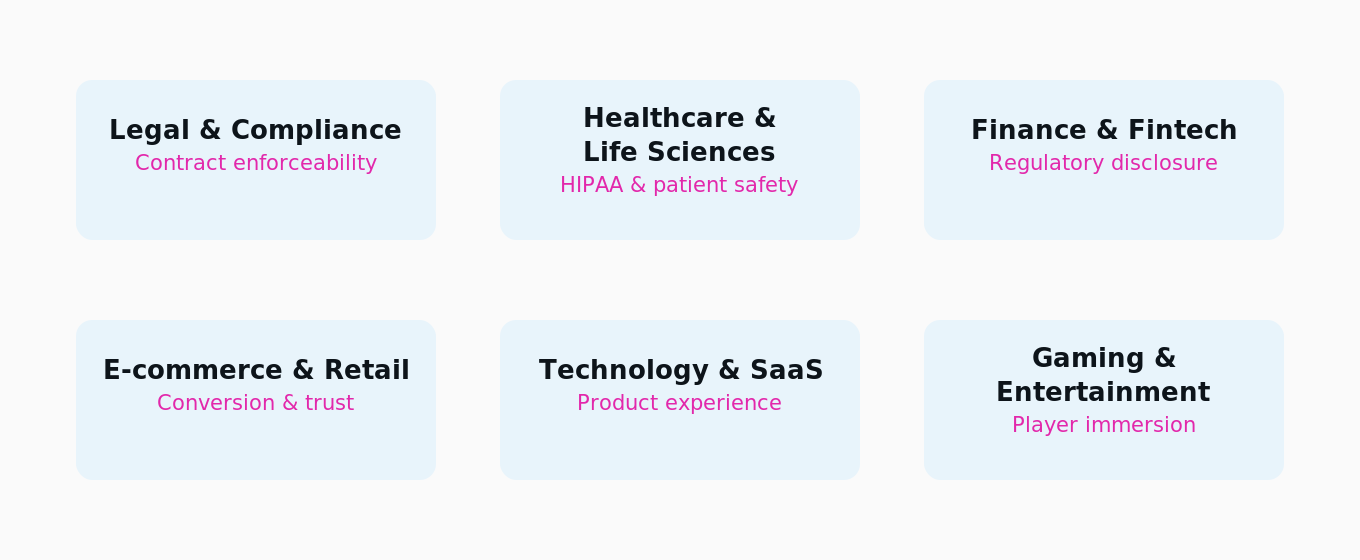
Six sectors carry the clearest and most distinct translation risk profiles: legal, healthcare, finance, e-commerce, technology and SaaS, and gaming. Each has its own compliance trigger, tolerance for error, and typical content mix.
| Sector | Primary Pain Point | Compliance Driver | Recommended Tier |
|---|---|---|---|
| Legal & Compliance | Unenforceable translated contracts | Court/regulator reliance on translated text | Premium |
| Healthcare & Life Sciences | Patient safety errors | HIPAA, clinical accuracy | Premium |
| Finance & Fintech | Regulatory disclosure drift | Financial reporting standards | Premium |
| E-commerce & Retail | Lost conversions at scale | Checkout & payment terms | Economy / Professional |
| Technology & SaaS | Broken product trust | Release cadence, UI consistency | Professional |
| Gaming & Entertainment | Broken player immersion | Regional content sensitivities | Professional |
A quick-reference map from sector to primary risk driver to the NexTranslate tier that typically fits.
Legal & Compliance
Legal translation risk comes from enforceability. A contract translated inaccurately can become unenforceable or create liability the original document never intended.
Contracts, NDAs, privacy policies, and government filings all carry legal weight in the target language, not just the source language. Regulators and courts in the destination market often treat the translated version as the operative document, so terminology consistency and certified translation matter more than stylistic fluency. NexTranslate’s legal and compliance translation services pair specialized native linguists with independent revisers on every regulated document, matching the Premium tier’s dedicated QC expert and custom SLA structure.
Any document a court, regulator, or counterparty might rely on belongs at the highest review tier, no exceptions for turnaround pressure.
Healthcare & Life Sciences
Healthcare translation risk is a patient safety risk first and a compliance risk second. A single mistranslated dosage instruction or clinical trial term can cause real harm.
Medical records, clinical trial documentation, regulatory submissions, and patient-facing materials require medically trained linguists who understand both the source terminology and how it maps to region-specific clinical standards. HIPAA and equivalent regional privacy frameworks govern how patient data moves through the translation workflow itself, not just the final document. Machine Translation Post-Editing can support high-volume triage content, but every clinically significant document needs human clinical review before it ships. NexTranslate’s guide to professional medical translation services covers the accuracy standards this sector requires in more depth.
Route anything that touches a clinical decision or a regulatory submission through certified, medically trained review, never through AI output alone.
Finance & Fintech
Financial translation risk centers on regulatory disclosure accuracy. A translated investor document or compliance filing that drifts from the source can expose a company to regulatory penalties in the target market.
Financial reports, investor materials, compliance documentation, and banking or insurance product content each answer to reporting standards that differ by country. Numbers, currency formats, and legal disclaimers need exact terminology consistency, and even small inconsistencies in how a term is rendered across documents raise flags with regulators or auditors. NexTranslate’s breakdown of AI translation in finance goes further into why speed without human review of regulatory language creates exposure that outweighs the time saved. NexTranslate’s financial translation services are built around that Premium-tier review depth by default.
Treat any fintech or financial content with a compliance filing attached as Premium-tier content by default.
E-commerce & Retail
E-commerce translation risk is mostly a conversion risk, not a legal one, but it compounds fast because product catalogs run into the thousands of SKUs.
Product listings, checkout flows, and promotional content need to read naturally and locally, not just accurately. A literal translation of a product description can be grammatically correct and still fail to convert, because it misses the cultural framing that makes a shopper trust a listing. NexTranslate’s e-commerce and retail localization work benefits from a blended workflow: AI-assisted drafts for high-volume catalog content with human review for anything customer-facing at checkout, where trust and legal terms intersect.
Prioritize human review on checkout, payment, and return-policy content even when catalog descriptions run through a lighter-touch tier.
Technology & SaaS
SaaS translation risk shows up as product risk. A mistranslated UI string or error message breaks the user’s trust in the product itself, not just the copy.
Product documentation, in-app content, onboarding flows, and release notes need to stay in sync with an engineering release cadence that ships weekly or faster. NexTranslate’s technology and SaaS localization depends on Translation Memory and terminology management to keep UI strings consistent across a growing codebase, and on a workflow that can absorb continuous small updates without a slow, manual review cycle for every string.
Build translation memory and glossary management into the workflow from day one, retrofitting consistency across a large SaaS product later is expensive.
Gaming & Entertainment
Gaming translation risk is a player experience risk. Dialogue, humor, and cultural references that do not land in a target market break immersion even when the literal translation is correct.
In-game text, dialogue, app store listings, and community content all need to feel native rather than translated, which usually means transcreation rather than direct translation for narrative content. NexTranslate’s gaming and entertainment localization work also has to account for text expansion in UI elements, subtitle timing constraints, and region-specific content sensitivities that vary widely by market.
Budget for creative adaptation, not just linguistic accuracy, anywhere a game’s tone or humor carries the experience.
The AI + Human Workflow That Adapts to Industry Risk
The same four-stage workflow, AI Draft, Human Refinement, AI Quality Assurance, and Final Approval, scales up or down in review depth depending on the sector, without changing its basic shape.
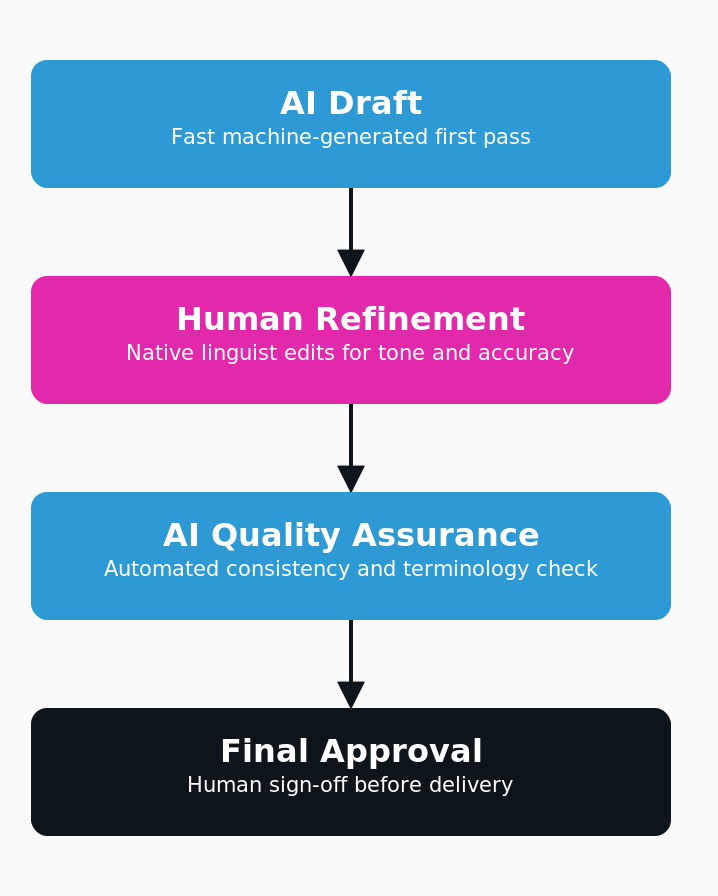
For low-risk content like a marketing blog, the workflow can move quickly through each stage with a single human reviewer. For regulated content like a clinical trial document, the same four stages expand: Human Refinement becomes a specialized native translator, AI Quality Assurance is paired with Linguistic Quality Assurance conducted by an independent linguist, and Final Approval includes a dedicated project manager signing off against a custom SLA. The stages do not change. The depth of human involvement at each stage does. Machine Translation Post-Editing sits inside the AI Draft and Human Refinement stages, and how “light” or “full” that post-editing needs to be depends on exactly the sector risk profile covered above.
The workflow is the same architecture end to end. What changes by industry is how many trained eyes touch each stage before anything ships.
Matching Content Risk to Review Depth: A Decision Framework
Three questions determine the right review depth for any piece of content: does an error create legal exposure, does it affect patient or user safety, and does a regulator or court ever see the translated version.
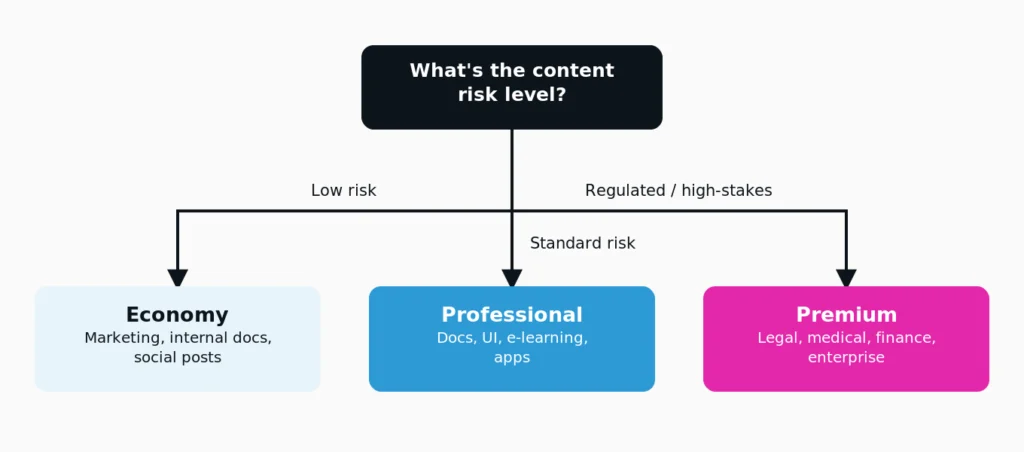
Content that answers no to all three questions, most marketing copy, internal communications, and social posts, fits the Economy tier: AI-assisted translation with human linguist review and basic proofreading, delivered in 24 to 48 hours. Content that answers no to legal and safety but touches the product experience directly, documentation, UI strings, e-learning material, fits the Professional tier: a native human translator with editor review and a human quality check on terminology and numbers. Content that answers yes to any of the three questions, legal contracts, medical records, financial disclosures, enterprise software localization, belongs in the Premium tier: a specialized native translator, an independent reviser, a dedicated project manager, and a QC expert working against a custom SLA.
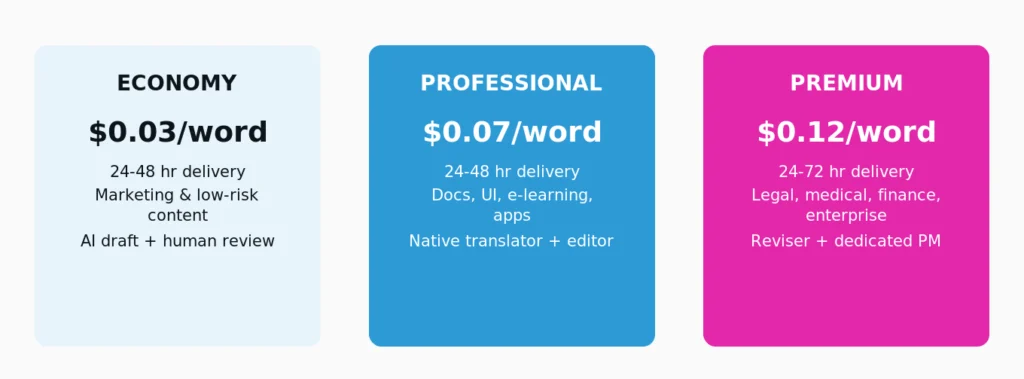
NexTranslate publishes this tiering openly rather than negotiating it deal by deal. Human proofreading is included at every tier by default, where many providers charge $0.02 to $0.05 per word extra for the same step, which is one of the reasons the transparent three-tier pricing model tends to save 30 to 40 percent in total project cost once proofreading is factored in.
Score the content against the three questions before requesting a quote, and the right tier becomes obvious before price ever enters the conversation.
What to Look for in a Localization Partner for Regulated Content
Four things separate a partner that can safely handle regulated content from one that cannot: subject-matter certified linguists, a documented quality assurance process, confidentiality workflows, and transparent pricing with no hidden proofreading fees.
- Certified, subject-matter linguists: not just native speakers, but translators trained in the specific domain (legal, medical, financial) with verifiable credentials.
- Documented QA process: a defined Linguistic Quality Assurance step performed by someone other than the original translator, following recognized standards such as ISO 18587 for post-edited machine translation.
- Confidentiality and NDA workflows: especially for legal, financial, and healthcare content that includes personally identifiable or commercially sensitive information.
- Transparent pricing: a published rate card beats a quote that arrives after a sales call, and proofreading should never be an unadvertised add-on.
Ask any localization vendor to show, not just tell you, how their QA step works before handing over regulated content.
Frequently Asked Questions
1. What makes industry-specific translation different from general translation?
Industry-specific translation accounts for the compliance standards, terminology, and consequences of error that are unique to a sector, not just the language pair. General translation optimizes for fluency; industry-specific translation optimizes for fluency plus regulatory and contextual accuracy.
2. Which industries require certified or notarized translation?
Legal, government, and many healthcare and financial documents typically require certified translation, and some jurisdictions require notarization on top of that. Certified translation services use specialist linguists and a verification step that standard translation does not include.
3. Can AI alone handle regulated industry content?
No. AI-only translation can draft regulated content quickly, but every clinically, legally, or financially significant document needs human review before it ships, because AI models are not accountable for compliance outcomes the way a certified human linguist and reviser are.
4. How do I know which NexTranslate pricing tier fits my content?
Score the content against three questions: does an error create legal exposure, does it affect user or patient safety, and could a regulator or court see the translated version. Any yes points to Premium; all no usually points to Economy or Professional depending on how product-critical the content is.
5. Do you follow industry compliance standards like HIPAA and GDPR?
Yes. NexTranslate’s regulated-content workflows are built around HIPAA for medical content, GDPR for data handling, and ISO translation standards, with NDA-bound workflows available at no extra cost.
6. How long does industry-specific localization typically take?
Economy and Professional tier content typically delivers in 24 to 48 hours. Premium tier content, which involves an independent reviser and dedicated project manager, typically delivers in 24 to 72 hours depending on document complexity and volume.
Conclusion: Match the Review, Not Just the Language
Industry-specific localization is not about buying a bigger service tier across the board, it is about routing each piece of content to the review depth its actual risk requires. A company that runs its investor deck and its blog through the same workflow is either overspending on one or exposing itself on the other. The sector frameworks above, paired with the three-question risk test, give any team a repeatable way to make that call without guessing.
We built NexTranslate’s three-tier structure specifically so that risk-appropriate review is not a negotiation, it is a published default. Explore the full range of industry translation and localization services, or get a quote for a specific project to see how the framework applies to your content mix.
- Filed under / Industry Use Cases