





The Complete Guide to SaaS Global Expansion: Markets, Languages, and a Localization Strategy That Scales

Most SaaS companies discover international demand before they are ready to serve it. Signups appear from Germany, Brazil, and Japan. Trials start in languages the product does not speak. The dashboard shows the demand, and the conversion rate quietly shows the cost of ignoring it. Free trials from non-English markets convert at a fraction of the domestic rate, and nobody can quite say why.
The instinct is to translate the interface and call it done. That instinct is why so many expansion efforts stall. Going global is not a translation task bolted onto a finished product. It is a sequence of decisions about which markets to enter, which languages to prioritize, how to prepare the product to be localized at all, and how to keep every language current as the product ships. Done in the wrong order, each step undoes the last.
This guide lays out that sequence end to end. It is written for founders, heads of product, and growth leaders who can see the international demand and want a strategy that converts it into revenue without drowning the engineering team or the budget. Each section links to a deeper resource where the topic deserves its own playbook.

The SaaS global expansion sequence. Each stage depends on the one before it, which is why order matters more than speed.
Why global expansion stalls without localization
SaaS expansion stalls when companies treat a global product as an English product with more users. The barrier is rarely the product itself. It is that buyers in new markets will not adopt what they cannot fully understand or trust in their own language.
The data is consistent across a decade of research. CSA Research has repeatedly found that a large majority of consumers prefer to buy in their own language, and that a significant share will not buy at all from an English-only experience. For self-serve SaaS, that translates directly into trial-to-paid conversion. A product that is technically available worldwide but linguistically available in one language is leaving most of its addressable market on the table.
The fix is to treat localization as core to the expansion strategy, not as a downstream chore. That starts with understanding the difference between simply translating a product and truly localizing it, which the breakdown of SaaS translation vs localization covers in depth.
When should a SaaS company start localizing?
Start localizing when meaningful signups or paying customers already come from a market where the product is not in the local language. For most product-led SaaS, that signal appears earlier than teams expect, often inside the first year of self-serve growth.
Waiting for a market to be large before serving it creates a chicken-and-egg problem. The market stays small precisely because the product does not speak its language. The better trigger is directional, not absolute. If a non-English market is generating trials, engagement, or inbound interest despite the language barrier, that is latent demand being suppressed, and it is the strongest possible signal to localize.
The practical rule: watch where organic signups originate, and localize into the first market that shows demand you are not yet capturing. Do not wait for a perfect business case. The suppressed conversion is the business case.
How to choose which markets to enter first
Choose markets by weighing demand against effort, not by market size alone. The best first markets are where you already see pull and where the cost to localize and support is manageable.
A large market with heavy regulatory, payment, and support requirements can be a worse first choice than a smaller market where your product already has traction and the operating overhead is light. Score candidate markets on existing demand signals, revenue potential, competitive whitespace, and the real cost of entry, which includes localization volume, payment and tax complexity, support-language coverage, and any compliance burden. Then sequence, do not spread. Entering one market well beats entering five poorly.
A simple market-scoring model
| Factor | What to Look For | Weight |
|---|---|---|
| Existing Demand | Signups, trials, inbound from the market | High |
| Revenue Potential | Market size and willingness to pay | High |
| Competitive Gap | Weak local or localized competition | Medium |
| Localization Effort | Content volume, language difficulty | Medium |
| Operating Cost | Payment, tax, support, compliance | Medium |
Score each candidate market on these factors. The first market to enter is the one that scores high on demand and revenue while staying manageable on effort and cost.
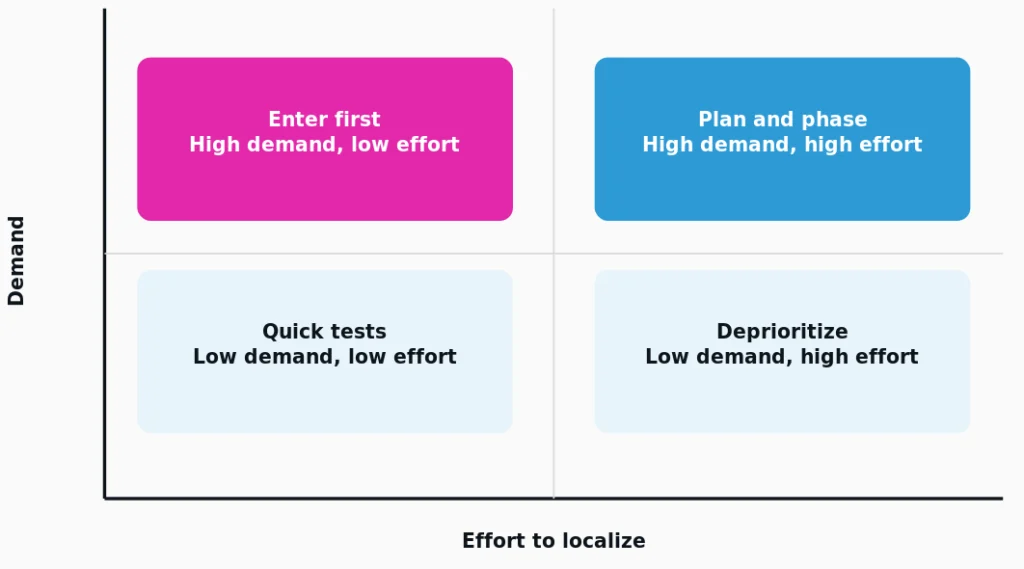
Plot each market on demand against effort. Enter the high-demand, low-effort quadrant first, then phase the high-demand, high-effort markets.
How to choose which languages to prioritize
Prioritize languages by the revenue they unlock per unit of effort, starting with the ones that combine strong demand with broad reach. A common starter set for B2B SaaS in 2026 is Spanish, German, and Brazilian Portuguese or French, with Japanese as a deliberate phase-two investment. The full method is laid out in the guide to which languages to localize first.
Language choice is not the same as market choice, because one language can serve many markets. Spanish opens most of Latin America plus Spain. Brazilian Portuguese unlocks a large single market. German tends to over-index on willingness to pay for B2B tools. Japanese carries a high lifetime value but demands more localization care, which is why it usually belongs in a second wave, after the lighter wins are banked. Dialect matters too. Latin American Spanish and European Spanish are not interchangeable in a product that wants to feel native.
The concrete takeaway: bank the high-reach, lower-effort languages first to fund the harder ones, and match dialect to the specific markets you are actually serving.
The internationalization foundation that makes localization possible
Internationalization (i18n) is the engineering work of separating user-facing text and locale-specific formatting from the codebase, so content can be translated without touching code. Without it, localization does not scale, because every translation becomes an engineering ticket. The practices are covered in detail in the guide to SaaS internationalization (i18n) best practices.
i18n is the foundation everything else sits on. It means externalizing strings into resource files, handling plurals and gender correctly, supporting different date, number, and currency formats, leaving room for text expansion in longer languages, and building for right-to-left scripts where relevant. Retrofitting i18n after launch is far more expensive than building it in, but even retrofitted, it is the prerequisite that turns localization from a manual scramble into a repeatable pipeline.
The takeaway for leaders: fund the i18n work before committing to launch dates. It is invisible to users and decisive for everything that follows.
The AI plus human model: speed without sacrificing trust
The localization model that scales for SaaS combines AI speed with human judgment, rather than choosing one. Pure machine translation is fast but risky on anything customer-facing. Pure human translation is accurate but too slow and costly for continuous product content. The hybrid model routes each content type to the right level of website and app localization effort.
In practice this means AI produces the first draft at scale, human linguists refine for tone, terminology, and cultural fit, an automated quality pass checks consistency, and a final human approval ships the result. Bulk, low-risk strings move quickly through lighter review, while marketing copy, legal text, and high-visibility screens get full human attention. That routing is what lets a team localize a large product surface without either blowing the budget or shipping errors into the market.

Keeping every language current with continuous localization
Continuous localization is the practice of translating product content as it is written, so new features ship in every language at close to the same time as the source. It is what prevents the slow drift back into a half-translated product. The mechanics are detailed in the guide to continuous localization for SaaS product teams.
A one-time translation goes stale the moment the next release ships. New strings appear in English, a settings page updates in the source locale only, and within weeks the product is inconsistent again. Continuous localization solves this by wiring engineering to a Translation Management System (TMS) so new and changed strings flow into localization automatically, get human review where it matters, and land back in production within days. The translation stream runs in parallel with development rather than blocking it.
For a complete operational view of how product-led teams run this end to end, the SaaS localization 2026 playbook ties the market, language, and workflow decisions into a single rollout.
Measuring expansion ROI market by market
Measure localization ROI by treating each market as its own funnel with its own conversion, retention, and revenue, not as a single global average. A blended number hides which markets are working and which are quietly failing.
The metrics that matter are per market: trial-to-paid conversion before and after localization, activation and retention by locale, support ticket volume in the local language, and revenue contribution per market against the cost to serve it. When a market underperforms, the funnel view usually points to the cause: an untranslated checkout, missing local payment methods, or support that does not operate in the buyer’s language. Managed against a per-market scorecard, localization stops being a cost line and becomes a measurable growth lever.
A phased rollout that does not overwhelm the team
Roll out in phases that each deliver a working, fully localized market before starting the next. Phasing protects quality and cash flow, and it lets each market fund the one after it.
A practical four-phase rollout
| Phase | Focus | Outcome |
|---|---|---|
| 1. Foundation | i18n, TMS, first pilot language | One market live and instrumented |
| 2. First Wave | 2 to 3 high-reach languages | Core markets converting |
| 3. Continuous | Wire localization to releases | Every language stays current |
| 4. Expansion | Phase-two languages, verticals | Scaled, measured growth |
Each phase completes a market before the next begins. Speed comes from repeatability, not from launching everything at once.
The discipline that ties the whole guide together is sequencing. Validate demand, build the i18n foundation, launch a first wave of high-reach languages, make localization continuous, and only then expand into harder markets. Skipping a step does not save time. It creates rework that costs more than the step would have.
Frequently Asked Questions
1. What is SaaS global expansion?
SaaS global expansion is the process of taking a software product into new international markets, which requires adapting the product, content, and go-to-market to each market’s language, culture, and regulations. It is broader than translation and depends on a localization strategy that scales with the product.
2. How do you decide which markets to enter first?
Weigh demand against effort. The best first markets combine existing demand signals and revenue potential with a manageable cost to localize and support. A smaller market where your product already has traction often beats a larger one with heavy regulatory and operational overhead.
3. Which languages should a SaaS company localize into first?
Prioritize languages that combine strong demand with broad reach. A common 2026 starter set for B2B SaaS is Spanish, German, and Brazilian Portuguese or French, with Japanese as a phase-two investment. The full method is in the guide to which languages to localize first.
4. Do you need internationalization before localizing?
Yes. Internationalization (i18n) separates user-facing text and locale formatting from the codebase so content can be translated without engineering rework. Without it, every translation becomes a code change and localization cannot scale. i18n is the prerequisite for a repeatable localization pipeline.
5. How do you keep a product localized as it keeps shipping?
Use continuous localization. New and changed strings flow automatically from engineering into a Translation Management System, get human review where needed, and ship back into production within days. The approach is detailed in the guide to continuous localization for SaaS product teams.
Conclusion: expansion is a sequence, not a switch
Global expansion fails when it is treated as a single decision to flip the product into more languages. It succeeds when it is treated as a sequence: validate where demand already exists, choose markets by demand against effort, prioritize languages by reach and revenue, build the i18n foundation, adopt an AI plus human model for speed with trust, make localization continuous, and measure every market on its own funnel. Each step earns the right to the next.
NexTranslate helps SaaS companies run this sequence end to end, from first market to continuous localization at scale, with a hybrid AI plus human model and transparent translation pricing. To map your own expansion sequence, explore the technology and SaaS translation services page or request a localization quote to price your first markets.
- Filed under / Industry Use Cases