




The Complete Guide to Professional Translation Services: Types, Process, and How to Buy
-
Karuppusamy Arunachalam
- August 26,2026
Every translation vendor page makes the same four promises: native speakers, subject matter experts, rigorous quality assurance, fast turnaround. The same four promises appear at three cents a word and at thirty cents a word. Nothing on those pages explains the gap.
The production model underneath the label changed while the label stayed still. The global language services market was worth USD 72.6 billion in 2025 and is projected at USD 73.4 billion for 2026, growing at under one percent a year, according to the Nimdzi 100. Across the same period, output per employee at the largest providers rose 73.6 percent, while many of them cut in-house linguistic and project management headcount by 20 to 25 percent. The industry did not get bigger. It got faster, by putting machines in front of people and keeping people accountable for what ships.
That shift is what a buyer now has to evaluate, and vendor marketing has not caught up to it. This guide covers what a professional translation service includes in 2026, the four provider types and what each is genuinely good at, the five stages of production, what the work costs and what moves the price, and a procurement sequence that works.
What counts as a professional translation service in 2026
A professional translation service is one where a named, qualified human linguist is accountable for the final text, whether or not a machine produced the first draft. Accountability is the line. The presence of AI is not.
Two ISO standards draw that line precisely, and the difference between them is the most useful thing a first-time buyer can learn. ISO 17100 covers human translation services and requires two qualified people on every job, a translator who produces the text and an independent reviser who checks it against the source. ISO 18587 covers post-editing of machine-translated content and defines two output levels: light post-editing, which makes the text accurate and understandable, and full post-editing, which brings machine output up to the quality expected of human translation. Both describe legitimate professional workflows. What sits outside both is raw machine output published with no reviser at any level and sold as a service.
The practical move is to stop asking vendors whether they use AI, because in 2026 effectively all of them do. Ask instead which standard each content type in your account maps to, and who signs off on it. A vendor who answers that question with one workflow for everything is selling a single production line and hoping your content fits it.
| Standard | What it covers | Required roles | Ask for it when |
|---|---|---|---|
| ISO 17100 | Human translation services end to end | Qualified translator plus independent reviser | Meaning, tone or liability sit on the text |
| ISO 18587 | Post-editing of machine-translated content | Qualified post-editor, light or full level | Volume is high and business risk is contained |
| Neither | Raw machine output, no human sign-off | None named | Never, for anything a customer will read |
What is included under professional translation services
Professional translation services is an umbrella term covering several distinct service lines, and most companies need three or four of them rather than one. Buying the wrong line is one of the more expensive mistakes in this category, because the work gets delivered, it just does not do the job it was bought for.
Three distinctions carry most of the confusion. Transcreation is not translation: a translator preserves the message, a transcreator rewrites it to land the same way on a different audience, which is why campaign taglines come back unrecognisable and are usually priced per concept or per hour rather than per word. Linguistic quality assurance (MTPE) is a workflow rather than a quality level, and it produces either light or full output depending on what was specified in the brief. Linguistic quality assurance (LQA) is a check rather than a production service, bought either as a final gate inside a workflow or as a standalone audit of translations another vendor delivered.
Name the service line explicitly in any brief or RFP. A request for translation of marketing content, when what was actually wanted was transcreation, produces an accurate translation of a headline that no longer works, and a debate about quality that neither side can win.
| Service line | What it covers | You need it when |
|---|---|---|
| Translation and localization | Core text conversion plus cultural adaptation | Any content crossing a language border |
| Website and app localization | Site and app content, metadata, layout handling | Customers evaluate or buy in-language |
| Software UI translation | Interface strings, error states, character limits | The product itself ships in other languages |
| Transcreation | Creative rewriting for a new audience | Campaigns, taglines, brand voice |
| MTPE | Human editing of machine output, light or full | Volume is high and risk is contained |
| LQA | Independent scored review of finished translations | Regulated content, or auditing another vendor |
| Multilingual content management | Ongoing workflow, memory and terminology ownership | Content changes every sprint, not once |
The four provider types, and what each is genuinely good at
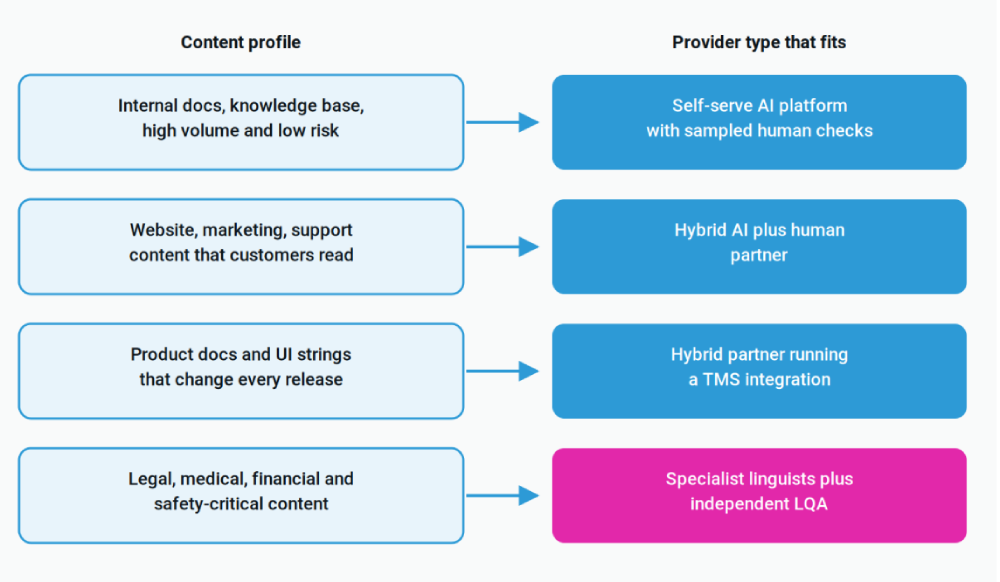
Four provider types serve this market: independent freelancers, traditional agencies, self-serve AI platforms, and hybrid partners that run machine drafting and human review inside one workflow. The right choice follows content risk, not budget.
Freelancers are strongest on a single language, a stable subject and low volume, and weakest the moment volume scales or a second language appears, because there is no revision layer unless the buyer hires and manages one. Traditional agencies supply project management and an independent reviser, but historically price every word at human rates, which makes bulk low-risk content expensive enough that it simply goes untranslated. Self-serve AI platforms invert that trade: strong unit economics, no accountable reviser, and no memory of terminology decisions from one project to the next.
Hybrid partners run professional translation services with machine drafting and human refinement in a single pipeline, which is why the model spread quickly across the industry. It is also the category where claims vary most, so the hybrid AI plus human workflow a vendor describes should be checked against what they can actually show you. The routing test underneath all four options is simple: if an error in a piece of content would cost more than the content cost to produce, it needs a human reviser. Everything else can start as a machine draft.
| Provider type | Best for | Weak point | Who is accountable |
|---|---|---|---|
| Freelancer | One language, stable subject, low volume | No revision layer, no capacity to scale | The individual |
| Traditional agency | Regulated and high-exposure content | Human rates on every word, slower cycles | Named PM and reviser |
| Self-serve AI platform | Internal and evergreen bulk content | No accountable reviser, no shared memory | Nobody |
| Hybrid partner | Mixed content at mixed risk levels | Claims vary widely, verify before signing | Platform plus named linguist |
How professional translation is actually produced
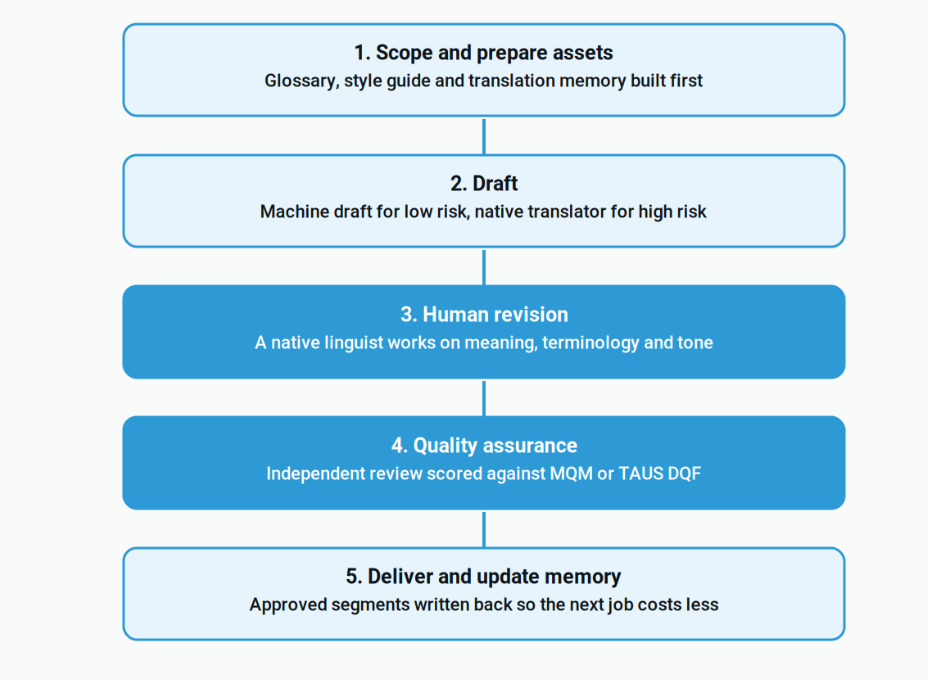
Professional translation runs through five stages: scope and asset preparation, drafting, human revision, quality assurance, and delivery with a memory update. Vendors differ most in how much of stage one and stage five they do, and that is usually where quality differences originate, not in the drafting itself. Any credible managed translation and localization workflow runs all five.
Stage one sets the cost of every later project. A glossary, a style guide and a translation memory (TM) built at the start, usually held inside a translation management system (TMS), mean the second project reuses the first project’s decisions instead of relitigating them. Stage two produces the draft, by machine for low-risk content or by a native translator for high-risk content. Stage three is where MTPE sits, with a human linguist working on meaning, terminology and tone rather than retyping text. Stage four is LQA, a separate review scored against a framework such as MQM or TAUS DQF, where errors are classified critical, major or minor rather than listed as opinions. Stage five delivers the files and writes approved segments back into memory, so the asset appreciates instead of evaporating.
Ask a vendor to describe stages one and five specifically. Almost everyone can describe two, three and four. The providers who own the glossary and the memory, and hand them back on request, are the ones whose effective cost per word falls over the life of the relationship.
What professional translation costs, and what moves the price
Professional translation runs from roughly USD 0.03 to USD 0.30 per word in 2026, and the workflow being bought moves that number more than the language pair does. A less common language on a light post-editing workflow often costs less than English into Spanish with an independent reviser and a dedicated project manager attached.
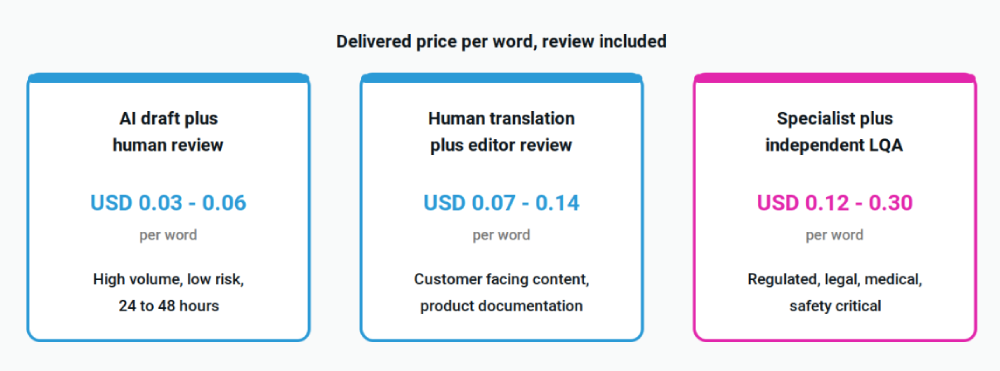
The trap sits outside the per-word number. Many providers quote a translation rate and bill proofreading separately at USD 0.02 to 0.05 per word, so the quote that looked cheapest at signature is not the cheapest at invoice. NexTranslate publishes its per-word rates with human proofreading included at every tier, which is a deliberate answer to that pattern. Whoever the vendor is, normalise every quote to a delivered price with review included, then compare.
The number that matters over a year is not the first project, it is the recurring one. A SaaS company translating a product that ships every two weeks pays for the same content repeatedly unless approved segments are stored and reused. With a maintained memory, the second year of a locale typically costs meaningfully less than the first for the same volume, because only genuinely new text is charged at full rate. Without one, year two costs the same as year one, and the vendor has no incentive to change that. This is why the ownership question in the procurement sequence below is a pricing question rather than a legal formality.
| Factor | Effect on price | Why it moves |
|---|---|---|
| Workflow tier | Largest single factor | Number of human passes over the text |
| Subject matter | Higher in regulated fields | Specialist linguists, smaller pool |
| Language pair | Higher for low-resource languages | Fewer qualified linguists available |
| Turnaround | Plus 20 to 30 percent for urgent | Out-of-hours capacity, parallel splitting |
| Repetition and memory | Falls over time | Approved segments reused, not re-translated |
| Formatting and DTP | 0.01 to 0.02 / word | Layout rebuilt after text expansion |
Routing content with the NEX Translation Matrix
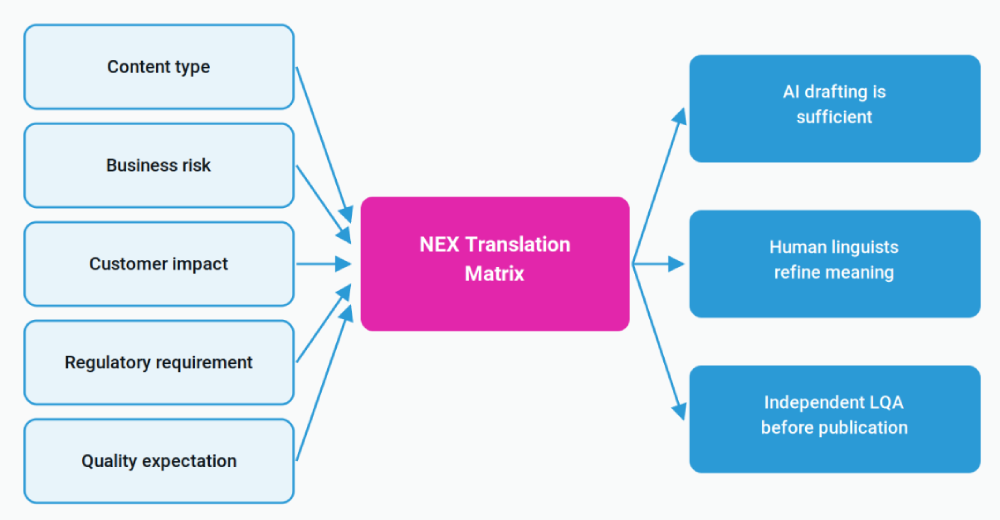
Applying one workflow to all content overpays on the low-risk material and underprotects the high-risk material at the same time. The NEX Translation Matrix™ scores each piece of content on five inputs and routes it to one of three workflows.
The five inputs are content type, business risk, customer impact, regulatory requirement and quality expectation. The three outcomes are that AI drafting is sufficient, that human linguists refine meaning, or that independent LQA is required before publication.
The rule that makes it work is that it routes content, not projects. A single product release usually produces all three outcomes at once: release notes to the first, in-app strings to the second, updated terms of service to the third. Routing runs per string or per document, never per job, because a buyer who routes per job ends up picking an average quality level that is wrong for everything in the batch. For content that lands in the first outcome, the follow-on question is how to tell whether the machine draft is good enough, which the guide to evaluating AI translation quality covers in detail.
How to buy: a six-step procurement sequence
Buying translation well is a procurement exercise, not a search. The sequence that works is inventory, classify, pilot, interrogate, normalise, contract, and the first two steps happen before any vendor is contacted.
- Inventory the content. Every content type needing translation over the next twelve months, with volume and update frequency. Buyers routinely underestimate the recurring portion, which is where the cost actually concentrates.
- Classify each type by risk using the five matrix inputs. This produces a workflow specification, so vendors are evaluated against a requirement rather than a pitch.
- Run a paid pilot on your own content, never on a sample the vendor selects. Two hundred words of your hardest material is worth more than any case study.
- Interrogate the workflow with the questions below, and ask for a scored sample, not a polished one.
- Normalise the pricing. Delivered price including review, the urgency premium, desktop publishing, and who owns the translation memory when the contract ends.
- Contract with a review cadence. A quarterly quality review against the classification, with the right to reclassify content types as the product changes.
Buying translation well is a procurement exercise, not a search. The sequence that works is inventory, classify, pilot, interrogate, normalise, contract, and the first two steps happen before any vendor is contacted.
Questions that separate a partner from a reseller
- Who revises the output, and are they a different person from whoever drafted it?
- Which ISO standard does each of our content types map to under your workflow?
- Who owns the translation memory and the glossary when the contract ends?
- What error scoring framework do you use, and can we see a scored sample?
- Is proofreading inside the per-word rate, or billed separately?
- What happens operationally when our in-market reviewer disagrees with a translation?
Frequently asked questions
What is the difference between translation and localization?
Translation converts text from one language into another. Localization (l10n) adapts the whole experience around it, including date and currency formats, imagery, legal disclosures and layouts that break when German runs 30 percent longer than English.
How much do professional translation services cost per word?
Between roughly USD 0.03 and USD 0.30 per word in 2026, depending on workflow, subject matter and turnaround. Compare quotes on delivered price with review included, since some providers bill proofreading separately at USD 0.02 to 0.05 per word.
Is AI translation good enough for business content?
For high-volume, low-risk content with a human review pass, yes. For regulated, legal, safety-critical or brand-defining content, machine output needs a native linguist and usually an independent reviser before it is published.
What does ISO 17100 certification actually guarantee?
That a qualified translator produced the text and a separate qualified reviser checked it, alongside defined competence and record-keeping requirements. It does not certify any individual translation, so ask for a scored sample as well as the certificate.
How do I check translation quality if I do not speak the language?
Ask for a scored LQA report with errors classified as critical, major or minor against a framework such as MQM, which turns quality into something reviewable without the language. Pair it with an in-market reviewer, usually a sales or support colleague in the target country, who checks whether the text sounds like a company they would buy from.
Should one vendor handle all languages, or several?
One vendor for all languages keeps terminology, memory and accountability in a single place, which matters more than squeezing the best rate in each market. Split vendors only when a specific language or regulated vertical genuinely needs a specialist the primary vendor cannot supply.
How long does professional translation take?
Standard business content typically turns around in 24 to 72 hours depending on volume and the number of review passes. Urgent delivery is usually available at a 20 to 30 percent premium, which buys out-of-hours capacity rather than a different quality level.
Conclusion: buy the workflow, not the word
The per-word rate is the least informative number in a translation quote. It says nothing about who revises the text, which standard the workflow follows, whether review is included, or who keeps the memory when the relationship ends. Two vendors quoting an identical rate can be selling entirely different things.
Buyers who inventory their content, classify it by risk, and evaluate vendors against that specification consistently pay less in total and ship fewer corrections. The classification work takes an afternoon. It changes every quote that follows it.
See how the three-tier pricing model maps to content risk, or request a quote on your own content and we will scope the workflow mix with you before putting a number on it.
Written by Karuppusamy Arunachalam, NexTranslate
Published August 2026 · Filed under Translation Services