





The Complete Guide to a Modern Localization Tech Stack: TMS, Continuous Localization, and Automation
-
Karuppusamy Arunachalam
- August 4,2026
A team buys a Translation Management System (TMS) in January. By July they are still pasting strings into spreadsheets, and the TMS has become an expensive place where old files go. Nobody misused the tool. They bought layer three of a five-layer problem and never built layers one and two.
This is the most common failure in localization tooling, and it does not look like a failure from the inside. Licences renew. Dashboards load. Meanwhile every string still requires a person to move it, and translation still blocks the release the way it did before the purchase.
A localization stack is architecture, not procurement. This guide covers the five layers, what a TMS does and does not do, how continuous localization changes the release cycle, what is safe to automate and what breaks when you automate it, and how to work out which rung of the maturity ladder you are actually on.
What a localization tech stack actually is
A localization tech stack is the set of systems that move content from where it is written to where it is read in another language, and back again, without a person copying files. It is defined by its connections, not by its tools.
This distinction is not pedantic. Two companies can both run the same TMS and have completely different stacks, because one has a repository connector firing on every merge and the other has a project manager exporting XLIFF on Fridays. The tool list is the least informative thing about a localization operation, which is exactly why most tech-stack content is a tool list.
A better diagnostic: trace one string end to end. A developer adds a label to a component. How does it reach a translator? What primes the first draft? Who checks it? How does the approved version get back into the build, and how long does the round trip take? Every manual handoff in that trace is a layer that has not been built yet.
The five layers of a modern stack
A modern stack has five layers: source systems, the connector layer, the TMS, language assets, and quality and delivery. Most teams buy layer three and under-invest in layers two and four, which is precisely where the expensive failures happen.
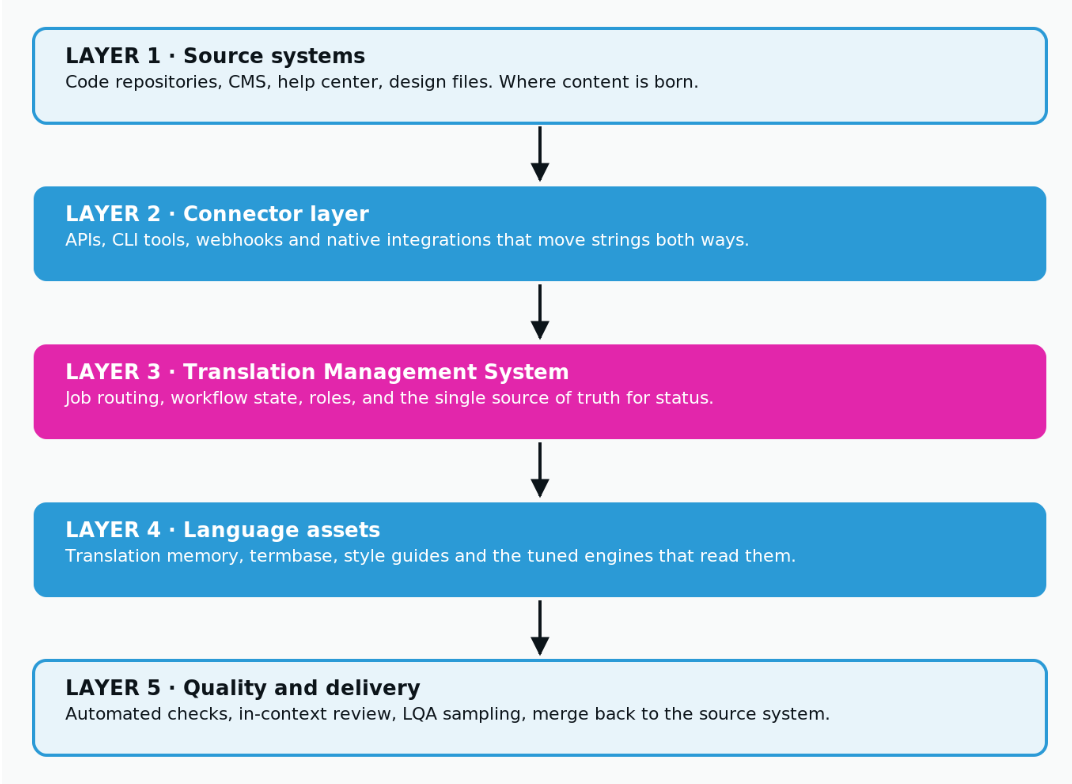
| Layer | What it does | What breaks without it | Typical components |
|---|---|---|---|
| 1. Source systems | Holds content in its native form | Nothing, this layer always exists | Git repos, CMS, help center, design files |
| 2. Connector layer | Moves strings in and out automatically | Manual exports, stale files, drift | APIs, CLI, webhooks, native plugins |
| 3. TMS | Routes jobs and holds workflow state | No visibility, status lives in email | Phrase, Lokalise, Crowdin, Smartling |
| 4. Language assets | Stores reusable meaning | You pay twice for the same sentence | Translation memory, termbase, style guide |
| 5. Quality and delivery | Checks output and returns it to source | Errors ship, rollbacks are manual | Automated QA, in-context review, LQA |
The layers nobody shops for, two and four, are the ones that determine whether the stack works.
Layer four is the one worth arguing about internally. It is the only layer that appreciates. Everything else in the stack is rented capability that a competitor can rent identically.
The TMS is the system of record, not the whole stack
A Translation Management System is a workflow database. It knows what needs translating, who is working on it, and what state each job is in. It does not, by itself, get content in or out, and it does not create quality.
Entry pricing across the main platforms in 2026 spans a wide range, from roughly $40 per month at the low end to several hundred for team plans, with enterprise tiers quoted on request. That spread tells you almost nothing about total cost of ownership, because the licence is rarely the expensive part. The expensive parts are the connector work to wire it into your systems and the person who runs it when a sync fails at 6pm on a release day.
There is a reliable signal that a TMS is not doing its job. If anyone on the team still exports a file, emails it, and imports the result, the TMS is functioning as a shared folder with a nicer interface. That is a layer two problem, and buying a different TMS will not fix it.
Continuous localization: what changes when translation enters CI/CD
Continuous localization means translation is triggered by the same events that trigger a build. A pull request merges, new strings sync to the TMS, jobs create themselves, and translated strings come back as a pull request rather than an attachment.
The trigger point is the design decision that matters most. Syncing on release means you discover every context problem, length overflow and missing plural form during the release window, when there is no time to fix them. Syncing on every merge spreads the same work across the sprint and surfaces issues while the developer who wrote the string still remembers writing it.
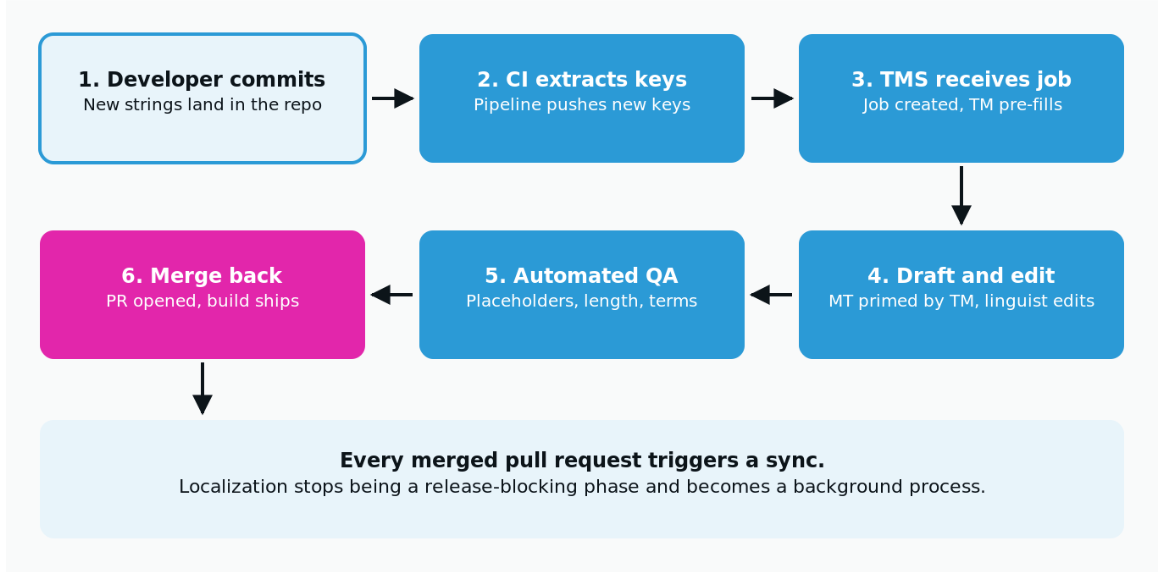
The second-order effect is organizational rather than technical. Once the loop runs on merge, localization stops being a phase that blocks shipping and becomes a background process that occasionally raises a flag. Teams that make this switch usually find their language count stops being a scary number, because adding a locale becomes a configuration change rather than a project. The operational detail of running this on a product team is covered in more depth in this piece on continuous localization for SaaS product teams.
What to automate, and what breaks when you automate it
Automate movement, triggering and checking. Do not automate judgement. The dividing line is simple: automate anything where being wrong is cheap and being slow is expensive, and keep a human on anything where that trade runs the other way.
Safe to automate, in roughly the order teams should build it:
- String extraction and key sync from the repository or CMS on merge
- Job creation and assignment based on content type and target locale
- Translation memory pre-fill and machine translation drafting
- Format QA: placeholder integrity, tag structure, length limits, number and date patterns
- Status notifications into the channel the team already reads
- Merge-back as a pull request rather than a manual import
Not safe to automate, regardless of how good the engine looks:
- Marking a string complete without any human having seen it in context
- Publishing machine output directly to legal, pricing, safety or compliance copy
- Approving a new term into the termbase without a reviewer
- Anything that cannot be rolled back quickly once it is live
The classic failure is auto-publish combined with an untuned generic engine. It works invisibly for months on low-risk content, then produces something wrong on a page that matters, and the team finds out from a customer. A controlled machine translation post-editing workflow prevents this by making the post-edit step a required state rather than an optional one, and by measuring output rather than assuming it. Benchmarking that output properly is its own discipline, covered in the complete guide to AI translation quality.
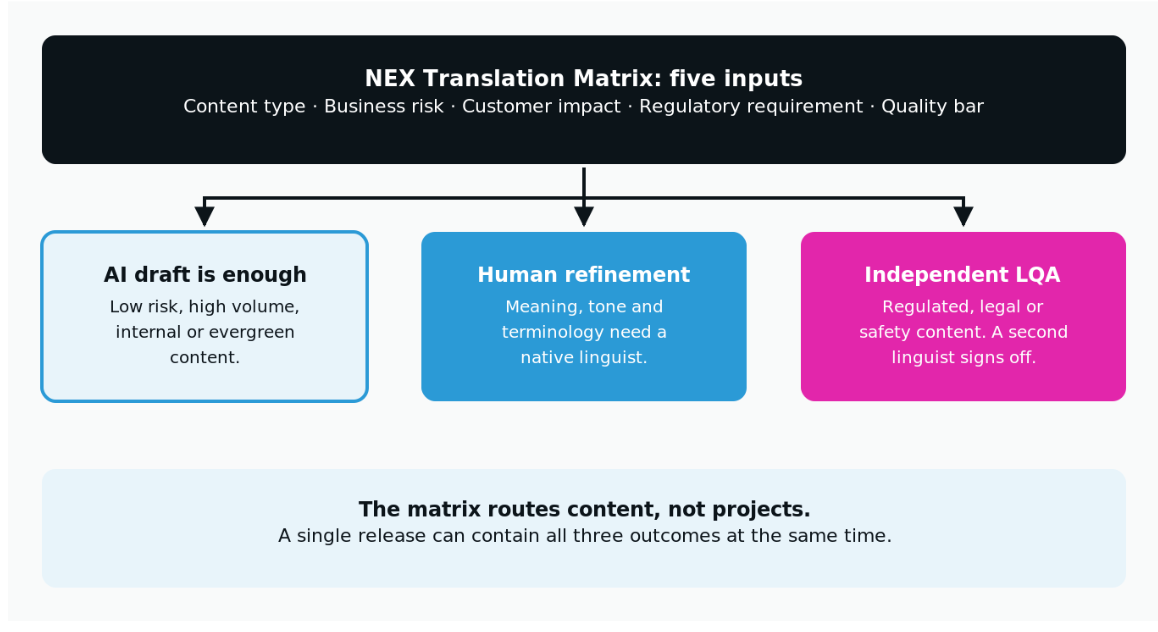
What turns that dividing line into something a pipeline can act on is a routing rule. NexTranslate formalises this as the NEX Translation Matrix™, which scores each piece of content against five inputs: content type, business risk, customer impact, regulatory requirement and quality expectation. The score selects the workflow, rather than the workflow being chosen by whoever filed the request.
Three outcomes fall out of it. Low-risk, high-volume or internal content where an AI draft is sufficient.
Content where meaning, tone and terminology need a native linguist to refine that draft. And regulated, legal or safety-critical content where an independent reviewer signs off before anything publishes. A single release usually contains all three, which is why routing has to happen per string rather than per project.
Translation memory and terminology are the only assets you own
Every tool in the stack is rented. The translation memory and the termbase are owned. They are the only components that get more valuable each year and the only ones that survive a vendor switch intact.
Translation Memory (TM) is a database of previously approved source and target segments. On a mature program, Common Sense Advisory puts reuse in the 30 to 50 percent range, which means a third to a half of the words in a typical update have already been paid for once. Nimdzi puts median payback for localization automation at around four months on programs spending over $200,000 a year, and the return comes overwhelmingly from that reuse rather than from replacing linguists.
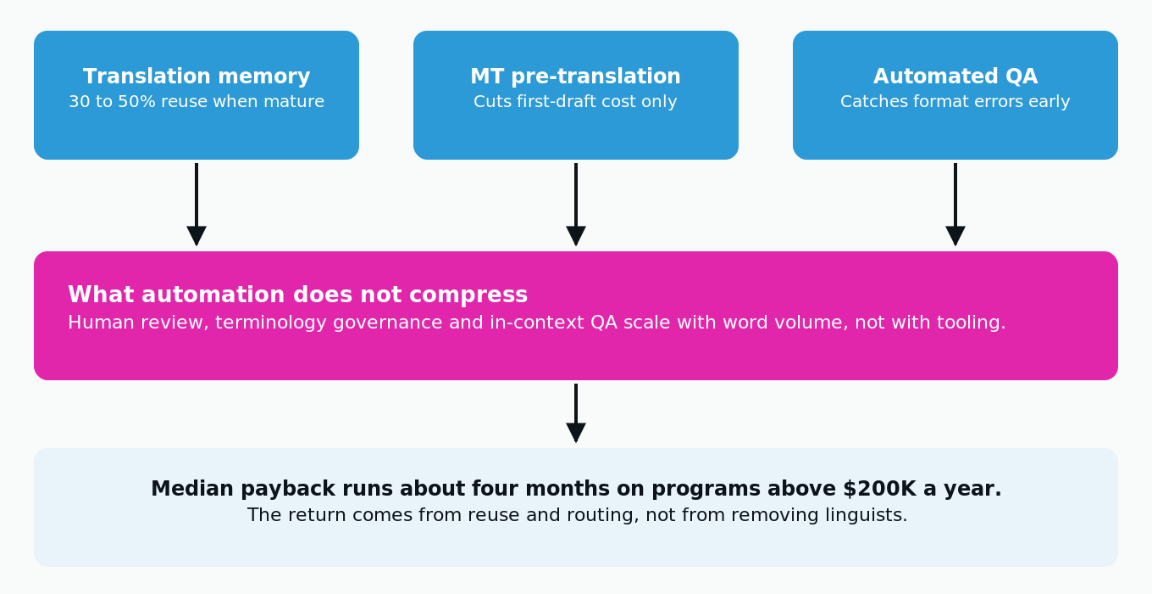
A TM is only worth what its hygiene allows. Segments approved without review, machine output written back as if it were human-approved, and merged memories from three different vendors all degrade reuse quality in ways that are painful to unwind later. Structured linguistic quality assurance (LQA) matters here for a reason that is not obvious: it protects the asset, not just the current delivery. One more thing to handle on day one rather than year three. Put TMX and TBX export rights in the vendor contract before you sign it. A TM you cannot export is not an asset you own.
Choosing a TMS: match the tool to the team, not the feature list
The right TMS is the one that fits how your content is produced. Developer-led product strings and marketing-led campaign content pull toward genuinely different tools, and the feature comparison grid will not tell you which pull is stronger in your company.
| Team profile | What matters most | Must-have integrations | Signal you have outgrown it |
|---|---|---|---|
| Developer-led SaaS | Branching, CLI, key management | Repo sync, CI plugin, design tool | Linguists requesting screenshots by email |
| Marketing-led content | In-context editing, review flow | CMS connector, DAM, analytics | Campaigns going out English-only "just once" |
| Support and knowledge base | Throughput and engine tuning | Help-center connector, versioning | Stale translated articles nobody flagged |
| Regulated or enterprise | Audit trail, role separation, SLA | SSO, audit log, TM and TB export | Approvals living in email threads |
| Mixed, no clear owner | Managed workflow over tooling | Whatever the team already uses | A renewal nobody can justify internally |
Pick the row that describes your team today, not the one you hope describes it after the next hire.
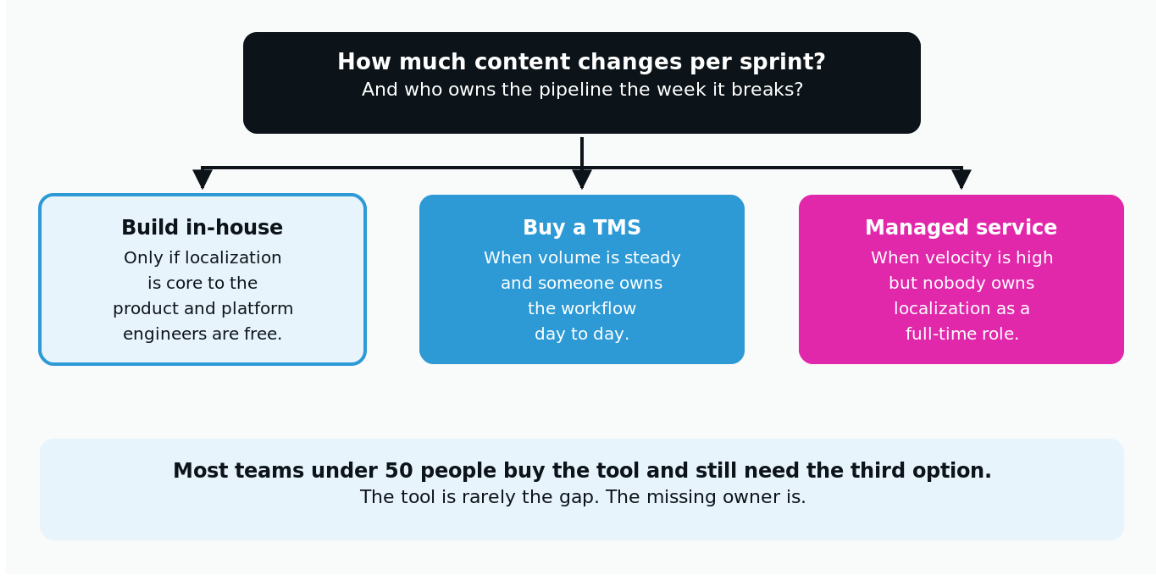
The build, buy or manage question resolves along the same lines. Building in-house is defensible only when localization is genuinely core to the product and platform engineers have the capacity, which is rarer than roadmaps suggest. Buying works when volume is steady and one named person owns the workflow. A managed service fits when velocity is high but no one owns localization as a full-time role, which describes most companies between 20 and 200 people.
Stack maturity: find your rung, fix the next one
Localization stacks mature through four levels: manual, connected, continuous, and governed. Almost every team that believes it is at level three is at level two, because the sync exists but a person still triggers it.
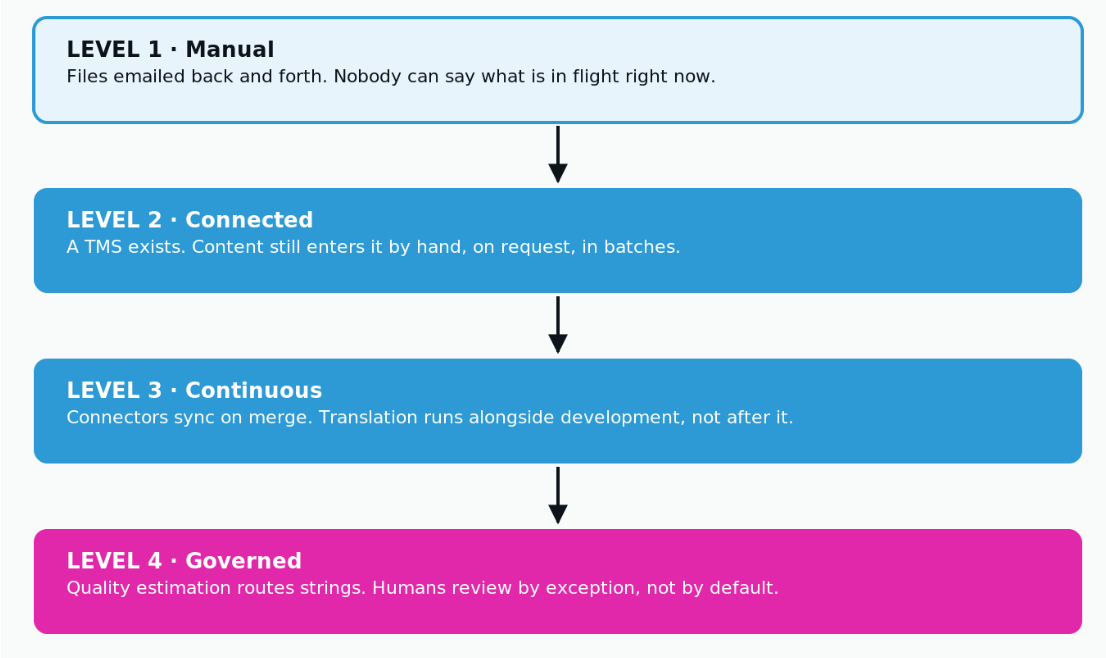
The tells are reliable. At level one, nobody can answer “what is currently in translation” without asking someone. At level two, they can answer it but only by opening the TMS, and content gets there because a human remembered. At level three, the question stops being asked because the answer is always “whatever merged this week”. At level four, a routing rule like the NEX Translation Matrix decides the workflow per string and humans review by exception rather than by default.
Do not skip levels. Teams that try to jump from manual straight to automated routing usually end up automating a broken process faster. Get the connector layer working, then move the trigger to merge, then start routing by confidence.
What the stack will not do for you
A stack removes coordination cost. It does not create linguistic quality, decide which markets to enter, or supply the person accountable for the outcome. Those three gaps account for most stalled localization programs, and none of them has a tooling fix.
Source-content discipline is the most under-diagnosed of the three. A pipeline cannot fix hardcoded strings, concatenated sentences, missing pluralization rules or a date format baked into a template. Internationalization (i18n) debt shows up as translation debt, and it always costs more to fix after the connector is live than before. The groundwork is covered in these internationalization best practices for product teams.
The second gap is strategic rather than technical. A stack that can ship forty languages does not tell you which four are worth shipping, and adding locales because the marginal cost is low is how teams end up maintaining markets that never justified themselves. That decision needs its own test. The NEX Framework™ applies three:
- Need. Is there validated demand in the market, or only the assumption of it? Signup geography, support tickets and organic search in-language are evidence. A competitor’s expansion is not.
- Economics. Does the commercial case survive contact with the full cost, including ongoing content maintenance, local support and payment handling, rather than the translation line alone?
- eXecution. Is the organisation operationally ready to run the market, meaning a stack that can sustain updates, an owner accountable for the locale, and product internationalization that will not break under it?
Most failed market entries clear the first two and fail on the third, which is exactly the gap a tech stack is supposed to close and often does not. Market sequencing is worked through in more depth in the SaaS global expansion guide.
The third gap is ownership, and it is the one that a partner can genuinely close. NexTranslate’s multilingual content management service exists for teams in exactly this position: the tooling is reasonable, the content keeps changing, and nobody has localization in their job title. That covers centralized workflows across the systems teams already run, from Contentful and Webflow to Zendesk and Shopify, alongside translation memory and glossary maintenance, string diffing on updates, and structured review before anything goes live. For product strings specifically, software UI translation handles the in-context problem that plain file translation cannot. The philosophy behind all of it is that AI gives the pipeline speed and humans give it trust, and no amount of automation moves that boundary.
Budget for both lines separately. Tooling is a fixed subscription cost, and translation is a variable per-word cost that scales with what you ship. Teams routinely blend the two into a single “localization budget” and then cannot explain why it moved. NexTranslate keeps published per-word pricing across three tiers with human proofreading included at each one, which makes the variable line predictable enough to forecast against a release plan.
Frequently asked questions
What is a localization tech stack?
A localization tech stack is the connected set of systems that move content from its source into other languages and back without manual file handling. It has five layers: source systems, connectors, a translation management system, language assets such as translation memory and terminology, and quality and delivery. The connections between layers matter more than the specific tools chosen.
Do we need a TMS if we only support three languages?
Not necessarily. Language count is the wrong variable. What matters is how often content changes and how many people touch it. Three languages on a product that ships weekly needs a connected pipeline more urgently than eight languages on a brochure site that updates twice a year.
How is continuous localization different from automating file transfer?
Automated file transfer moves the same batch process faster. Continuous localization changes the trigger, so translation is initiated by a code or content event rather than by a person deciding it is time. The practical difference is that translation stops being a release phase and becomes a background process.
Can we build our own localization tooling instead of buying?
You can, and it is defensible when localization is core to the product and you have platform engineers with capacity. In most other cases the build costs more than the licence saves, because the ongoing work is connector maintenance rather than initial construction. Build the connectors, buy the workflow.
How much does a localization tech stack cost?
There are two separate lines. Tooling runs from roughly $40 per month for entry plans to enterprise contracts quoted on request. Translation is a per-word cost that scales with volume and required review depth. Budget them separately, because tooling spend is fixed and translation spend follows your release cadence.
How do we decide which content needs a human linguist?
Score the content rather than the project. The NEX Translation Matrix uses five inputs, content type, business risk, customer impact, regulatory requirement and quality expectation, to route each item to one of three workflows: AI draft alone, human refinement of that draft, or independent linguistic review before publication. Most releases produce all three outcomes at once, so the routing has to run per string.
What should we set up first?
The connector between your source system and wherever translation happens, then translation memory, then automated format checks. Those three deliver most of the available benefit. Advanced routing and quality estimation are worth adding once content is already flowing without manual handling.
Conclusion: the stack is plumbing, the assets are the value
Localization tooling gets bought like a product and needs to be designed like infrastructure. The tools are interchangeable and increasingly similar. What is not interchangeable is the connector work that makes content move on its own, the translation memory that compounds, and the terminology decisions that keep a hundred documents consistent with each other.
The practical sequence is unglamorous. Trace one string end to end and count the manual handoffs. Close them from the source system outward. Move the trigger to merge. Protect the memory. Add routing last. Teams that follow that order stop noticing their language count, which is the only real success metric for a localization stack.
If you are trying to work out which layer to build next, or whether your current tooling is the problem, we can map your content flow and tell you where the manual handoffs actually are. Request a scoped quote and we will come back with a layer-by-layer read rather than a tool recommendation.
Written by Karuppusamy Arunachalam, NexTranslate
Published August 2026 · Filed under Product & Technology