





A hotel group spends four months translating its marketing site into six languages, then sends every booking confirmation in English. The guest who converted on a beautifully localized room page receives a confirmation she cannot fully read, a cancellation policy she has to guess at, and a pre-arrival email that goes unopened. She arrives anyway. She does not book direct next time.
That gap is the shape of most travel localization programs. Budget concentrates on the pages that win the booking and thins out across everything after it. The funnel ends up multilingual at the top and monolingual everywhere trust is actually built.
Travel translation is usually bought as a website project. It works better as a routing problem. One property produces a destination blog post, a booking string, an allergen line and a fire safety notice in the same week, and those four cannot share a workflow. This guide covers where language breaks the guest journey, which content carries legal exposure, what the work costs, and how to sequence travel and hospitality translation services that hold up after the booking.
Where language actually breaks the guest journey
Language breaks the guest journey at five points, and in most travel brands only the first one is funded. Discovery, booking, confirmation, on-property and post-stay review each fail differently, and the later failures cost more because they hit guests who have already paid.
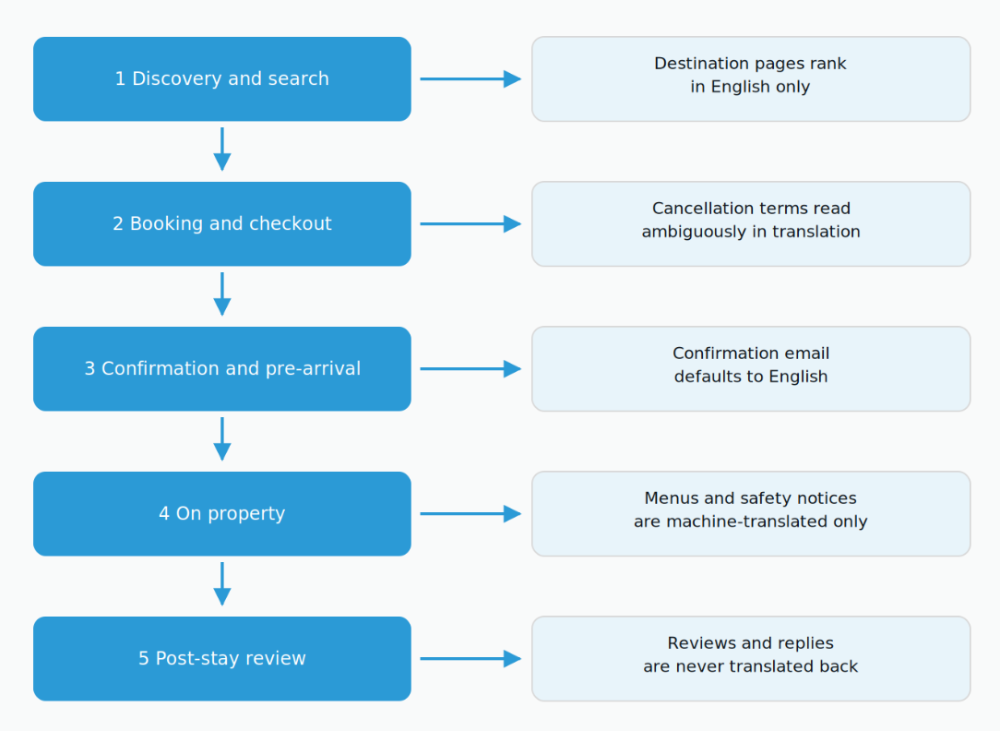
The five language touchpoints in the guest journey. Only the first one usually gets budget, and it is the cheapest failure on the list.
Discovery gets the attention because it is measurable, and multilingual SEO for new language markets is genuinely how a property gets found by someone searching in Portuguese. It is also the cheapest failure here. A guest who never finds the page never becomes a cost.
The expensive failures start at booking. A guest who reaches the payment step in her own language and then hits an English-only cancellation policy has to accept an obligation she cannot fully read. Some do not. The ones who do become the chargebacks that surface two months later, with no attribution back to a translation decision.
After that, every touchpoint carries trust and none carries a conversion metric. A confirmation email is the first thing a guest reads after handing over money. A review reply is what the next guest reads before booking at all. That is why both are the last to be localized.
Map the five touchpoints before scoping any translation work, then fund them in roughly the reverse of the usual order.
Why travel content cannot share one translation workflow
Travel spans a wider content risk range than almost any other vertical, so one workflow applied to everything either overpays for blog posts or underprotects safety notices. Routing by risk is the only approach that survives a real hospitality content calendar.
The NEX Translation Matrix™ scores five inputs for every piece of content: content type, business risk, customer impact, regulatory requirement, and quality expectation. Those inputs produce one of three outcomes.
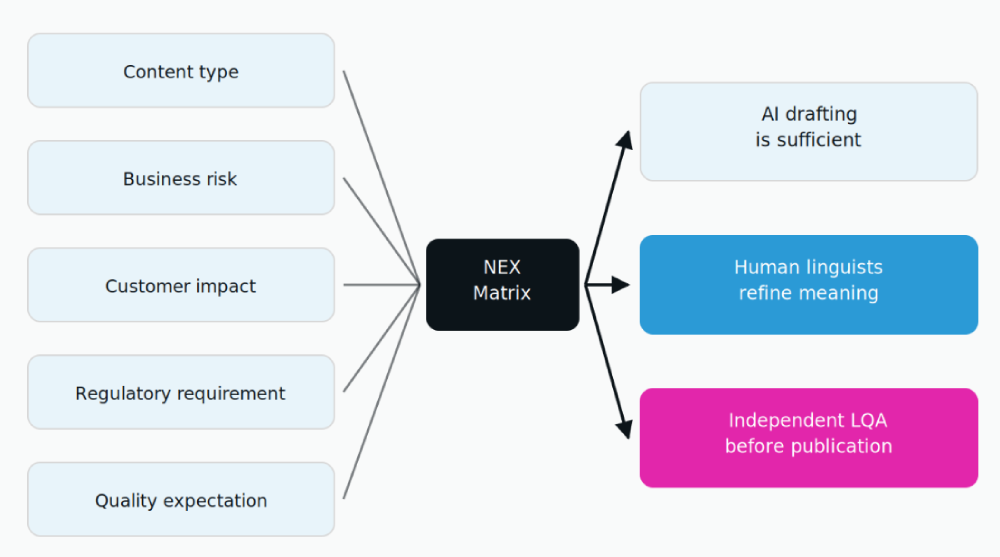
The NEX Translation Matrix scores five inputs per piece of content and routes it to one of three workflows.
The routing rule matters more than the label. The matrix routes content, not projects. One seasonal resort campaign produces all three outcomes at once: the social captions are AI drafting territory, the landing page needs a native linguist refining meaning and tone, and the terms attached to the promotional rate need independent review before anything goes live. Routing per string, never per job, is what stops a program from burning budget on low-risk volume.
Machine translation post-editing does most of the work in the middle band. A machine drafts, a native linguist edits for meaning, terminology and tone. ISO 18587 defines what full post-editing actually requires, which is worth knowing because “we post-edit” means very different things at different vendors.
| Travel content type | Business risk | Routing outcome | Review layers |
|---|---|---|---|
| Destination blogs and city guides | Low | AI drafting sufficient | One linguist review |
| Social and seasonal campaigns | Low | AI drafting sufficient | One linguist review |
| Inbound guest reviews | Low | AI drafting sufficient | Spot check only |
| Room and amenity descriptions | Medium | Human linguists refine | Translator plus editor |
| Booking engine and app strings | Medium to high | Human linguists refine | Translator plus editor, in context |
| Confirmation and pre-arrival email | Medium to high | Human linguists refine | Translator plus editor |
| Menus with allergen information | High | Independent LQA | Second linguist signs off |
| Safety and evacuation notices | High | Independent LQA | Second linguist signs off |
| Cancellation terms and contracts | High | Independent LQA | Second linguist signs off |
Routing runs per content type, not per project. A single seasonal release usually produces all three outcomes in the same week.
Which travel content is legally regulated, and where
Allergen information, safety instructions and consumer cancellation rights are regulated content in most markets travel brands sell into, and raw machine output with no named human reviewer does not meet that bar. These belong in independent review regardless of budget.
In the European Union, Regulation (EU) No 1169/2011 requires allergen information to reach the consumer for non-prepacked food, which covers restaurant and hotel menus. A mistranslated ingredient line is therefore not a quality problem, it is a liability. The same applies to evacuation notices and to any statement about what a guest is entitled to when a booking changes.
Linguistic quality assurance is the review layer built for exactly this. A second, independent linguist checks the translation against the source and against market requirements, then signs off before publication. It costs more per word than post-editing, and it is the cheapest line in the budget the first time it catches something.
| Content | Typical requirement | Market examples | Cost of getting it wrong |
|---|---|---|---|
| Allergen and ingredient lines | Must reach the consumer in market | EU Regulation 1169/2011 | Medical incident, liability |
| Fire and evacuation notices | Local fire and building codes | Most jurisdictions | Guest safety, inspection failure |
| Cancellation and refund terms | Consumer protection disclosure | EU, UK, several US states | Chargebacks and disputes |
| Accessibility statements | Public accommodation rules | US ADA, EU accessibility rules | Complaints, reputational damage |
| Health and entry requirements | Public health and border notices | Varies by destination | Denied boarding, refund claims |
Regulated hospitality content by category. Every row routes to independent review regardless of word count or budget.
The wider pattern of which verticals carry which obligations is mapped in the industry-specific localization guide, which runs the same routing logic across legal, medical and finance content.
The booking funnel strings that cost more than they look
The most expensive translation errors in travel are not in marketing copy. They sit in short interface strings, where one ambiguous word becomes a refund request.
“Free cancellation until 6pm” does not survive translation without a timezone. “Per person” and “per room” collapse into each other in languages where the distinction rides on a case ending a translator will drop if they cannot see the price next to it. Half board, full board and all inclusive have no stable equivalent across markets, and guests book assuming their local meaning applies. A date written 03/04 means two different days depending on who reads it. A resort fee disclosed only in English is a dispute waiting to be filed.
These strings share three properties that make them dangerous. They are short, so they look cheap. They carry a financial obligation. And they are usually translated in a spreadsheet, with no view of the screen they appear on. Booking engine and app localization should run against the live interface rather than a string export, and every approved string belongs in a translation memory (TM) so the same phrase is never re-translated three different ways across the website, the app and the confirmation email.
Treat the booking funnel as regulated content even where it is not. The financial exposure is the same.
Guest reviews are the translation job most travel brands skip
Guest reviews and the replies to them are public marketing that almost nobody translates. CSA Research, surveying 8,709 consumers across 29 countries, found 73 percent want reviews in their own language, which means the social proof a brand has already earned is invisible to most of the market it is chasing.
There are two jobs here and they are not the same. Displaying inbound reviews in the reader’s language is high-volume, low-risk work, exactly what AI drafting with a light review layer is for. The reply is different. It is the property speaking in public, usually about something that went wrong, and a machine-translated apology reads as one nobody wrote. That is transcreation work: the intent carries across, the wording gets rebuilt for the market.
The asymmetry is worth noticing. Review volume is enormous and cheap to handle. Reply volume is small and expensive. Most travel brands do neither, then buy paid acquisition in markets where their own earned proof was sitting untranslated.
Seasonal velocity is what actually breaks batch translation
Travel content changes faster than a batch translation cycle can publish it. Rates, availability, seasonal packages and event calendars move weekly, so a three-week turnaround does not deliver late content, it delivers wrong content.
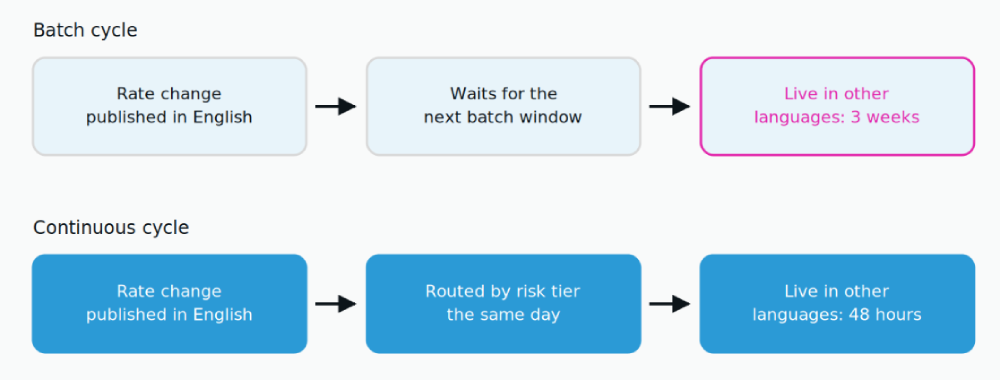
A rate change under a batch cycle and under a continuous cycle. The middle step is where the three weeks go.
A batch model works when the source is stable. Hospitality source content is not. A winter package replaces an autumn one, a rate moves after a competitor repositions, and each change has to reach six languages before it stops being true. When it does not, the German page quotes a rate the property no longer honours, which is worse than having no German page.
The alternative is continuous. Content changes trigger translation automatically, routing runs per string by risk tier, and a translation management system (TMS) holds the memory so only the delta gets paid for. The economics improve as the memory grows, because recurring seasonal content is largely last year’s with the dates and prices changed.
If a travel brand cannot turn a rate change around in 48 hours, the process is the problem, not the budget.
What travel translation costs, and what moves the number
Travel translation is priced per word, and the tier is set by risk rather than volume. Most hospitality programs run across all three tiers in the same month, which is why one blended rate quoted for “the website” usually means the vendor has not asked what is in it.
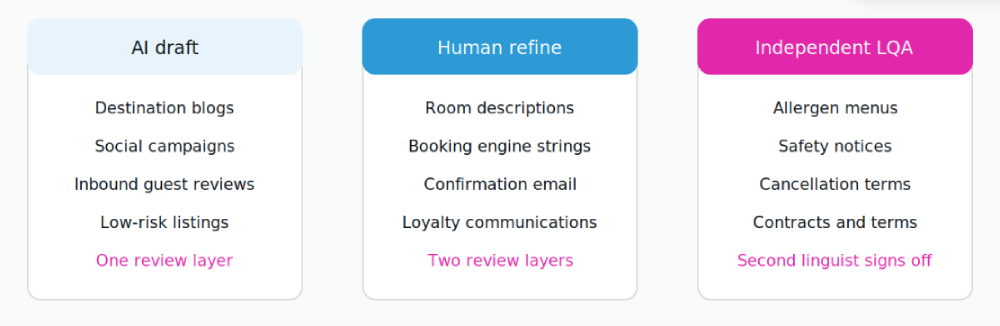
Travel content by routing tier. Most hospitality programs produce work in all three columns in the same month.
AI-assisted translation with a human linguist review starts from USD 0.03 per word, the right home for destination blogs, social campaigns and low-risk listings. Content a guest acts on, such as room descriptions and booking strings, moves up to a native translator with an editor review at USD 0.07. Regulated content sits at the top tier with an independent reviser and a quality control expert. All three are published on the transparent translation pricing page, with human proofreading included at every tier instead of billed separately, which is where most of the 30 to 40 percent difference against a proofreading-extra vendor comes from.
Four things move the number in travel specifically. Language pair, because Nordic and Japanese rates sit well above Spanish and Portuguese. Urgency, because a campaign that has to land before a booking window opens carries a rush premium of 20 to 30 percent. Desktop publishing, because menus and in-room collateral are laid-out documents. And glossary work, which a property pays for once and saves on every seasonal re-run.
How to sequence a travel localization program
Sequence by revenue proximity, not page count. Content guests act on after deciding to pay comes before content that attracts them, because the second kind is easy to buy later and the first kind is already leaking.
- Weeks 1 to 2: inventory and route. Score every content type on the five matrix inputs and assign a tier. This step is always skipped and always why the program stalls later.
- Weeks 3 to 4: regulated content. Allergen lines, evacuation notices, cancellation terms. Independent review, no exceptions.
- Weeks 5 to 8: the booking and confirmation path, translated in context. Build the glossary and translation memory here, because everything downstream reuses it.
- Weeks 9 to 12: guest-facing property content. Room descriptions, menus, concierge material, loyalty communications.
- Ongoing: destination and campaign content. The volume tier, where the memory built in weeks 5 to 8 starts paying for itself.
Frequently asked questions
What are travel translation services?
Travel translation services cover every guest-facing asset a hospitality brand produces, from destination pages and booking strings to menus, safety notices and review replies. The defining feature is range, which is why the category is a set of workflows rather than one.
Can machine translation be used for hotel and travel content?
Yes for the low-risk majority, no for anything carrying legal or financial obligation. Post-edited machine translation suits destination blogs, social campaigns and inbound reviews, while allergen information, evacuation notices and cancellation terms need an independent second linguist.
How much does travel translation cost?
Per-word rates run from around USD 0.03 for AI-assisted translation with human review up to around USD 0.12 for regulated content with an independent reviser. Menus add desktop publishing, and seasonal rush work carries roughly 20 to 30 percent.
Which languages should a hotel or travel brand translate into first?
Start with the languages already visible in the booking data rather than the largest markets in the abstract. Search geography, booking origin, support enquiries and OTA traffic by market give a validated demand signal.
Do guest reviews need to be translated?
Displaying reviews in the reader’s language is one of the highest-return, lowest-risk translation tasks in hospitality, because CSA Research found 73 percent of consumers want reviews in their own language. Replies need a human, since a machine-translated apology reads as one nobody wrote.
How long does it take to localize a hotel website?
A focused hotel website localization into three to five languages usually runs eight to twelve weeks, with the first four going to inventory, glossary and regulated content. Seasonal updates should then turn around in 24 to 72 hours.
Conclusion: guest trust is built after the booking, not before it
The pages that win a booking are the easiest part of travel localization to justify and the least likely to lose a guest. What loses guests is the confirmation email they cannot read, the cancellation term they had to guess at, the menu that says the wrong thing about an allergen, and the review reply obviously written by a machine. None of those four carry a conversion metric, which is why they are still in English.
Routing by risk is what makes the whole set affordable. The low-risk volume gets handled cheaply so the high-risk content can afford the review it needs. That ordering costs less in total than translating the marketing site three times and leaving the funnel monolingual.
If you are scoping a travel or hospitality localization program and want the routing mapped before the budget is set, our team will review your content inventory and tier it with you. You can request a quote or start from the published tiers to see where each content type lands.
Written by Karuppusamy Arunachalam, NexTranslate
Published August 2026 · Filed under Industry Use Cases
