






A team picks Germany. The marketing site gets translated, a German pricing page ships, and everyone moves on to the next quarter. Six months later the pipeline from that market is thin, the localization line comes up in a budget review, and someone concludes the market was a mistake.
The market was probably fine. What was missing was a written theory of how localization would produce revenue. Without it, nothing got measured, and nothing that goes unmeasured survives a second budget cycle.
Market entry localization fails as a budget item far more often than it fails as a translation problem. The words are usually accurate. The gap sits between the localized asset and the revenue it was supposed to move, which is why localization enters the plan as a launch expense and leaves as a line item to cut. What follows is the framing shift that keeps it funded, the three gates a market has to clear before anyone translates a word, and how to attribute the result locale by locale.
Why market entry plans treat localization as a cost
Localization gets classified as a cost because it is bought as a project with a finish line, and projects that finish have no ongoing revenue story. The purchase order covers a fixed word count for a launch date. Nothing in that structure asks what the words are supposed to earn.
Compare it to any other growth channel. Nobody buys paid search as a fixed number of impressions delivered by a date. They buy it against a cost per acquisition and adjust monthly. Localization is the only entry investment routinely bought by volume and judged on delivery, which makes it the easiest line to cut when the market runs slow.
Ownership compounds it. Translation belongs to whoever raised the purchase order, normally marketing, so the marketing site gets localized while product documentation, in-app strings, billing emails and the help centre stay in English.
The fix is not a bigger localization budget. It is changing the unit of purchase from words delivered to revenue path covered.
What changes when localization is framed as a revenue lever
Framing localization as a revenue lever changes three things: what gets localized first, which metric the spend is judged against, and who owns the decision. The content itself looks similar. The sequence and the scoreboard do not.
| Question asked | Cost centre answer | Revenue lever answer |
|---|---|---|
| What gets localized? | The marketing site, top down | The path a buyer walks from first search to first payment |
| What is the unit of purchase? | Words delivered per purchase order | Revenue path coverage per locale |
| What is measured? | Cost per word, on-time delivery | Trial to paid and retention inside the locale |
| Who owns it? | Whoever raised the purchase order | The go-to-market owner for that market |
| When does it end? | At launch | It does not. It moves to a maintenance cadence |
The same spend, two framings. Only the right column produces a number a budget review can act on.
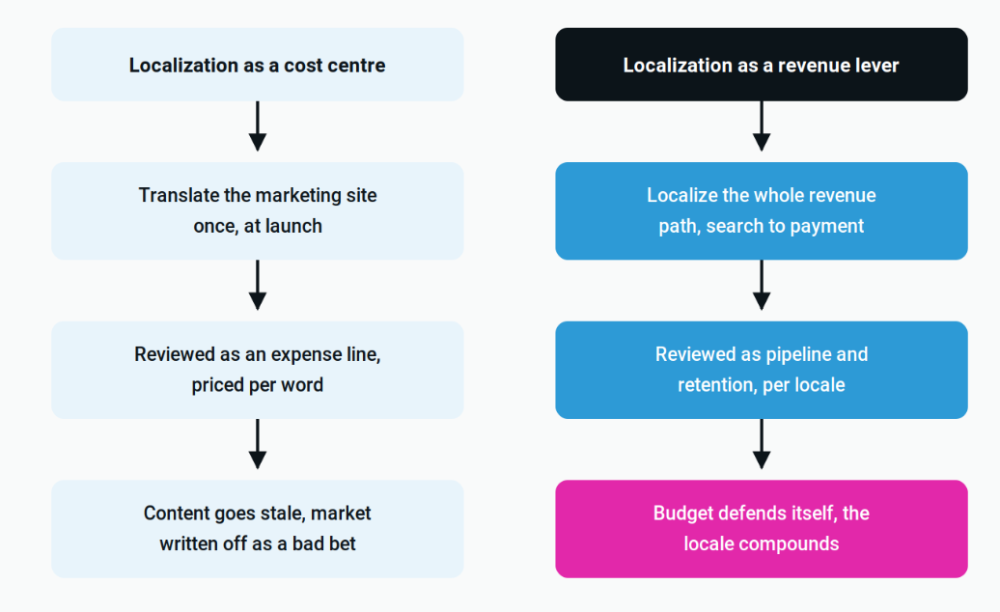
Two ways to fund the same market entry. The left path ends with a market written off that was never properly tested.
The practical effect is that the revenue lever framing produces an argument. When a locale has its own conversion rate, retention curve and fully loaded cost, the month-nine conversation is about increasing the investment or reallocating it. Under the cost centre framing there is no such conversation, only a number that looks like an expense and gets treated as one.
The three gates a market has to clear before you localize
A market is ready for localized entry when it clears three gates: validated demand, an economic case that survives full cost, and the operational capacity to keep the locale current. The NEX Framework™ names these Need, Economics and eXecution, and the order matters because each gate is cheaper to fail than the one after it.
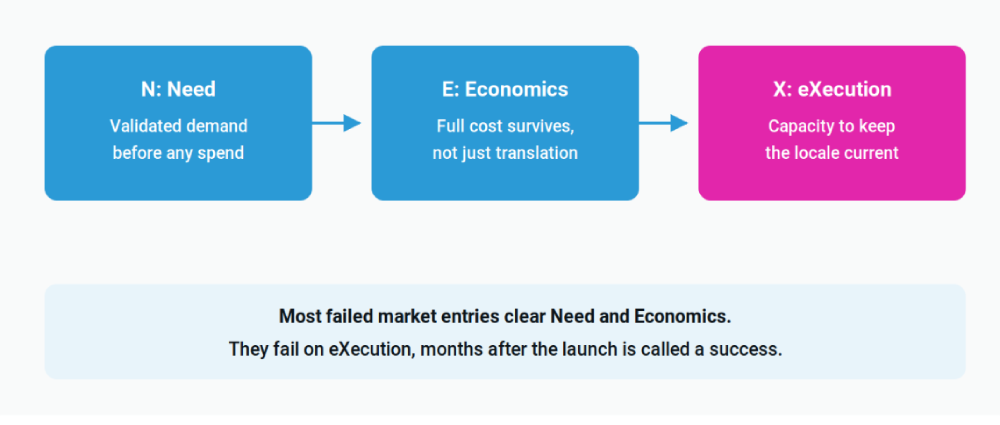
The three NEX Framework gates. The first two are usually cleared. The third is where entries quietly die.
Need: is the demand already visible?
Need is validated by evidence the market produced on its own. Signup geography, in-language organic search volume, support tickets arriving in the language, inbound enquiries from the region. A competitor announcing expansion is not evidence of demand, it is evidence of their planning process. If a market shows no signal before localization, localization is a bet on creating demand rather than capturing it, which is a different and far more expensive project.
Economics: does the case survive the full cost?
Economics fails because the model carries only the translation line. The real cost of a locale includes ongoing content maintenance as the product changes, local support hours in a workable time zone, payment methods and tax handling, and the engineering time multilingual releases consume. A market that only works at launch pricing with launch-only costs is not a market. It is a launch.
eXecution: can the organisation keep the locale alive?
eXecution asks whether the company can sustain the locale after launch week. That means a content stack that handles updates rather than one-off jobs, a named owner for the locale who is accountable for its numbers, and internationalization (i18n) work in the product that will not break when a German string runs thirty percent longer than the English one.
Most failed market entries clear Need and Economics and fail on eXecution. The demand was real, the model worked, and then nobody updated the German help centre for eight months. For the wider question of which markets and languages to sequence first, the SaaS global expansion guide covers the scoring model in depth.
Which content actually moves revenue in a new market
Revenue moves in a new market when the path from first search to first payment is fully in the buyer’s language. Everything else is second order. Most entry budgets get this backwards, localizing the brand story and the about page first while pricing, checkout and onboarding stay in English.
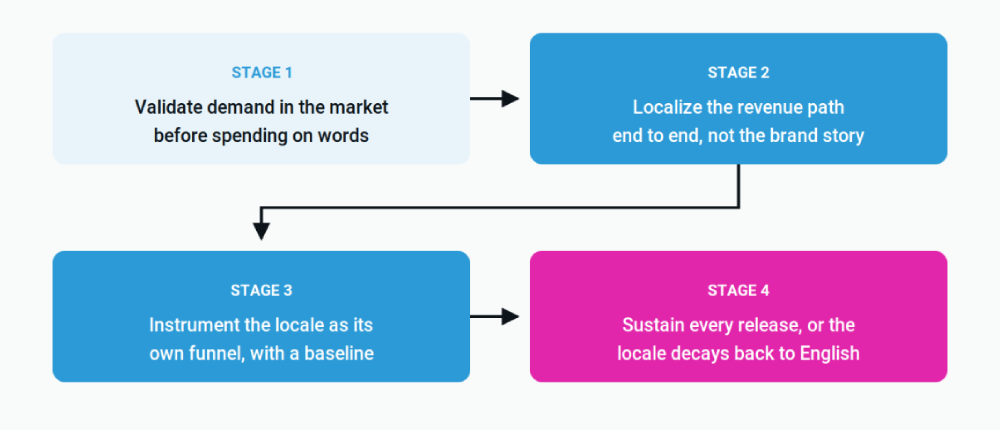
The four stage market entry sequence. Stage four is the one most entry budgets never fund.
The revenue path is a chain: search result, landing page, pricing page, signup flow, onboarding, first value in the product, support when the buyer gets stuck, renewal. A gap anywhere in that chain is where the locale leaks. A German buyer who reads a German landing page and lands on an English pricing table has been told, in a way no survey will capture, that this product is not really for them.
CSA Research has documented this across multi-country consumer studies: buyers overwhelmingly prefer to purchase in their own language, and a substantial share will not buy at all from an English-only experience. In B2B the effect is quieter but identical, because the person evaluating the product is rarely the only person who has to approve it. Discovery is the first link and has its own mechanics, covered in ranking in new language markets. The links after it are where entry plans go thin, and what to adapt beyond translation sets out the non-text elements that also change: currency, date formats, payment methods, address fields and legal copy.
The rule for stage two is to localize in the order a buyer encounters it, not the order the content team already owns it. Brand narrative comes after the path converts.
How to route entry content without inflating the budget
Entry cost stays controlled when content is routed by risk rather than translated at one uniform quality level. A blog post and a data processing agreement do not need the same workflow, and paying premium rates for both is how entry budgets end up looking indefensible.
The NEX Translation Matrix™ scores each piece of content on five inputs: content type, business risk, customer impact, regulatory requirement and quality expectation. It produces three outcomes. AI drafting is sufficient for low-risk, high-volume content. Human linguists refine meaning where tone or terminology carry weight, which is the workflow machine translation post-editing is built for. Independent linguistic quality assurance runs before publication on anything regulated, legal, safety-critical or highly exposed, with a second linguist signing off.
The routing rule matters more than the labels: the matrix routes content, not projects. A single launch produces all three outcomes at once, so routing runs per string or per document, never per job. Sending an entire market entry through one tier is how companies overpay for help centre articles and underprotect their terms of service at the same time.
| Entry stage | Content in scope | Workflow routing | Signal to watch |
|---|---|---|---|
| Pre-entry validation | One landing page, one pricing page | AI draft, human refinement | In-language organic sessions |
| Launch | Signup, checkout, onboarding, core interface | Human refinement, LQA on billing and legal | Trial to paid rate in locale |
| Post-launch support | Help centre, product docs, lifecycle email | AI draft, human refinement | Ticket deflection in language |
| Regulated content | Terms, data processing agreement, invoices | Independent LQA before publication | Legal sign-off, zero rework |
| Sustain | New release strings, campaign updates | Routed per string at each release | Language lag, measured in days |
Routing runs per item, not per project. A single launch produces all three matrix outcomes at the same time.
Cost predictability is part of the argument to finance. NexTranslate publishes transparent per-word pricing across three tiers with human proofreading included at every one of them. That matters for entry budgets because proofreading is the line most providers bill separately, at USD 0.02 to 0.05 per word. Across a hundred thousand words of revenue path, that stops being a rounding error.
How to measure localization revenue market by market
Localization revenue becomes measurable when each locale is treated as its own funnel with its own conversion, retention and support metrics, rather than as a slice of a global number. A locale that represents three percent of traffic will never surface in a blended dashboard, which is exactly why it gets defunded.
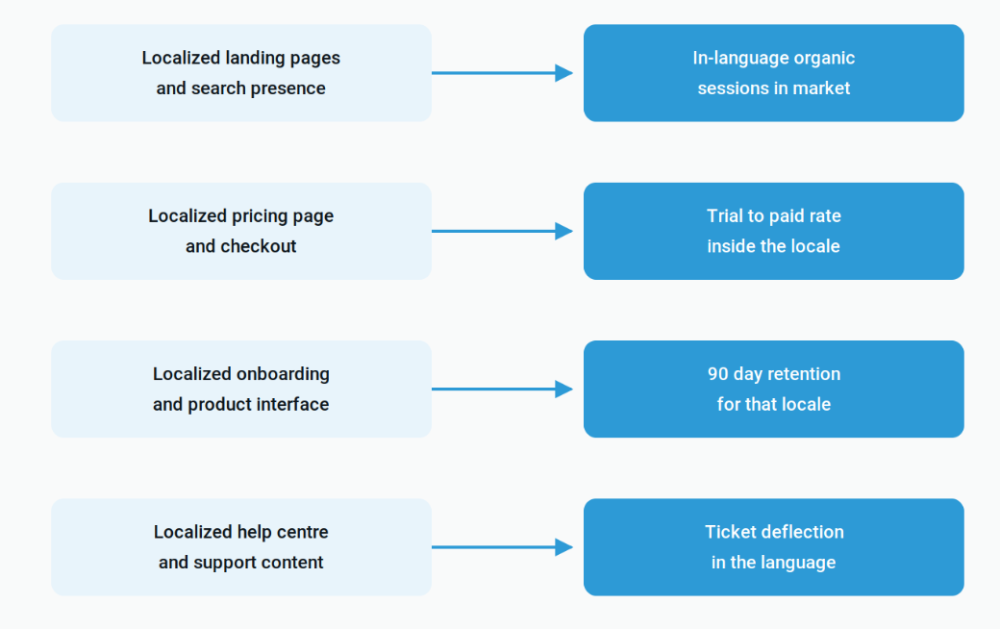
Where localized content lands in the pipeline. Each pairing is a metric to instrument before launch, not after.
The instrumentation is not exotic. Locale as a dimension in analytics, conversion events split by language rather than only by country, in-language query data from Search Console, pipeline tagged by market in the CRM, retention cohorts cut by locale. Most teams already have the tooling and never split the reporting.
One discipline separates a measurable entry from an unmeasurable one: record the locale’s numbers before localization ships. Without a pre-localization baseline there is no before, and every result afterwards is an assertion rather than a finding. CSA Research has found that organisations which formally track localization return on investment report materially stronger internal support for it, which is the mechanism this post turns on. The counterfactual is worth quantifying too, and the cost of skipping localization entirely sets out what the do-nothing option costs in the same markets.
Report one number upward per market: revenue attributable to the locale against the fully loaded cost of that locale, with the pre-launch baseline beside it. That single line is the difference between a market entry that gets a second year of funding and one that does not.
The sustain problem: why month seven decides the market
Most market entries do not fail at launch. They fail in month six or seven, when the product has shipped four releases and the localized version has shipped none. The English experience keeps moving forward and the localized one quietly becomes a worse version of the same product.
The metric that catches this is language lag: days between an English string going live and its localized equivalent going live. It is the single most useful operational number in a market entry and almost nobody tracks it. Two days is a healthy locale. Sixty days means the market is judging a product that no longer exists.
Fixing it is an operations problem rather than a translation problem. New strings have to enter the localization workflow automatically at release rather than being collected manually into a quarterly batch, translation memory has to carry terminology forward so repeat content is not repriced every cycle, and someone has to own the locale by name. This is the work that multilingual content management exists to absorb: centralised assets, string diffing so only genuinely new content is routed, governed approval steps, and integrations into the content and code systems a team already uses so nothing depends on a person remembering to export a file.
A budget that funds launch but not maintenance is not a market entry budget. It is a launch budget with a market attached, and it produces one good quarter followed by a decline that looks, from the outside, like the market was the problem.
Frequently asked questions
What is market entry localization?
Market entry localization is the practice of adapting a product, its buying experience and its support content for a specific new market as part of the entry plan rather than after it. It differs from general translation in that it is scoped around a revenue path and measured against locale-level commercial outcomes, not word volume or delivery dates.
How much should a company budget for localizing a market entry?
Budget by revenue path rather than by page count. A typical business software entry covers roughly sixty to a hundred and twenty thousand words across landing pages, pricing, signup, onboarding, interface strings, help centre and legal documents, with per-word rates varying by risk tier. The commonly underestimated figure is recurring maintenance, usually fifteen to thirty percent of the initial volume per year for an actively developed product.
Which languages should a SaaS company enter first?
Start with the language where demand already exists, not the largest addressable market. For business software expanding from English, checking signup geography and in-language search demand commonly surfaces German, Spanish, French or Brazilian Portuguese first. The right answer is whichever market is already producing signups despite having no localized experience, because that is demand arriving in spite of friction.
Can AI translation handle a market entry on its own?
AI translation can handle the volume of a market entry but not the risk profile of one. Machine output is well suited to high-volume, low-exposure content such as help centre articles and blog archives, where speed matters more than nuance. Pricing pages, contractual terms, billing communication and onboarding copy carry commercial and legal consequences, which is why the hybrid model routes those through human refinement or independent review before publication.
How long before localization shows revenue impact?
Expect leading indicators within four to eight weeks and revenue signal within one to two sales cycles. In-language organic sessions and trial starts move first because discovery responds quickly. Trial to paid conversion and retention lag, because they depend on onboarding and support content that is usually localized later. Judging a locale before one full sales cycle has closed is the most common cause of a market being abandoned prematurely.
Conclusion: localization is not the price of entering a market, it is what makes entry pay
The companies that win a new market are rarely the ones that translated the most words. They localized the revenue path first, routed content by risk so the budget stayed defensible, measured the locale as its own funnel against a recorded baseline, and funded the maintenance that stops the locale decaying back into English. Every one of those is decided before the first word is translated.
If a market is already producing signups without a localized experience, the demand gate is cleared and the question is only how fast the revenue path can follow. We work with product and go-to-market teams to scope exactly that path, stage by stage, with the routing and cost mapped before anything is committed. Request a quote for that market and we will come back with the sequence, not just a per-word number.
Written by Karuppusamy Arunachalam, NexTranslate
Published August 2026 · Filed under Global Expansion
