




The Complete Guide to Marketing Localization and Transcreation: Adapting Campaigns Without Losing Brand Voice

A campaign that converts in English rarely converts word for word in German. The tagline lands flat. The hero claim reads as an overpromise a local regulator would question. The subject line that carried the whole email becomes a sentence nobody in that market would say out loud. Most teams find this out after launch, when the localized page converts well below the source and nobody can point to the sentence that broke it.
The reflex fix is to spend more. Send everything to a creative agency, rewrite the whole campaign, pay premium rates on help centre articles that nobody reads for tone. The opposite reflex is just as common: push the entire campaign through machine translation because the volume is large and the deadline is Friday. Both reflexes make the same mistake. They treat a campaign as one thing. It never is.
A single product launch produces a tagline, a hero claim, three landing pages, a lifecycle email sequence, paid social with character limits, a press release, release notes and a batch of help centre articles. Those assets carry wildly different risk. Some need a copywriter who thinks in the target language. Some need a linguist to correct meaning. Some need a machine draft and a proofread. This guide covers how to tell them apart, how to write brand voice down precisely enough that it survives adaptation, and how to run the whole thing on a calendar that does not slip.
What marketing localization covers, and where transcreation begins
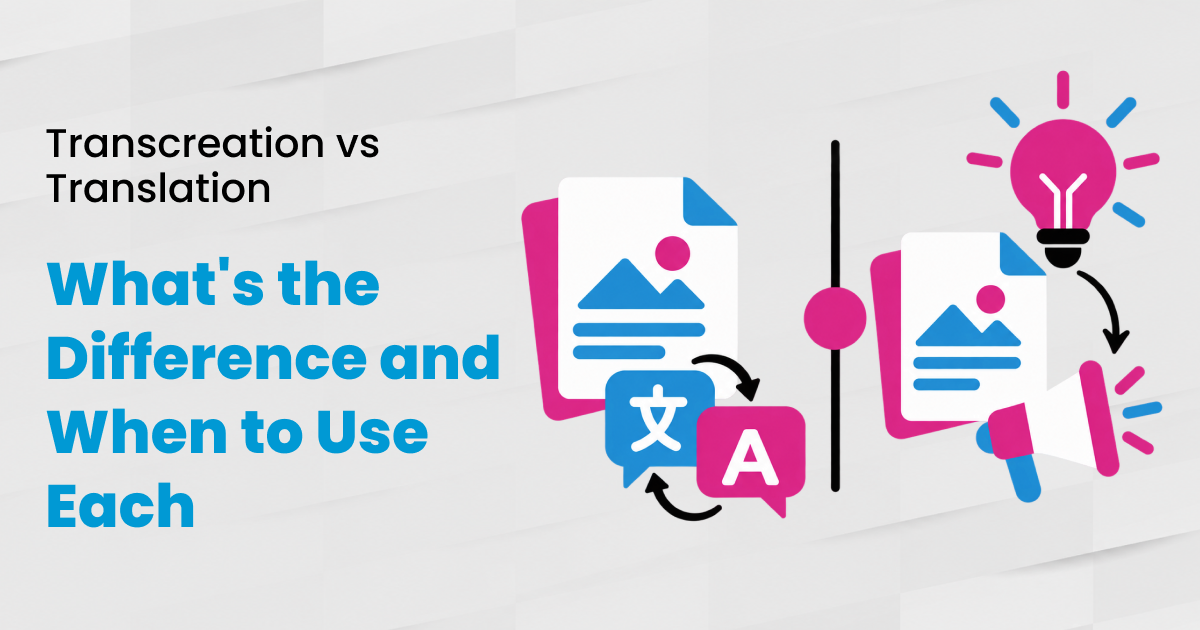
Marketing localization adapts an existing message so it works in a new market. Transcreation rewrites the message so it produces the same response, even when almost none of the original words survive. The difference is not quality. It is mandate.
Localization, often abbreviated to l10n, covers language, currency, date and number formats, imagery, legal claims, call-to-action conventions, and the proof points that carry weight in a given market. The target text stays tethered to the source. A reviewer can hold the two side by side and confirm they say the same thing.
Transcreation cuts that tether. The linguist works from a creative brief rather than a source string, which is why transcreation services are staffed with copywriters who happen to be native linguists rather than translators who happen to write well. It applies to taglines, hero claims, campaign concepts, ad copy with hard character constraints, video scripts and product naming. The deliverable is usually several routes plus a recommendation, not a single rendering.
Here is the practical test. If checking the target against the source would be meaningful, the asset is localization work. If checking it that way would be meaningless, because the target deliberately says something different in order to mean the same thing, the asset is transcreation work. Decide which mandate an asset carries before you brief anyone. Briefing a transcreation job as a translation job is the most common way marketing teams end up with flat copy and then blame the linguist.
Why literal translation breaks marketing but not documentation
Documentation survives literal translation because its job is to be unambiguous. Marketing does not, because its job is to be persuasive, and persuasion is built from idiom, rhythm, cultural reference and implied status. None of those travel on their own.
The failure points are specific and they repeat across accounts:
- Register. German and French force a formality choice on the first pronoun. Get it wrong and a friendly product voice reads either as a stranger being presumptuous or as a bank letter.
- Urgency norms. A hard-sell call to action that lifts conversion in the United States reads as pushy in Japan and as unserious in Germany.
- Regulated superlatives. Comparative and superlative advertising claims are constrained by competition law in several European markets, so a translated “best in class” can create legal exposure that did not exist in the source.
- Social proof conventions. Named customer logos persuade in some markets; certifications, local presence and headcount persuade in others.
- Text expansion. Translations out of English commonly run 20 to 35 percent longer, which breaks button labels, ad character caps and hero layouts designed around the English string.
The takeaway is not that marketing needs more budget than documentation. It is that the damage concentrates in a small number of very short assets. In marketing and advertising localization, the tagline and the hero claim are usually under fifty words combined and account for most of the risk in the entire campaign. Protect those. Route the rest by volume.
Define brand voice before the first word is adapted
Brand voice survives translation only when it has been written down as rules a linguist in another country can apply without asking you. A list of adjectives is not a brand voice. A voice charter with worked examples, locked terms and an allowed tonal range is.
Most brand guidelines fail this test because they were written for an in-house team that already shares context. “Confident, human, never corporate” means something to a copywriter who sits three desks from the founder. It means nothing to a linguist in São Paulo working from a brief. A charter closes that gap in four layers.
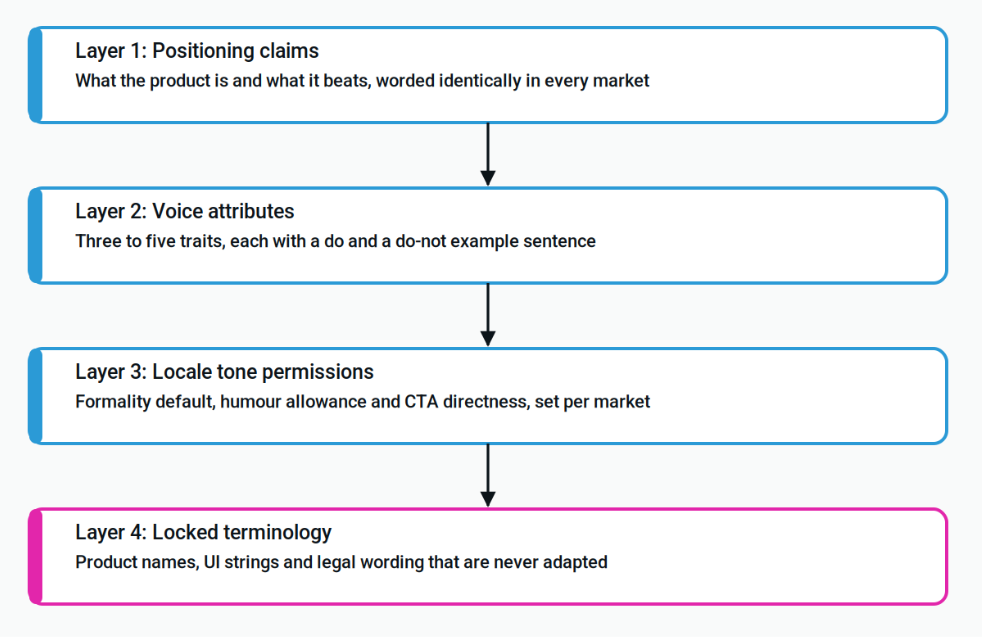
Layer 1: positioning claims
The sentences that state what the product is and what it beats. These must not drift. Fix the wording once, in the source, and treat every localized version as a rendering of that fixed claim rather than an opportunity to improve it.
Layer 2: voice attributes with worked examples
Three to five traits, each carrying a do and a do-not example sentence. “Confident” is unusable on its own. “Confident: state the outcome without hedging. Do: cuts onboarding to two days. Do not: can help reduce onboarding time” is a rule somebody can apply in any language.
Layer 3: locale tone permissions
Where the linguist is allowed to move, set per market. Formality default, whether humour is permitted, how direct a call to action may be, whether second person singular is acceptable. Without this layer linguists either play it safe and produce bland copy, or take liberties and produce copy the in-market reviewer rejects.
Layer 4: locked terminology
Product names, feature names, interface strings that appear inside marketing copy, legal and compliance wording, and competitor names. Everything in this layer goes into a glossary and a Translation Memory (TM) so approved phrasing is reused rather than reinvented on each asset and each quarter.
A charter takes about a day to write and removes most of the review cycles a localized campaign would otherwise burn. Glossary creation and style guide development appear on NexTranslate’s published add-on rates for exactly this reason. The point is not who builds it. The point is that somebody writes it down before the campaign rather than after the first bad draft.
Route content by risk, not by campaign
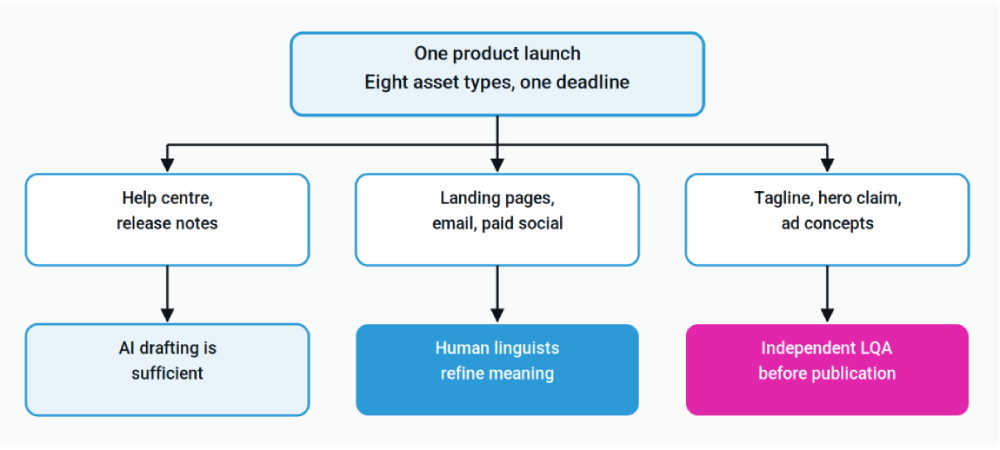
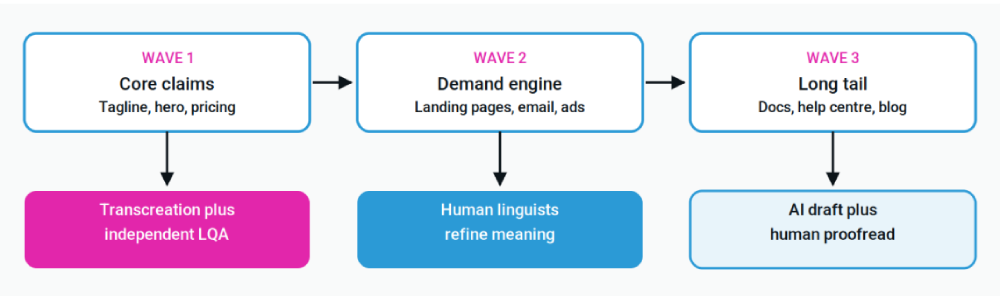
A campaign is not a workflow. Route every asset individually, because a single launch almost always generates work for all three workflow tiers at once.
The NEX Translation Matrix™ scores each piece of content on five inputs: content type, business risk, customer impact, regulatory requirement and quality expectation. Those five inputs resolve to one of three outcomes. AI drafting is sufficient. Human linguists refine meaning. Or the asset goes through independent Linguistic Quality Assurance (LQA) before publication, with a second linguist signing it off.
State the routing rule explicitly, because this is where teams get it wrong: the matrix routes content, not projects. A single release usually produces all three outcomes at once, so routing runs per string or per document, never per job.
| Asset | Business Risk | Workflow Outcome | Typical Tier |
|---|---|---|---|
| Tagline, hero claim, campaign concept | High | Transcreation, independent sign-off | Project rate |
| Paid social and display with character caps | High | Transcreation, independent sign-off | Project rate |
| Landing pages and pricing page copy | Medium to high | Human linguists refine meaning | Professional |
| Lifecycle and nurture email | Medium | Human linguists refine meaning | Professional |
| Case studies and customer quotes | Medium | Human linguists refine meaning | Professional |
| Regulated claims, legal and compliance copy | High | Independent LQA before publication | Premium |
| Press releases and analyst briefings | Medium | Human linguists refine meaning | Professional |
| Release notes and product changelogs | Low | AI drafting is sufficient | Economy |
| Help centre articles and FAQs | Low | AI drafting is sufficient | Economy |
| Long-form blog and SEO content | Low to medium | AI drafting is sufficient | Economy |
Two operational notes. First, the low-risk rows are not “machine translation and hope”. They are Machine Translation Post-Editing (MTPE), where a linguist edits the machine draft against a defined standard. ISO 18587, the international standard for post-editing of machine translation output, exists precisely because raw output is not a publishable deliverable. Second, the middle rows are ordinary translation and localization services and they carry most of the word volume in any campaign, which makes them the line item worth negotiating.
What transcreation costs, and why it is priced differently
Transcreation is usually priced by the hour or by the project, not by the word, because the deliverable is a small number of words that took a long time to find. Localization is priced per word. Mixing the two models is how marketing budgets get blown on a tagline and starved on the landing page that the tagline points to.
Consider the arithmetic. A tagline might be eight words. A transcreation team will produce three or four routes for it, pressure-test each against the voice charter, check for unintended meanings in the market, write a back-translation and a rationale for the recommended route, and iterate once after review. That is most of a day for eight words. Per-word pricing is meaningless at that ratio.
Meanwhile the landing pages, the email sequence and the help centre are genuine per-word work, they scale predictably, and they should be priced that way.
| Factor | Localization | Transcreation |
|---|---|---|
| Starting point | Source text | Creative brief and intent |
| Who does the work | Native linguist | Native copywriter with marketing background |
| Deliverable | One target version | Several routes plus a recommendation |
| Quality check | Accuracy against source | Back-translation plus written rationale |
| Pricing model | Per word | Per hour or per project |
| Typical volume share | Around 95 percent of campaign words | Around 5 percent of campaign words |
| Where budget goes wrong | Under-resourcing high-traffic pages | Applying it to content nobody reads for tone |
On the per-word side, published rates make the routing decision easier to defend internally. NexTranslate’s transparent translation pricing runs from USD 0.03 per word for low-risk content, through USD 0.07 for website and product copy, to USD 0.12 for regulated and high-exposure work, with human proofreading included at every tier rather than billed as a separate line. That matters for campaign budgeting because proofreading is commonly quoted at USD 0.02 to USD 0.05 per word elsewhere, which is enough to change which tier a given asset can afford.
Budget the campaign in two lines, not one. A creative line for the handful of assets that need rewriting, and a per-word line for the volume. A blended rate hides the fact that you are overpaying on one and underpaying on the other.
Run the campaign on one calendar, not one per locale
Localized campaigns slip because the source copy keeps changing after localization has started. Freeze the source, then run every locale off the same calendar with a named owner per market.
Five process decisions carry most of the schedule risk:
- Set a source freeze date and a rule for what happens after it. Post-freeze edits become a delta batch, not a re-brief. Without that rule, one copy change in the source restarts every locale.
- Name the in-market reviewer and book their time. The reviewer, not the linguist, is the real bottleneck in almost every localized campaign, because reviewing is nobody’s day job.
- Give reviewers a structured form, not an open document. Ask whether the claim is accurate, whether the tone is permitted, and whether the terminology matches the glossary. Open comment threads invite rewriting, which restarts the cycle.
- Require a back-translation and rationale on transcreated assets. This is what lets a marketing lead who does not speak the language sign off on intent rather than on wording, and it is the single highest-leverage artefact in the whole process.
- Book the format work separately. Desktop publishing for designed layouts, subtitle timing for video, and character-cap checks for paid social and app store listings are production tasks, not linguistic ones, and they get forgotten in the schedule.
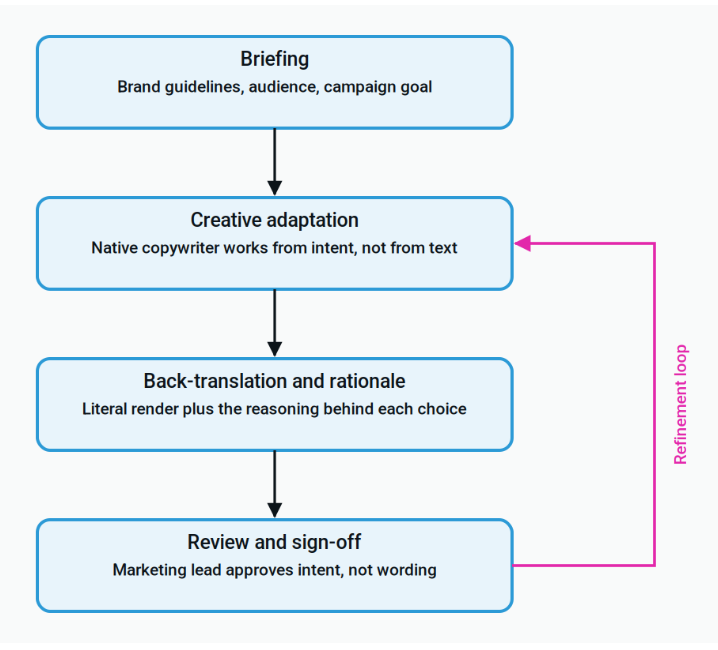
There is also a cadence decision underneath the calendar. Campaign bursts run as batches. The assets that keep changing after launch, the product pages, the pricing page and the help centre, are better handled as continuous localization through a Translation Management System (TMS) that picks up changed strings automatically. Teams that batch everything end up with locales that are three releases behind, and teams that run everything continuously pay for a pipeline their campaign assets do not need.
Measure the localized campaign, not just the translation
A localized campaign is measured against the source market’s conversion rate for the same asset, not against an abstract quality score. Quality scoring tells you whether the language is right. Conversion tells you whether the message is.
Set the measurement up before launch, because retrofitting it is usually impossible. Three things need to be true on day one. Language and market must be tracked as separate dimensions, since a Spanish-language visitor in the United States is not a Mexico visitor and blending them will hide both. Each locale needs its own conversion baseline, compared against the source market for the same asset at the same funnel stage. And the comparison needs a ramp period, because a new locale has no brand recall, no retargeting pool and no organic footprint yet.
On the quality side, LQA scoring against a defined error typology gives you a defensible number to sit next to the conversion number. That pairing is what lets you diagnose an underperforming locale. A clean quality score with poor conversion points at the message or at market fit. A poor quality score with poor conversion points at the workflow tier the asset was routed to.
Two search-side notes belong in the same measurement plan. Localized pages need in-language keyword research rather than translated keywords, which is a different exercise and is covered in more depth in NexTranslate’s multilingual SEO guidance. And AI answer engines now handle a growing share of in-language buyer questions, which rewards a specific shape of content: claims stated plainly in single sentences, questions answered directly before they are expanded, and a genuine in-language FAQ rather than a translated wall of prose. Campaign copy that was transcreated well tends to do badly here unless somebody also writes the plain-language version.
Five failure modes, and the fix for each
Localized campaigns fail in predictable ways, and every one of these failures is a process failure rather than a linguistic one. The linguist is almost never the problem.
- Transcreating everything. The budget goes on help centre articles and there is nothing left for the assets that carry the brand. Fix: route per asset using the matrix, and cap the creative line at the assets that genuinely need it.
- Translating everything. The tagline arrives literal, the hero claim arrives legally awkward, and the campaign reads as though it was assembled by somebody who has never been to the market. Fix: identify the top five percent of words and protect them.
- No voice charter. Every locale produces a slightly different brand, and nobody can say which one is correct because the standard was never written down. Fix: write the four layers before kickoff.
- Unowned in-market review. Copy sits in a review queue for three weeks, then gets rewritten by a sales lead who was never briefed. Fix: name the reviewer, book the window, and give them a structured form.
- Design built around English string lengths. The German hero headline wraps to three lines and the call-to-action button clips. Fix: give the designer expansion allowances before layout is locked, and proof the longest locale rather than the easiest one. Proper internationalization (i18n) of the product and the templates is what makes this a design decision rather than a launch-week emergency.
Frequently Asked Questions
1. What is the difference between marketing localization and transcreation?
Marketing localization adapts an existing message so it works in a new market while staying recognisably the same message. Transcreation rewrites the message from a creative brief so it produces the same response, even when almost none of the original words survive. Localization is checked against the source. Transcreation is checked against the intent, which is why it ships with a back-translation and a written rationale.
2. Does every marketing asset need transcreation?
No. In a typical product launch, well under a tenth of the words need it. Taglines, hero claims, ad concepts and anything with a character limit or a pun need a copywriter working in the target language. Landing page body copy, lifecycle email, release notes and help centre content are localization work, and routing them to a creative workflow costs more without improving performance.
3. How much does marketing localization cost?
Localization is priced per word and transcreation is usually priced per hour or per project, so a campaign budget needs both lines. Published per-word rates at NexTranslate run from USD 0.03 for low-risk content to USD 0.12 for regulated and high-exposure work, with human proofreading included at every tier rather than billed as an extra.
4. How long does transcreation take compared with translation?
Transcreation takes far longer per word, because the linguist produces several routes, tests them against the market and the brand charter, and writes a rationale for the one they recommend. A single tagline can take a day. Per-word localization of a landing page or an email sequence runs on standard turnaround, typically 24 to 48 hours at the volumes one campaign produces.
5. Can AI handle marketing translation?
AI handles the volume well and the voice badly. Machine output is a strong starting draft for help centre content, release notes and long-form blog posts. It is unreliable wherever rhythm, idiom or a regulated claim is doing the work. ISO 18587 exists because machine output is expected to be post-edited by a human before publication, and marketing is the content type where that editing layer matters most.
6. How do you keep brand voice consistent across languages?
Write the voice down as rules a linguist in another country can apply, then enforce them with tooling. That means a voice charter with do and do-not examples, a locked glossary of product and legal terms, and a translation memory so approved phrasing is reused rather than reinvented on every asset.
Conclusion: brand voice is an operations problem, not a language problem
The teams whose campaigns travel well are not the ones who spend the most per word. They are the ones who decided, before the brief went out, which assets carry the brand and which carry the volume. They wrote the voice down in a form somebody in another country could apply. They froze the source, named the reviewer, and asked for a back-translation so the sign-off meant something. Everything else is execution.
If a launch is already on the calendar, start with the routing table above and the four charter layers. If you want the creative assets handled by native copywriters who work from intent rather than from source strings, we handle creative adaptation for global campaigns alongside per-word localization on the same timeline, so one campaign does not need two vendors and two calendars. Send us the asset list and the launch date and request a quote, and we will come back with the routing and the two budget lines rather than one blended rate.
- Filed under / Localization