

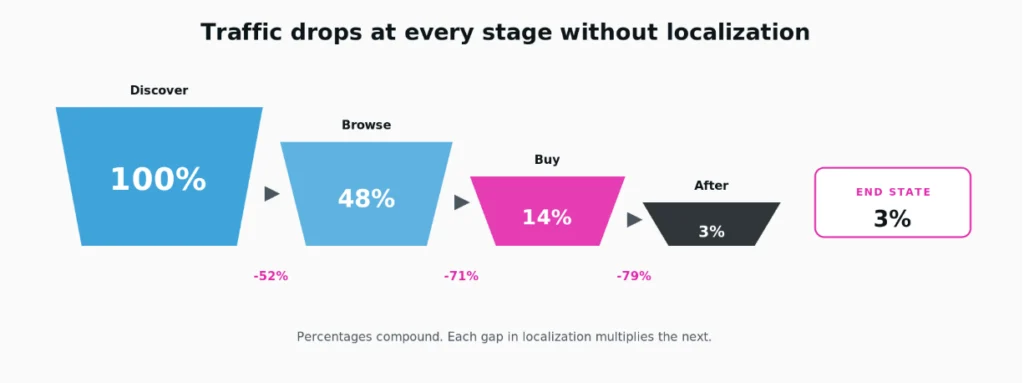
Most online shoppers refuse to buy in a language they cannot read fluently. CSA Research puts the number at 76 percent who prefer to buy in their native language, and 40 percent who will not buy from a foreign-language site at all. That is the ceiling on your international revenue if your store ships in English only. The product is fine. The prices are competitive. The traffic is real. The shopper still bounces at the product page or drops the cart at checkout.
Ecommerce website translation is how you unblock that traffic. Done well, it turns visitors in Madrid, Tokyo, Sao Paulo, or Berlin into buyers who trust the store enough to complete a checkout in their own language, currency, and payment method. Done badly, it produces a store that reads correctly on the homepage and breaks silently at every stage after that.
This guide is a step-by-step playbook for store owners. What to translate at each stage of the shopping journey, which translation method fits which type of content, how to localize prices, payments, and shipping, how multilingual SEO works, and a 30-day launch plan you can copy into your project tracker.
QUICK ANSWER
Ecommerce website translation converts your product pages, checkout, emails, and support content into your customers’ languages, then localizes prices, payments, shipping, and SEO for each market. The best results come from AI translation for scale on large catalogs, native linguist review for high-impact pages such as checkout and top sellers, and a workflow that keeps new products translated automatically as they publish.
Why ecommerce website translation drives global sales
Ecommerce revenue moves in the same direction as language access. Every barrier between a shopper and a familiar buying experience compounds into a lower conversion rate. Translation removes the biggest barrier, but it works only when it is paired with the localization pieces buyers expect.
Five reasons ecommerce website translation is a growth lever in 2026:
- Shoppers buy more in their own language. CSA Research reports 76 percent of consumers prefer buying in their language, and 40 percent will not buy at all from a site in another language.
- Local currency and payment methods raise conversion and cut cart abandonment. Baymard research puts checkout abandonment above 70 percent, with unfamiliar payment options and confusing pricing among the top causes.
- Localized product pages earn more organic traffic. Local-language SEO surfaces you for the terms shoppers actually search, not literal translations of English keywords.
- Trust rises with returns policy, reviews, and customer support in the shopper’s language. Return and refund clarity in the local language reduces support ticket volume and one-star reviews.
- Cross-border ecommerce continues to outgrow domestic ecommerce. Any market entry that gets translation right captures compounding revenue for years, not months.
Ecommerce translation vs ecommerce localization
Translation is the linguistic layer: converting product titles, descriptions, buttons, error messages, and emails from one language to another. Localization is broader: adapting the store for a market, including currencies, sizes, payment methods, shipping, imagery, cultural fit, and legal compliance.
A UK fashion store selling into Germany and the UAE illustrates the difference. Translation handles the product copy in German and Arabic. Localization handles EUR and AED pricing, EU size conversions, Arabic right-to-left layout, Klarna in Germany and Tabby in the UAE, and Ramadan promotion timing. For a deeper explanation of translation vs localization as a general concept, see our complete Website Translation Services guide.
For ecommerce specifically, the rest of this post covers what to translate and how, then how to localize the pieces of the shopping experience that most stores miss.
What to translate on your ecommerce website across the shopping journey
The most common failure mode of ecommerce translation is translating the homepage and product pages, then leaving the checkout, emails, help center, and product feeds in English. The shopper reads a beautifully translated product description, adds it to cart, and abandons at the first English-language error message. Organizing by shopping journey stage prevents this.
Discovery: SEO metadata, category pages, product feeds, and ads
Where shoppers first find you. Translate SEO meta titles and descriptions, category and landing pages, product feeds for Google Shopping and Facebook, search and social ads, social captions, and image alt text. Local keyword research (not literal translation of your English keywords) is what earns rank in the target market.
Browsing: product pages, reviews, and Q and A
Where shoppers evaluate what to buy. Translate product titles, descriptions, specifications, size guides, variant names, text inside product images, video subtitles, product page FAQs, customer reviews, and Q and A threads. Product pages carry the most weight per word for conversion, so this is where an AI plus native linguist workflow pays back fastest.
Buying: cart, checkout, and payment
Where translated stores lose the most money. Translate cart and mini-cart messages, form fields, address format labels, error and validation messages, shipping and tax copy, payment method names, promo code copy, and trust badges. Checkout localization is where full human translation plus functional testing earns its cost, because a single unclear error message drops conversion on every visit.
After purchase: emails, returns, and support
Where retention and repeat purchase happen. Translate order confirmation emails, shipping notifications, invoices, returns and refund policy, help center articles, chatbot copy, and customer support macros. Returns policy clarity in the local language is one of the strongest predictors of second-purchase rate.
Legal and policy pages
Terms of service, privacy policy, cookie banner, warranty, and consumer rights. Recommend human translation with a legal-specialist linguist rather than raw AI, because errors here create regulatory exposure that costs more than the translation.
How to choose the right translation method for each content type
One translation method does not fit an entire ecommerce store. Product descriptions, checkout copy, marketing headlines, and legal pages have different quality bars, different volumes, and different consequences for getting wrong. Matching content type to method is the single decision that most improves cost efficiency without sacrificing conversion.
Four methods cover most needs. Raw machine translation runs at high speed and low cost with no human review. Machine translation post-editing (MTPE) uses AI for the first pass and a native linguist for review, refinement, and terminology enforcement. Full human translation uses a native linguist end to end for maximum accuracy and brand voice. Transcreation rewrites campaigns, taglines, and ads creatively for the target market rather than translating them literally.
The table below sets the recommended method for each of the ten most common ecommerce content types, with the reasoning for each pick.
| Content type | Recommended method | Why |
|---|---|---|
| Long-tail product descriptions (large catalogs) | AI plus human review (MTPE) | Volume makes full human uneconomic; AI catches the meaning and a linguist enforces terminology |
| Top-selling product pages | Full human translation | Every conversion counts; brand voice and nuance are worth the incremental cost |
| Homepage and category pages | Full human translation | First impression; drives most navigation and organic search entries |
| Checkout and cart | Human plus functional testing | Zero tolerance for confusion; tested on the live UI before launch |
| Marketing campaigns, ads, and taglines | Transcreation | Creative adaptation, not translation; needs marketing-specialist linguists |
| Customer reviews (user-generated) | Machine translation with visible label | Volume; preserves authenticity when labeled “translated automatically” |
| Legal and policy pages | Specialist human translation | Regulatory exposure; cheap to get wrong is expensive to fix |
| Transactional emails | AI plus human review (MTPE) | Structured, repetitive templates; linguist verifies tone and variables |
| Help center articles | AI plus human review (MTPE) | High volume; consistency matters more than creative flourish |
| SEO metadata and slugs | Human with local keyword research | Direct impact on organic ranking; needs market-specific keyword input |
How to localize your online store: 9-step process
A repeatable process makes the difference between a first-market launch that ships in 6 weeks and one that stalls for 6 months. Each step below has a target output and a rough timeline. The full process usually takes 4 to 8 weeks per market for a mid-sized store, depending on catalog size and platform.
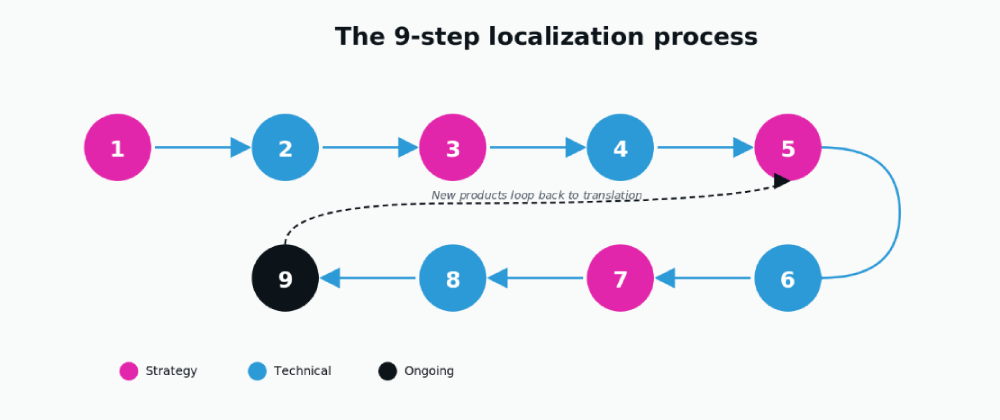
Step 1: Pick your target markets using data
Pull Google Analytics traffic by country, abandoned checkouts by country, marketplace demand data (Amazon, Etsy, Zalando), and shipping feasibility per market. Start with 1 to 3 markets, not 10. The most common first three for global D2C brands in 2026 are Germany, France, and either Brazil or Japan, though your traffic data trumps generalities.m
Step 2: Prioritize pages and products
Top-selling products, highest-traffic category pages, the full checkout, and the top-performing marketing landing pages first. Blog content and long-tail catalog products go in a second wave. Auditing first prevents the trap of translating archived collections before the pages that actually convert.
Step 3: Set up your platform for multiple languages
Every major ecommerce platform supports multilingual stores. Shopify Markets handles storefront language and currency per market. WooCommerce runs through WPML, Polylang, or TranslatePress. Magento (Adobe Commerce) uses store views. BigCommerce uses multiple storefronts. Pick the platform-native approach where possible, because third-party plugins introduce sync and SEO edge cases.
Step 4: Build a glossary and brand style guide
A glossary defines product terminology, brand names that stay in English, and industry-specific vocabulary. A style guide sets tone of voice per market, size and measurement rules, capitalization conventions, and how to handle unit conversions. Both are built once and reused on every future product launch, which lowers cost on every subsequent update.
Step 5: Translate and localize product content
AI first-pass translation for scale on large catalogs, native linguist review for brand voice on high-value pages. Translation memory catches repeated phrases across similar products, cutting cost on catalogs with high variant density. Localize units (metric or imperial), sizes (US, EU, UK), and imagery references (celebrities, cultural context) at the same time as the words.
Step 6: Localize prices, payments, and shipping
Display prices in local currency with sensible rounding (49.00 in EUR often reads better than 49.99 in some markets, and vice versa). Show tax-inclusive pricing where required by law (EU) and tax-exclusive where standard (US). Offer local payment methods: iDEAL in the Netherlands, UPI in India, Klarna and Sofort in Germany and the Nordics, Pix in Brazil, Alipay and WeChat Pay in China. Localize shipping times, duties, and returns policy per market.
Step 7: Optimize for multilingual SEO
Local keyword research per market, not literal translation of English keywords. Translated URLs and slugs, localized product structured data (schema.org Product with language and price attributes), hreflang tags, and multilingual XML sitemaps. For markets with local search engines (Baidu in China, Yandex in Russia, Naver in South Korea), submit to those in parallel. For the SEO layer in more depth, see our multilingual SEO deep-dive.
Step 8: Test the full shopping experience
Native-speaker test purchase from search result through order confirmation email. Mobile checkout in each locale. Layout checks for text expansion (German runs 30 percent longer than English) and right-to-left support for Arabic and Hebrew. Email trigger checks (welcome, cart abandon, shipping, review request). Currency and tax accuracy at every step. Full linguistic quality assurance before soft launch catches the errors that break trust.
Step 9: Keep new products and promotions translated
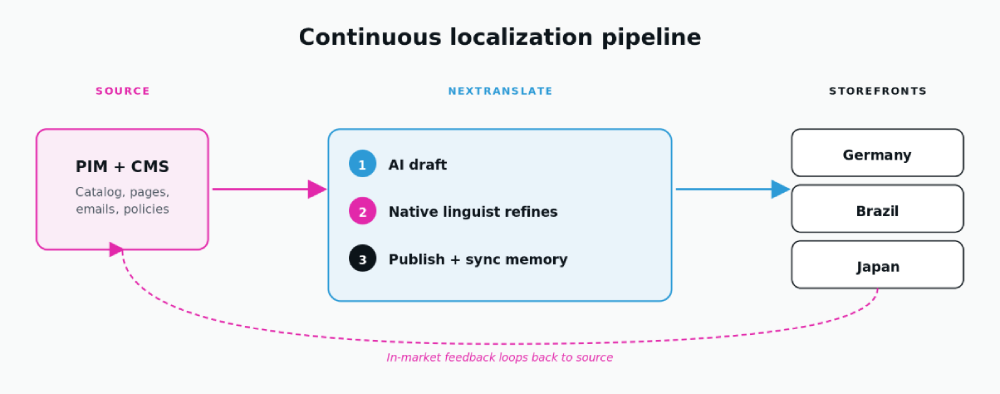
Every store adds new products, seasonal campaigns, and promotional pages every week. A continuous localization workflow connects the CMS or PIM to the translation platform via API or connector. New content flows into translation automatically. Seasonal campaigns (Singles’ Day in November, Diwali in October or November, Black Friday, Ramadan) go on the calendar so translations land ahead of the campaign, not after.
Ecommerce localization checklist by market element
The table below is a scannable reference for the elements that need per-market localization. Copy it into your project tracker and mark each element as Done, In Progress, or Not Applicable per target market.
| Store element | What to localize | Example |
|---|---|---|
| Currency | Symbol, position, decimal separator | USD $49.99, EUR 49,99 €, JPY ¥5,400 (no decimals) |
| Pricing format | Rounding, tax inclusion, price psychology | EU shows tax-inclusive; JP rounds to whole yen |
| Payment methods | Local methods above card only | iDEAL, Klarna, Pix, UPI, Alipay, WeChat Pay |
| Sizes and units | Size charts, measurement units | EU vs US sizes for clothing, metric vs imperial |
| Date and address formats | Order dates, delivery estimates, address fields | DD.MM.YYYY in DE, YYYY/MM/DD in JP, postal code position |
| Shipping and delivery | Carrier options, timelines, duties | DHL in DE, Yamato in JP, local last-mile in BR |
| Returns policy | Window, cost, legal minimum | EU 14-day right of withdrawal, UK 14-day consumer contracts |
| Imagery and models | Diverse models, market-relevant scenes | Winter clothing on southern-hemisphere stores in July |
| Holidays and promotions | Local shopping events, cultural moments | Diwali in IN, Golden Week in JP, Singles Day in CN |
| Customer support | Hours, language, channel preference | WhatsApp in BR, LINE in JP, live chat in DE |
Compliance and legal considerations for global stores
Ecommerce compliance requirements vary by market and change every year. This section covers the frameworks most stores need to know about. It is not legal advice. Confirm current requirements with a local advisor before launch, especially for regulated categories such as food, cosmetics, electronics, or medical devices.
- European Union. GDPR sets data privacy rules. The EU General Product Safety Regulation (GPSR) requires specific product safety information in the local language of the market of sale. The Omnibus Directive requires “was and now” pricing history transparency and prohibits fake reviews. Cookie consent must be granular and opt-in.
- France. Toubon Law requires certain commercial content in French for the French market. Product descriptions, warranties, and consumer safety information must be available in French.
- Quebec. Charter of the French Language requires French to be predominant on Quebec-facing storefronts. Bill 96 updates strengthened this in 2023 and 2024.
- United Kingdom. UK data protection law post-Brexit is broadly aligned with GDPR. Consumer contract regulations mirror EU return rights with local nuances.
- California. CCPA and its 2023 updates require privacy disclosures. Not language-specific but often overlaps with translation projects for Spanish-language storefronts.
- Brazil. LGPD (data protection) and consumer defense code (CDC) shape both privacy and returns requirements.
The general rule: consumer-facing legal content (terms, privacy, warranty, returns, product safety) usually needs to be in the language of the market of sale. Translate these with specialist human linguists, not raw AI.
Selling on global marketplaces: translating listings
If your store also sells on global marketplaces, listing translation follows a different playbook than storefront translation. Marketplaces impose their own SEO signals, character limits, and content structure per market.
- Amazon. Localize title, bullet points, backend search keywords, and A+ content per marketplace. Amazon uses different ranking signals per country storefront, so keyword research is per marketplace, not per language.
- eBay. Localize title, item specifics, description, and category selection per country site. Each site indexes differently.
- Zalando. Europe-focused. Requires localized product content per country and works best with brand-approved translations.
- Noon. Middle East focused. Arabic and English side by side with right-to-left layout for Arabic.
- Mercado Libre. Latin America focused. Portuguese for Brazil, Spanish for the rest, with market-specific size and shipping conventions.
Launching your store in a new market?
NexTranslate translates product catalogs, checkout flows, and marketing content in 60+ languages, with AI speed, native linguist review, and QA included at proofreading-only pricing.
Common ecommerce translation mistakes that kill conversions
Eight patterns show up repeatedly in ecommerce translation projects that underperform. Each one is preventable with the process above, but they are common enough to name explicitly.
- Translating the homepage and product pages but leaving checkout, emails, or size guides in English. The shopper hits the language wall at the moment of highest intent.
- Raw machine translation on top-selling product pages. Saves a small amount of money and costs a larger amount of conversion.
- Showing foreign currency or offering no local payment options. Cart abandonment spikes at the payment step.
- Literal keyword translation instead of local keyword research. The pages exist but never rank in the target market.
- Forgetting image text, videos, and product feeds. Google Shopping and social ads still show English creative even when the storefront is localized.
- No process for translating new products. The store starts fully translated at launch and drifts to half-translated within a quarter.
- Ignoring cultural details: colors with negative meaning, models that do not reflect the market, sizes in the wrong system, holidays scheduled for the source market.
- Auto-redirecting shoppers by IP without a language switcher. Breaks VPN users and confuses users who prefer a different language than their location.
Your 30-day ecommerce localization launch plan
The full 9-step process above takes 4 to 8 weeks for most mid-sized stores. If you are running a compressed timeline, the 30-day plan below focuses on the highest-impact work first. Adjust the volume per week to your team size and catalog depth.
| Week | Focus | Key tasks |
|---|---|---|
| Week 1 | Scope and prepare | Pick 1 to 3 target markets from traffic data. Prioritize top 20 products, checkout, top 3 landing pages. Build a glossary and style guide. Choose translation partner. |
| Week 2 | Translate high-impact content | Translate top 20 product pages, homepage, category pages, checkout flow, cart messages, error strings, welcome email, order confirmation email, cart abandon email. |
| Week 3 | Localize commerce and SEO | Set up currency and local payment methods. Add local shipping options and returns policy. Translate legal pages with specialist. Run multilingual SEO: hreflang, meta, sitemaps, structured data. |
| Week 4 | Test, soft launch, measure | Native-speaker test purchase in each market. Mobile checkout QA. Layout and RTL testing. Soft launch with a controlled traffic slice. Measure conversion rate, cart abandon, tickets, and returns by locale. |
KPIs to track from day one of the soft launch: conversion rate by locale, cart abandonment rate at each step, organic traffic by language, return rate by market, and support ticket volume per locale. These four numbers tell you whether the localization is working and where to invest next.
How NexTranslate helps online stores go global
NexTranslate serves E-commerce and Retail as a core industry vertical. Our translation and localization service is built for the volume, velocity, and quality demands of a global storefront.
- AI draft for speed on large catalogs, refined by native linguists for brand voice and accuracy on high-impact pages.
- Translation, proofreading, and QA included in the base price at proofreading-only pricing (most vendors bill proofreading separately).
- 60 plus languages with certified linguists and domain specialists across fashion, electronics, beauty, home goods, and health.
- Website and app localization, marketing transcreation, MTPE, and linguistic QA in one workflow.
- 24/7 turnaround with a dedicated project manager. Useful for product launches, seasonal campaigns, and rapid response to inventory changes.
For per-word pricing details, see our transparent translation pricing.
Frequently asked questions
What is ecommerce website translation?
Ecommerce website translation converts your online store’s product pages, checkout, emails, and support content into your customers’ languages, then localizes prices, payments, shipping, and SEO for each market. See our ecommerce translation services page for the full scope.
How do I translate my ecommerce website?
The 9-step process: pick markets from data, prioritize high-impact pages, set up the platform for multiple languages, build a glossary and style guide, translate content with a hybrid AI plus human workflow, localize prices and payments, optimize multilingual SEO, test the full experience, and set up continuous localization for new products.
Can I use machine translation for product descriptions?
For long-tail catalog descriptions in large stores, AI plus human review (MTPE) is the current best-value approach. For top-selling product pages and marketing copy, full human translation earns its cost through higher conversion. Raw machine translation without human review works only for user-generated content such as reviews, where the label “translated automatically” preserves authenticity.
How do I translate a Shopify or WooCommerce store?
Shopify Markets offers native multilingual storefronts with per-market language, currency, and pricing. WooCommerce uses WPML, Polylang, or TranslatePress plugins. Both integrate with translation platforms via API, connector, or plugin, so content flows from CMS to translation and back automatically.
Which languages should my online store support first?
Pull traffic and cart data before deciding. Common first three markets for D2C brands in 2026 are Germany, France, and either Brazil or Japan, but your data trumps averages. The strongest signal is where you already have organic traffic and abandoned carts, because those markets have already shown demand without any translation investment.
Does translating my online store help SEO?
Yes, if the translation is paired with multilingual SEO: local keyword research, translated URLs and metadata, hreflang tags, and multilingual sitemaps. Translation without multilingual SEO produces pages that exist in the target language but do not rank in the target market.
How much does ecommerce website translation cost?
Cost depends on catalog size, target languages, and the mix of methods (MT, MTPE, human, transcreation) applied to different content types. Hybrid AI plus human workflows in 2026 typically run $0.07 to $0.12 per source word. Full human translation runs $0.15 to $0.25 per word. For a general framework on pricing drivers, see the cost breakdown in the pillar guide.
How do I keep translations updated when I add new products?
Set up continuous localization at launch, not after. A connector between your CMS or PIM and the translation platform pushes new product content into translation automatically, then merges the translations back into the storefront. Cadence is usually 24 to 72 hours from source publish to translated locale, depending on the tier chosen.
Should I translate customer reviews?
Yes, with raw machine translation and a visible “translated automatically” label. This preserves authenticity (reviews stay in the reviewer’s original language on request), scales to the volume of reviews modern stores accumulate, and gives shoppers in the target market useful signal without paying for human translation on every review.
Conclusion
Ecommerce website translation is not one project. It is a program that runs for as long as your store adds products and enters new markets. The stores that get this right start with data-backed market selection, translate the full shopping journey (not just the homepage), match content type to the right translation method, localize the pieces that actually block conversion (prices, payments, checkout, returns), and set up continuous localization from day one so the store does not drift out of sync as new SKUs land.
At NexTranslate, we help ecommerce and retail brands ship into new markets with hybrid AI plus human translation, native linguist review on every project, and dedicated project managers for high-velocity catalogs. To scope your project, contact our team.
Get your ecommerce translation quote
Send us your store URL and target markets. We will come back with a scoped quote covering product catalogs, checkout, marketing, and emails at proofreading-only pricing.
Written by Karuppusamy Arunachalam, Founder, NexTranslate
Last updated [October 2026] · Filed under Industry Use Cases