




Most teams frame this as a budget decision. Machine translation post-editing is cheaper, human translation is better, pick based on what you can afford. That framing quietly costs money in both directions. It leads teams to pay full human rates for content nobody will scrutinize, and to run bare machine translation on the exact copy where an error triggers a refund, a complaint, or a compliance problem.
The real question is not which is cheaper. It is which approach matches the risk and purpose of a specific piece of content. Get that mapping right and you can cut translation spend meaningfully without lowering the quality of anything that matters. Get it wrong and you either burn budget or ship errors, sometimes both in the same project.
This guide compares MTPE and human translation across cost, quality, and speed, and introduces the NEX Translation Matrix™, a practical decision framework for selecting the right workflow for every content type.
What is machine translation post-editing?
Machine Translation Post-Editing (MTPE) is a workflow where a machine translation engine produces a first draft and a professional human linguist edits it to the required quality level. It is not raw machine output, and it is not translation from scratch. It sits between the two. Machine translation post-editing is the standardized name for this process, defined internationally by ISO 18587.
The engine handles the mechanical conversion at speed. The human handles what machines still get wrong: context, terminology, tone, and the judgment calls that decide whether a sentence is merely correct or actually right. Because the linguist is refining rather than typing every word, the work is faster and cheaper than translating from a blank page.
The key thing to understand is that MTPE is a spectrum, not a single service. How much the human changes depends on the quality bar the content needs, which is where light and full post-editing come in later.

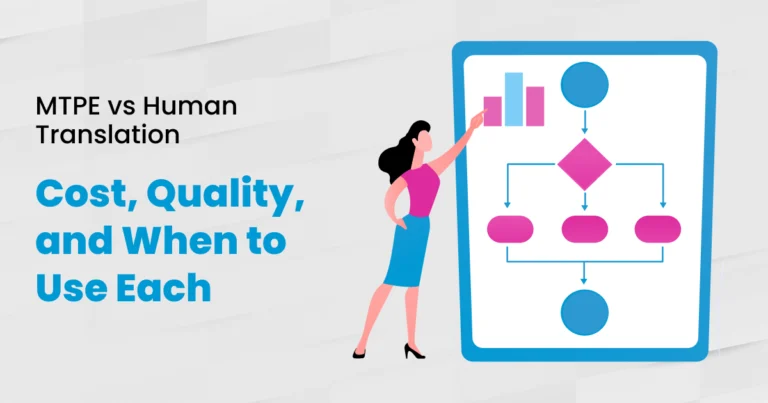
The MTPE workflow. A machine draft is refined by a human editor, quality-checked, and approved, rather than translated from scratch.
What is full human translation, and when does it earn its cost?
Full human translation is a professional linguist translating from the source with no machine draft as the starting point. It earns its higher cost on content where fluency, nuance, and brand voice are the whole point, not a nice-to-have.
A human translator working from scratch makes different choices than an editor cleaning up a machine draft. They can restructure a sentence entirely, carry a metaphor across languages, or adapt an idea to a local market rather than translating its words. On a supplement claim, a slogan, or a legal clause, that difference is not cosmetic. It is the difference between a translation that reads as native and one that reads as translated.
The cost is justified when the content is customer-facing, persuasion-driven, or legally sensitive. It is harder to justify on a 40,000-word internal knowledge base that three support agents will ever read.
Cost: How much does MTPE actually save?
MTPE typically costs 30 to 60 percent less than full human translation for the same word count, depending on language pair, content type, and engine quality. The savings are real, but they are not fixed.
The saving comes from editor effort, not magic. When the machine draft is good, the editor makes light corrections and the price drops sharply. When the draft is poor, for a rare language pair or highly specialized content, the editor is effectively retranslating, and MTPE can end up costing as much as or more than human translation. This is the trap teams miss when they assume MTPE is always the budget option.
This is also why proofreading policy matters to the true cost. NexTranslate includes human proofreading at every tier of its transparent translation pricing, where many providers charge it separately, which is often where a cheap-looking per-word MTPE rate quietly inflates.
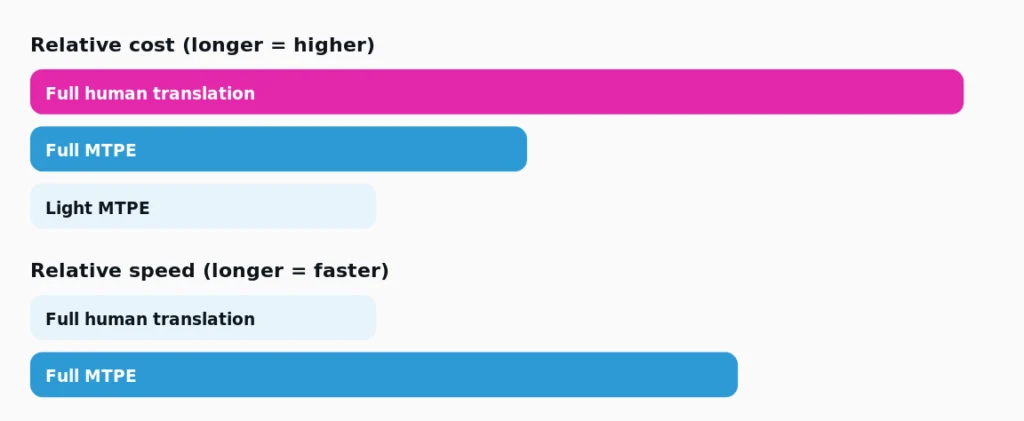
Relative cost and speed of the three approaches. Light MTPE is the cheapest and fastest, full human translation the most expensive.
Quality: Can MTPE match human translation?
Full MTPE can reach a quality level that is difficult to distinguish from human translation on many content types, but only with skilled editors and a structured quality step. Without a review layer, machine drafts carry consistency and context errors that a spellcheck never catches. That review layer is linguistic quality assurance (LQA).
The gap between MTPE and human translation is narrowest on structured, factual content and widest on creative and persuasive content. A product spec, a manual, or a support article post-edited well is genuinely publication-ready. A brand tagline or an emotionally driven landing page often is not, because the machine draft anchors the editor to the source structure and away from the rewrite the copy actually needs.
For content where the machine draft is the wrong starting point, the answer is not better editing. It is choosing full translation and localization services or transcreation instead.
Speed: How much faster is MTPE?
MTPE is meaningfully faster than human translation, often on the order of 50 to 60 percent higher daily throughput, though the gain varies widely by language pair. Speed is the reason MTPE scales to large catalogs and continuous content that human-only workflows cannot keep up with.
A human translator handles a set volume of words per day. An editor post-editing a decent machine draft handles considerably more, and a light post-edit handles more still. For a SaaS company shipping product strings every sprint or an e-commerce brand with tens of thousands of SKUs, that throughput difference is what makes localization feasible at all. The trade is that raw speed only helps if the quality bar is met, which brings the choice back to content type.
MTPE vs human translation at a glance
| Factor | MTPE | Full Human Translation |
|---|---|---|
| Cost | 30 to 60% lower | Highest per word |
| Speed | Fast, high throughput | Slower, fixed daily volume |
| Best Content | Bulk, factual, repetitive | Creative, legal, brand-critical |
| Quality Ceiling | Near-human with good editing | Highest fluency and nuance |
| Main Risk | Weak draft raises real cost | Overpaying on low-stakes text |
Neither option wins outright. The right choice depends on the risk and purpose of the specific content.
Light vs full post-editing: The choice inside MTPE
Light post-editing fixes only what blocks understanding. Full post-editing brings the output to a standard indistinguishable from human translation. Choosing between them is the second decision after choosing MTPE at all.
Light post-editing accepts a functional, accurate result that may not be stylistically polished. It suits internal documentation, high-volume descriptions, and content where the goal is clarity, not persuasion. Full post-editing corrects grammar, tone, terminology, and flow to a publish-ready standard, and is recommended for anything customer-facing or regulated. NexTranslate offers both, and matches the level to the content rather than applying one setting to everything.
The practical rule: use light post-editing where a reader needs to understand, and full post-editing where a reader needs to trust.
The NEX Translation Matrix™
The NEX Translation Matrix™ is NexTranslate’s decision framework for selecting the right translation workflow for every content type. Instead of treating every word the same, the matrix evaluates content based on three factors: business risk, content purpose, and the quality required.
Rather than asking, “Should we use MTPE or human translation?”, the better question is, “What does this content need?” High-volume, low-risk content benefits from MTPE, while customer-facing, brand-critical, and regulated content deserves full human translation.
The NEX Translation Matrix™ visualizes this decision process, helping teams consistently route every content type to the appropriate translation workflow.
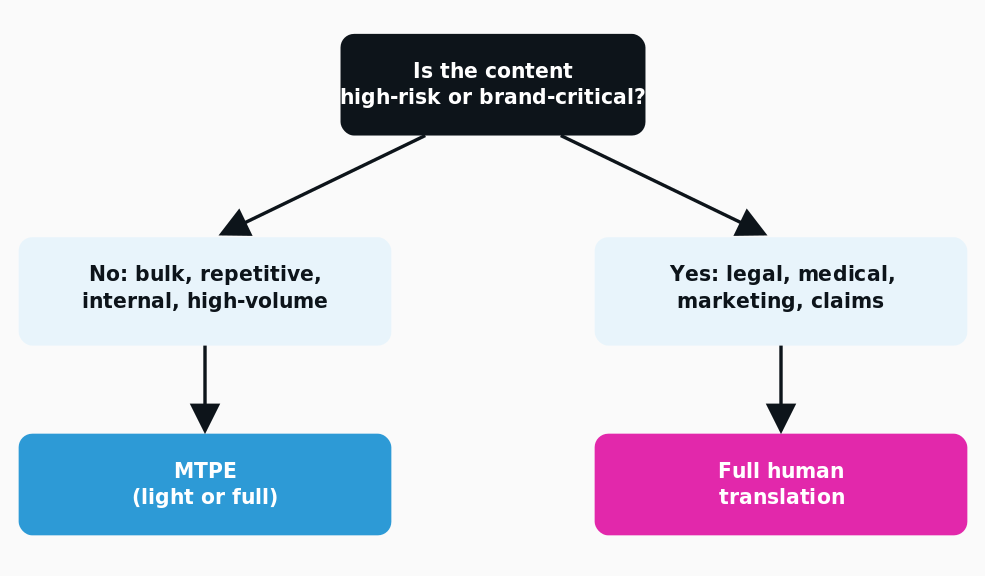
A simple routing rule. High-risk or brand-critical content goes to full human translation, everything else to MTPE at the right level.
In practice, the matrix helps teams apply this decision consistently across every localization project. In practice, the strongest localization programs do not choose MTPE or human translation once. They route each content type to the right approach and combine them inside a single workflow. This is the AI plus human model at the core of NexTranslate’s AI evaluation services and translation delivery.
A single product release might send UI strings through light post-editing, help-center articles through full post-editing, and the launch landing page through full human translation or transcreation. The buyer does not pick a philosophy. They apply a rule, content type by content type, and let the workflow assign the method.
That is how you capture the cost and speed of machines on the bulk while protecting quality where it counts.
For SaaS teams building this into a repeatable process, the SaaS localization playbook shows how the routing works across a full product surface.
Frequently asked questions
Is MTPE cheaper than human translation?
Usually, yes. MTPE typically costs 30 to 60 percent less than full human translation because the linguist edits a machine draft rather than translating from scratch. The exception is poor-quality machine output, where heavy editing can erase the saving. Cost depends on language pair, content type, and how much editing the draft needs.
Does MTPE reduce translation quality?
Not when it is done properly. With skilled editors and a linguistic quality assurance step, full post-editing reaches a quality level that is hard to distinguish from human translation on structured content. Quality drops only when machine output ships without adequate human review.
When should you use human translation instead of MTPE?
Use full human translation for high-stakes and brand-critical content: legal and compliance text, medical material, marketing copy, taglines, and anything where nuance, persuasion, or legal exposure is involved. For bulk, factual, and repetitive content, MTPE is usually the better value.
What is the difference between light and full post-editing?
Light post-editing fixes only what blocks understanding and accepts a functional result. Full post-editing corrects grammar, tone, terminology, and flow to a publish-ready, near-human standard. Use light for internal or high-volume content, and full for anything customer-facing or regulated.
How do I decide MTPE vs human translation for a project?
Route by risk and purpose, not by budget alone. Send bulk and factual content to machine translation post-editing, and reserve full human translation for brand-critical and regulated material. Most programs mix both in one workflow rather than choosing once.
Conclusion: match the method to the content, not the budget
MTPE versus human translation is the wrong question asked once. The right question is asked per content type: how much does an error here cost, and how much does polish here earn. Route bulk, factual, and repetitive content to MTPE, at light or full depending on the quality bar, and reserve full human translation for the copy that carries brand, legal, or emotional weight. That single discipline is what lets a localization budget stretch further without shipping anything worse.
If you want help applying the NEX Translation Matrix™ to your content, NexTranslate builds this routing into every project. Explore its machine translation post-editing workflow or request a translation quote to price a mixed workflow across your content types.
Written by: Karuppusamy Arunachalam, NexTranslate
Published: July 2026 · Filed under AI & LLM Evaluation
