





Most e-commerce localization failures do not announce themselves. There is no error message, no broken page, no angry ticket. The store loads, the words are in the right language, and the numbers in your analytics quietly slide the wrong way. Add-to-cart rate dips in one market. Checkout completion lags another. Return requests climb in a third. Nothing looks broken, so nothing gets fixed.
That is what makes localization mistakes expensive. They hide inside conversion metrics that have a dozen plausible explanations, so teams blame pricing, shipping, or ad spend long before they suspect the translation. Meanwhile shoppers who cannot fully understand a product, a policy, or a payment screen simply leave. Research consistently shows that a large share of buyers will not purchase in a language they do not understand, and that showing prices in local currency lifts conversion.
The eight mistakes below are the ones that most often go undiagnosed. Each is common, each is fixable, and each maps to a specific point in the shopping journey where revenue leaks out.
Mistake 1: Treating translation and localization as the same thing
Translation converts words. Localization adapts the entire buying experience, including currency, tone, imagery, sizing, and legal copy, to feel native in the target market. Treating the two as interchangeable is the root cause behind most of the mistakes on this list.
A translated store answers the question can the shopper read this. A localized store answers a harder one: does this feel like it was built for me. Those are different bars. A German shopper can read a literally translated returns policy and still bounce because it references a refund window that does not match EU norms. The sentence is correct. The experience is foreign.
The fix is to treat localization as a product function, not a text-processing step. Map every market-specific element before you translate a single word, then decide which need full content and marketing transcreation and which need straight translation. For a deeper, sector-by-sector view, the industry-specific localization guide breaks this down by vertical.

The AI plus human workflow applied to product content. AI supplies speed, humans supply the tone and intent that literal translation loses.
Mistake 2: Letting the checkout revert to the default language
The single most damaging localization gap is a checkout that switches back to English, or shows unfamiliar payment methods, at the exact moment the shopper is ready to pay. Even motivated buyers abandon here.
Checkout is where intent is highest and patience is lowest. A shopper who navigated a fully localized catalog will still drop if the payment step suddenly asks them to trust an English form, an unfamiliar card logo, or a total in the wrong currency. The friction is not cognitive so much as emotional. Doubt at the payment screen reads as risk.
Audit the funnel end to end, in the target locale, on a real device. Confirm that language, currency, address fields, tax display, and payment options all stay localized from cart to confirmation to the post-purchase email. The checkout is not the finish line. It is the part of the store that has to feel the most local.
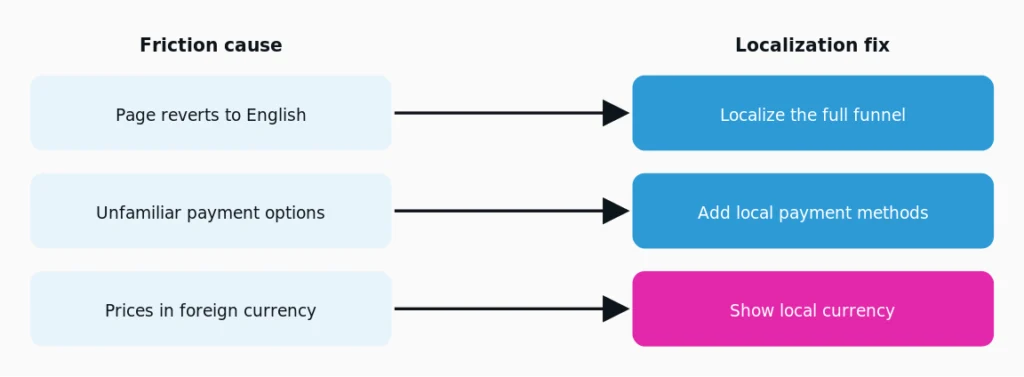
Three of the most common checkout friction causes, each mapped to its localization fix.
Mistake 3: Machine translating product content and shipping it unreviewed
Raw machine translation is fine for a first draft and dangerous as a final product. A single mistranslated product claim, size, or return condition can cost a sale, trigger a return, or create legal exposure. Product content needs human review before it goes live. That is exactly what machine translation post-editing (MTPE) is for.
The economics of large catalogs push teams toward pure machine translation, and for high-volume, low-risk strings that can be reasonable. The failure comes from applying it everywhere, including the copy that carries commercial and legal weight. A washing instruction rendered literally can imply the wrong care. A supplement claim translated without market context can breach local advertising rules.
The practical model is tiered. Use machine translation with light post-editing for bulk descriptions, and reserve full human editing for claims, policies, and hero product pages. NexTranslate builds this AI plus human workflow into e-commerce projects so speed and safety are not a trade-off.
Mistake 4: Ignoring currency, formatting, and local payment norms
Prices shown in a foreign currency, dates in the wrong format, and missing local payment methods are conversion killers that have nothing to do with language. Showing local currency alone can lift conversion meaningfully.
Every market has payment habits that feel non-negotiable to shoppers. Buyers in some regions expect cash on delivery or QR-based payments. Others default to local bank transfer schemes. If your checkout only offers international credit cards, you are not serving a large slice of ready buyers. The same applies to how numbers, dates, and addresses are formatted. Forcing one market’s conventions onto another reads as careless.
Treat currency, formatting, and payment as core localization scope, not as an engineering afterthought. Decide the supported payment methods per market before launch, display prices in local currency by default, and localize date, number, and address formats to match local expectation.
Where translation is enough, and where full localization pays off
| Funnel Stage | Translation Alone | Full Localization |
|---|---|---|
| Category & Search | Readable labels | Local search terms, browse habits |
| Product Pages | Understandable copy | Market claims, sizing, imagery |
| Checkout | Words converted | Currency, payment, tax, address |
| Policies | Literal text | Local legal and returns norms |
| Post-purchase | Translated email | Local tone, timing, support links |
Translation clears the comprehension bar. Localization clears the trust bar, which is where conversions are won or lost.
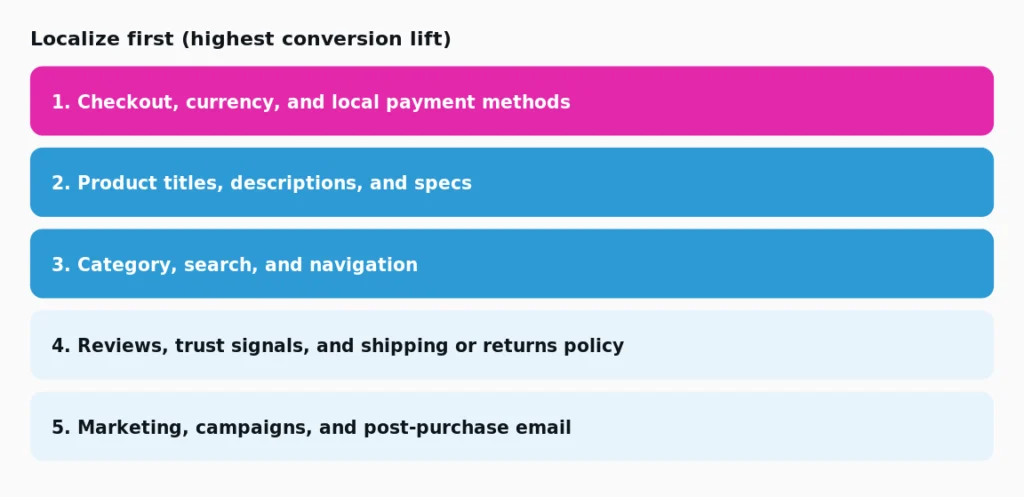
The e-commerce localization priority stack. Start at the top for the fastest conversion lift, then work down.
Mistake 5: Localizing the storefront but not the trust signals
Reviews, shipping details, returns policies, and support content are trust signals, and shoppers read them before they buy. Leaving them in the source language undoes the localization work done everywhere else.
A beautifully localized product page loses its effect the moment a hesitant shopper scrolls to reviews written in another language, or clicks a returns link that opens an untranslated legal page. Trust is cumulative. Every element that reverts to the source language subtracts from it, right at the point of decision. This is especially true for higher-consideration purchases where buyers actively look for reassurance.
Include reviews, ratings summaries, shipping and returns policies, and core support articles in localization scope from day one. If translating every review is not feasible, prioritize the summary, the policy pages, and the top support questions that block a purchase.
Mistake 6: Running literal translation on marketing and campaign copy
Marketing copy translated literally almost always underperforms, because taglines, promotions, and emotional hooks rarely survive a word-for-word conversion. Campaign copy needs transcreation, not translation.
A promotion that plays on a pun, a holiday, or a cultural reference can land as flat or confusing in another market. The words are accurate and the meaning is lost. Amazon’s 2020 Swedish marketplace launch became a widely cited example of how literal translation and cultural mismatch, including mistranslated product names and inappropriate terms, can spark backlash rather than sales.
Route brand-critical copy through transcreation, where linguists rewrite for intent and emotional resonance in the target market rather than translating word for word. Reserve literal translation for functional copy where clarity, not persuasion, is the goal.
Mistake 7: Shipping localized content with no quality assurance layer
Without a structured quality check, localization errors reach live pages and stay there until a customer finds them. A dedicated linguistic quality assurance (LQA) pass catches terminology drift, truncated strings, and context errors before shoppers do.
Machine and even human translation can be locally correct but globally inconsistent. The same product attribute gets three different names across the catalog. A button label overflows its container in a longer language. A number or unit converts incorrectly. None of these are caught by a spellcheck, and all of them erode conversion. LQA exists to find them in a review environment rather than in production.
Build a quality assurance step into the workflow, not as an optional extra. A structured LQA pass reviews accuracy, terminology consistency, formatting, and in-context display, so the version that ships is the version that was checked.
Mistake 8: Treating localization as a one-time project
Stores change constantly, so a one-time translation goes stale the moment a new product, promotion, or policy ships in the source language only. E-commerce localization has to be continuous, which is where website and app localization workflows and a connected content pipeline matter.
The catalog that was fully localized at launch drifts within weeks. New SKUs appear in English. A seasonal banner goes live untranslated. A revised returns policy updates in the source locale only. Each gap is small, and together they rebuild the exact inconsistency the launch was meant to remove. Shoppers notice a store that is half current and half stale.
Move from project thinking to a continuous localization model. Connect the store’s content updates to a translation pipeline so new and changed content flows into localization automatically, with human review on anything that carries commercial or legal weight. Localization becomes maintenance, not a periodic rescue.
Frequently asked questions
What is the difference between e-commerce translation and localization?
Translation converts product and store text from one language to another. Localization adapts the full experience, including currency, payment methods, formatting, imagery, tone, and legal copy, so the store feels native to the target market. Translation clears comprehension. Localization clears trust, which is what drives conversion.
Which parts of an online store should you localize first?
Start with checkout, currency, and local payment methods, since that is where high-intent shoppers abandon. Then localize product titles and descriptions, category and search, trust signals like reviews and returns policies, and finally marketing and post-purchase email. This order delivers the fastest conversion lift per unit of effort.
Is machine translation good enough for product descriptions?
For bulk, low-risk descriptions, machine translation with light human post-editing is often sufficient. For product claims, policies, sizing, and hero pages, full human review is essential because a single error can cost a sale or create legal exposure. A tiered machine translation post-editing model balances speed and safety.
How much does e-commerce localization cost?
Cost depends on volume, language pairs, and how much content needs human review versus light post-editing. NexTranslate uses transparent translation pricing with human proofreading included at every tier, and offers volume-based rates for large catalogs, so large SKU counts do not force a choice between speed and quality.
How do you keep a large catalog localized as it changes?
Use a continuous localization workflow that connects your store’s content updates to a translation pipeline. New and changed content flows into localization automatically, with human review reserved for commercially or legally sensitive copy. This prevents the slow drift back into a half-localized store.
Conclusion: Localization is a conversion lever, not a translation task
Every mistake on this list shares a root cause. Localization gets scoped as a language problem when it is really a trust and conversion problem. The words are the easy part. The currency at checkout, the payment method a shopper recognizes, the returns policy that matches local norms, the review that reassures in the buyer’s own language: those are what turn a browsing visitor into a paying customer.
The stores that win in new markets treat localization as continuous, tiered, and human-reviewed, not as a one-time bulk translation. If you are scaling a catalog into new languages and want to close these gaps before they cost conversions, explore NexTranslate’s e-commerce localization services or request a localization quote to map the fastest path to a store that feels native in every market.
Written by: Karuppusamy Arunachalam, NexTranslate
Published: July 2026 · Filed under Industry Use Cases
