




The Complete Guide to AI Translation Quality: How to Evaluate, Benchmark, and Trust Machine Output

A model can produce a translation that reads perfectly and still be wrong. That is the uncomfortable part of shipping multilingual content in 2026. AI translation is fast, cheap, and fluent, which makes bad output harder to catch, not easier. The sentence sounds native, so nobody questions it, and the error ships to a market where no one on the team can read the language.
Most teams have no reliable way to answer a simple question: is this translation actually good enough to release? They rely on gut feeling, a bilingual colleague’s spare afternoon, or the quiet assumption that a well-known engine must be fine. None of that scales, and none of it holds up when a regulator, a customer, or a lawyer finds the mistake.
This guide breaks down how AI translation quality is measured, which metrics deserve trust, how to run an evaluation you can defend, and where human review changes the outcome. The goal is a repeatable process any global team can use, regardless of which vendor or engine sits underneath.
What does AI Translation Quality Actually Mean?
AI translation quality is the degree to which machine output preserves the meaning, tone, terminology, and cultural fit of the source, measured against a defined standard rather than a gut reaction. It is not a single number, and it is not the same as fluency.
A useful definition separates two things that get confused constantly. Adequacy is whether the translation says what the source said, with nothing added, dropped, or reversed. Fluency is whether it reads naturally in the target language. Modern AI is extremely good at fluency and only sometimes good at adequacy, which is why fluent-but-wrong output is the defining risk of machine translation today.
Quality also depends on context. A marketing tagline, a legal indemnity clause, and a mobile app button each have different tolerance for error. Measuring quality means picking a standard that matches the stakes of the content, then scoring against it consistently. The takeaway: define quality as measurable adequacy plus fluency plus fitness for the specific use, not as a vague sense that the text looks right.
Why Fluent AI Output is The Dangerous Failure Mode
The most dangerous machine translation errors are the ones that read well, because fluency disguises inaccuracy and shuts down scrutiny. A clumsy translation invites a second look. A smooth one gets approved.
Large language models are trained to produce natural-sounding text, so they rarely fail in obvious ways anymore. Instead they fail quietly: a negation dropped, a figure rounded, a legal term swapped for a near synonym that carries different weight, a brand name softened into something generic. In WMT24 evaluations that included LLM systems, automatic metrics and human MQM judgments diverged in part because humans and machines conceptualize quality differently, with COMET rewarding closeness to a reference while humans reward broader fidelity and fluency. In other words, the machine cannot fully judge itself.
The fix is to stop treating fluency as a proxy for correctness. Fluency tells you the output is readable. It says almost nothing about whether it is right. That gap is exactly what a real evaluation process is built to close.
The Metrics that Measure Translation Quality, Explained
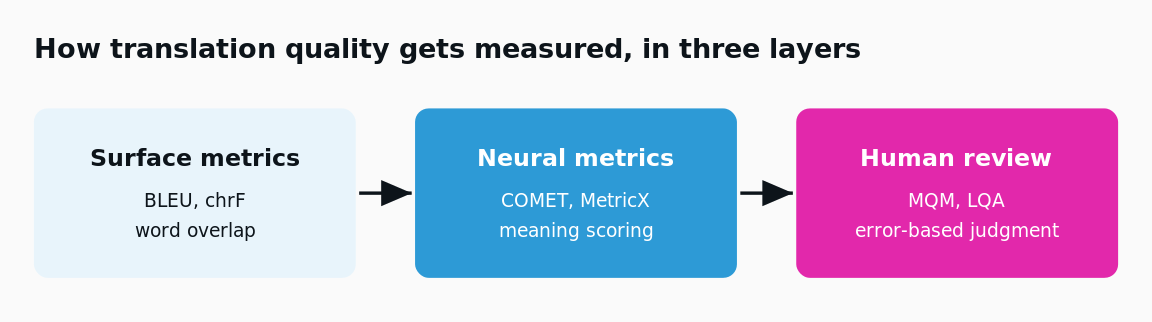
Translation quality metrics fall into three families: surface metrics that count word overlap, neural metrics that score meaning, and human frameworks that catalog errors. Each answers a different question, and no single one is enough on its own.
BLEU and chrF compare machine output to a human reference translation by counting matching words or characters. They are fast and cheap, which is why they dominated for years, but they punish valid rewordings and miss meaning entirely. COMET and similar neural metrics encode the source, the output, and the reference into a shared semantic space and predict a human-like quality score, correlating far better with human judgment than BLEU. The newest approach, LLM-as-a-judge (GEMBA being the best known), prompts a large model to grade the translation, which is flexible but inherits the model’s own blind spots.
Above all of these sits human evaluation, usually structured through Multidimensional Quality Metrics (MQM), an error-based framework that categorizes and weights every issue found. MQM is slower and more expensive, and it remains the standard the automatic metrics are trying to approximate. The table below shows what each metric is good for and where it breaks down.
| Metric | What it measures | Strength | Blind spot |
|---|---|---|---|
| BLEU / chrF | Word or character overlap vs a reference | Fast, cheap, reproducible | Ignores meaning; punishes valid rewording |
| COMET / MetricX | Semantic closeness via neural model | Correlates well with humans | A black box; weak on LLM output |
| LLM-as-judge (GEMBA) | Model grades the translation | Flexible, explains its scores | Inherits the model's own biases |
| MQM (Human) | Categorized, weighted errors | The trusted gold standard | Slow and costly to run at scale |
No metric is complete. Automatic scores triage volume; MQM decides what is truly release-ready.
How to Actually Evaluate AI Translation Quality
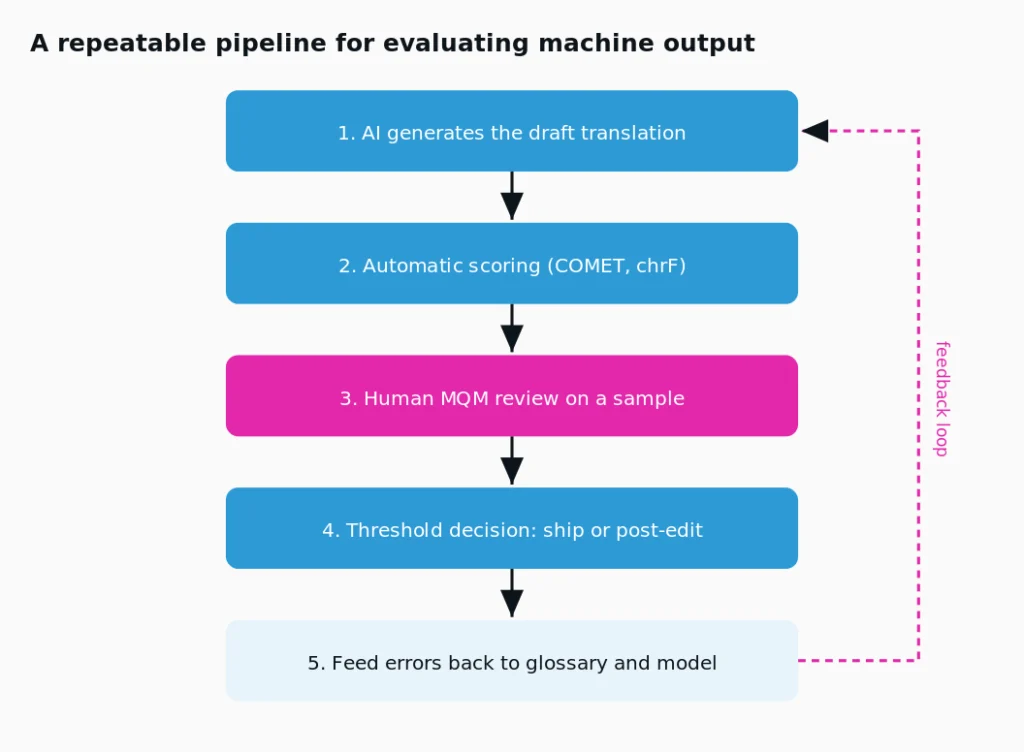
A defensible evaluation combines automatic scoring across all content with human MQM review on a representative sample, then gates release on a defined threshold. Automatic metrics handle volume; humans handle judgment; the threshold turns both into a decision.
In practice the workflow runs in five stages. The engine produces a draft. An automatic metric like COMET scores every segment so you can rank and triage. A trained linguist runs an MQM review on a sample, typically the lowest-scoring segments plus a random slice, so the evaluation catches both known-weak and blind-spot errors. Those findings decide whether the batch ships as-is or routes to post-editing. Finally, the errors feed back into glossaries, style guides, and model tuning so the next batch starts higher.
The single most useful number to track is edit distance, or how much a human had to change the machine output to make it acceptable. It converts quality into effort, and effort into cost, which is the language executives actually budget in. Start there and the rest of the process has a spine.
How to Set a Benchmark and a Quality Threshold
A quality threshold is the minimum score or maximum error rate a translation must clear before it ships, set per content type rather than once for everything. Without a threshold, a score is just trivia. With one, it becomes a gate.
Set thresholds by tying them to the MQM score, which is calculated by subtracting weighted error penalties from a perfect score across a normalized word count. High-stakes content such as legal or medical might require a near-zero critical error rate and an MQM score above 95. Marketing or internal content can tolerate more, so a lower bar keeps cost sensible. The point is to decide the bar before you run the evaluation, not to reverse-engineer a passing grade after seeing the output.
Benchmark against your own history, not an abstract ideal. Score a batch you already trust, treat that as your baseline, and measure every new engine or workflow against it. This is also how you compare vendors honestly: same source, same reference, same metric, same reviewer. Anything less is marketing. If you want that benchmark run for you, NexTranslate’s team can score a sample of your existing content and report back where it lands. Explore the multilingual AI evaluation workflow to see how a structured benchmark is built and delivered.
The MQM Error Model, Explained
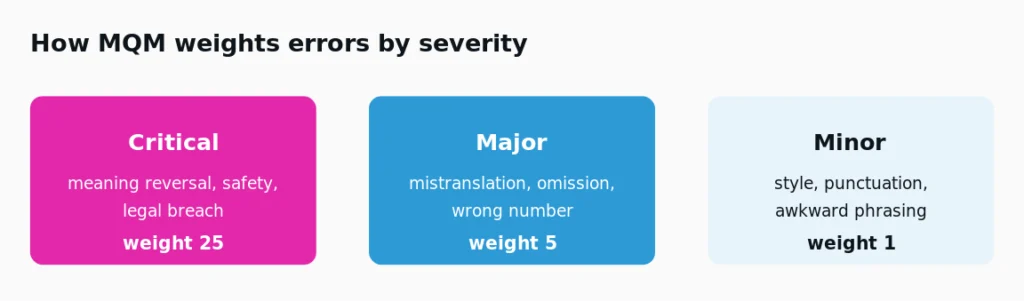
Multidimensional Quality Metrics (MQM) scores a translation by classifying every error into a category and a severity, then applying weighted penalties. Severity is what makes it credible: not every mistake counts the same.
A critical error changes meaning, creates a safety or legal risk, or reverses intent, and carries the heaviest penalty. A major error is a real mistranslation or omission that a reader would notice and be misled by. A minor error is stylistic, an awkward phrasing or a punctuation slip that does not distort meaning. Weighting these differently is why MQM tracks with real-world consequence, while a raw error count treats a reversed negation and a missing comma as equals.
For teams that want the meaning-level guardrail without building an MQM program in-house, structured
linguistic quality assurance applies the same severity logic to finished translations. The companion explainer, What Is LQA, walks through the severity model in plain terms and how it protects a brand at release.
Matching Workflow to Risk: the NEX Translation Matrix™
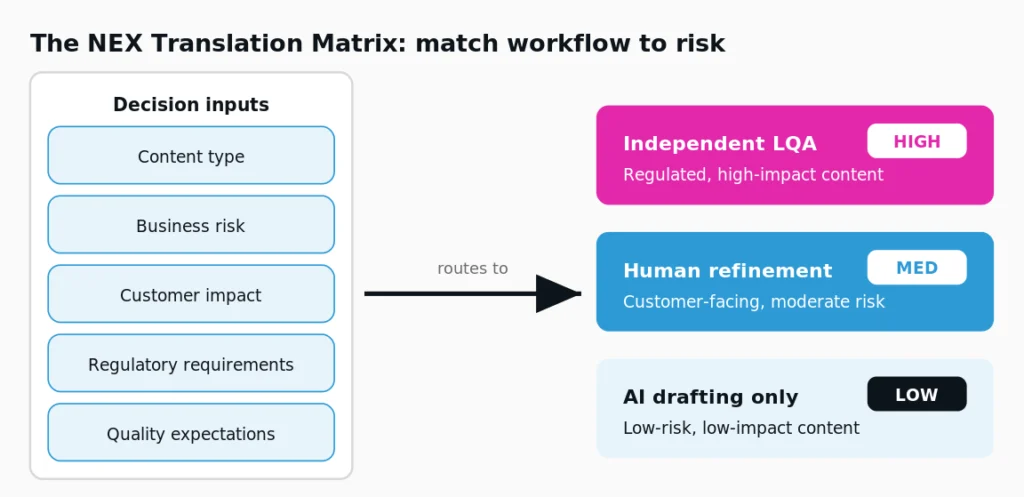
The NEX Translation Matrix™ decides the right workflow for each piece of content by weighing five factors instead of forcing everything through one process. Not all content carries the same risk, so not all of it earns the same level of review.
The Matrix reads five inputs: content type, business risk, customer impact, regulatory requirements, and quality expectations. It then routes the work to one of three levels. Low-risk, low-impact content such as a support article, a user review, or an internal memo can run on AI drafting with a light check, because a mistake is cheap to fix. Customer-facing or moderate-risk content, like product documentation or marketing pages, needs human linguists to refine meaning and tone. Regulated or high-impact content, such as a contract clause, a dosage instruction, a financial disclosure, or a UI string shipping to millions, requires independent Linguistic Quality Assurance before publication. There, meaning-level review is not overhead, it is insurance.
This is also the logic behind tiered pricing, where content that demands specialist review costs more because it requires more. NexTranslate’s transparent translation pricing maps its tiers to exactly this risk gradient, with human proofreading included at every level rather than billed as an extra.
Building a Quality Loop that Improves Over Time
The highest-leverage move in translation quality is closing the loop: every error caught should make the next batch better. A one-time review protects one release. A feedback loop compounds.
Concretely, that means routing MQM findings back into three assets. Glossaries lock in the correct term the model kept missing. Style guides encode the tone and formatting decisions reviewers keep correcting.
Translation Memory (TM) stores approved segments so identical content is never re-translated or re-reviewed. Over months, this pushes the raw machine output higher, shrinks the post-editing burden, and lowers cost per word without lowering the bar. Machine Translation Post-Editing (MTPE) is where much of this compounding happens in practice.
Structured machine translation post-editing turns each correction into reusable signal instead of a one-off fix, which is what separates a maturing localization program from a team that re-solves the same problems every sprint.
How NexTranslate Approaches AI Translation Quality
NexTranslate treats quality as a rubric-driven, human-in-the-loop process rather than a single automated score. AI produces the speed; trained native evaluators produce the trust. That combination is the whole point: neither half is reliable alone.
The workflow mirrors the pipeline in this guide. Machine output is generated, then native-language evaluators score it against a structured rubric covering accuracy, fluency, contextual relevance, cultural appropriateness, and safety. Senior reviewers validate the scoring, resolve discrepancies, and sign off, which is what makes the results consistent across languages and reviewers rather than a matter of individual taste. For AI teams specifically, the same framework evaluates LLM responses, detects hallucinations, and validates machine translation before it reaches users.
This is the model behind NexTranslate’s AI evaluation services, and it extends the same discipline used across its translation and localization services. The promise is simple: measurable quality, delivered at a speed AI makes possible and a level of trust only human judgment provides.
Frequently Asked Questions
How is AI translation quality measured?
AI translation quality is measured with a mix of automatic metrics and human review. Automatic metrics like COMET score meaning at scale, while human frameworks like Multidimensional Quality Metrics (MQM) catalog and weight errors by severity. The most trusted programs run automatic scoring across all content and human MQM review on a representative sample.
Is BLEU or COMET a better quality metric?
COMET is the stronger metric for most modern use. BLEU only counts word overlap against a reference, so it misses meaning and penalizes valid rewordings. COMET uses a neural model to score semantic closeness and correlates far better with human judgment, though it can be weak on output from large language models, where human review still matters most.
Can AI translation be trusted without human review?
It depends on the stakes. Low-risk, high-volume content can often ship on automatic scoring plus a light human spot-check. High-risk content such as legal, medical, financial, or widely visible product text needs meaning-level human review, because fluent machine output can be confidently wrong in ways no automatic metric reliably catches.
What is a good MQM score?
A good MQM score depends on content type, but a common bar for high-stakes content is above 95 with a near-zero critical error rate. Lower-stakes content can pass at a lower threshold. The key is to set the threshold before evaluating, tied to the cost of an error, rather than choosing a passing grade after seeing the output.
Does NexTranslate include human review in its pricing?
Yes. Human proofreading is included at every NexTranslate pricing tier, unlike providers that bill it separately at $0.02 to $0.05 per word. Higher tiers add specialist native translators, independent revisers, and quality control experts for high-stakes content, so the level of review scales with the risk of the material.
Conclusion: Fluency is not Proof, Measurement is
The reason AI translation quality is hard is that the failures hide inside good-looking sentences. Speed without measurement just ships errors faster. The teams that win globally are the ones that treat quality as a defined standard, score against it consistently, and reserve human judgment for the moments where being wrong is expensive.
If you want a benchmark on your own content and a clear read on where machine output stands, get a tailored quote or contact the NexTranslate team to run a pilot evaluation. AI gives you speed. Human review gives you trust. A real quality process gives you both.
- Filed under / AI & LLM Evaluation