





A subsidiary registration in Germany fails six weeks after filing. The translated articles of incorporation were accurate. Every clause was rendered correctly by a qualified linguist, and the file carried a signed certificate of accuracy from a reputable US provider. The registry rejected it anyway, because German commercial registries want a translation stamped by a translator sworn before a German court, and a US certificate of accuracy is not that.
Nothing was mistranslated. The filing failed on the form of the attestation. That failure mode is common, it is almost always discovered late, and it is expensive in a way that has nothing to do with the price per word. A rejected filing costs a funding milestone, a hiring start date, or a product launch window.
Certified translation gets written about almost exclusively as an immigration topic. For companies expanding across borders the stakes are different and the rules are less forgiving. This is what certification means, what it does not mean, and how to buy it without paying for layers that nobody asked for.
What makes a translation certified
A certified translation is a translation delivered with a signed statement, the certificate of accuracy, in which the translator or the language provider attests that the translation is complete and accurate and that the signer is competent in the language pair. Certification is a statement of accountability, not a government licence.
This surprises most first-time buyers. In the United States there is no licensing body that issues certified translator status, and no government register to check a name against. The federal standard for immigration filings, 8 CFR 103.2(b)(3), asks only that the translator certify the translation is complete and accurate and that they are competent to translate. The authority behind a certified translation is the signer’s willingness to put their name to it.
A usable certificate of accuracy carries five things:
- A statement that the translation is complete and accurate
- A statement of the signer’s competence in the source and target languages
- The full name of the translator or the authorized representative of the provider
- The date of certification
- Contact details the receiving authority can use to verify the claim
The practical takeaway is that a certificate without contact details or a named signer is decorative. If nobody can be reached to stand behind the document, the attestation has no weight, whatever the letterhead looks like.
Certified, notarized, sworn and apostilled are four different things
These four terms describe four separate layers of validation, and only one of them says anything about translation quality. Buyers routinely ask for the wrong layer, pay for it, and still get rejected.
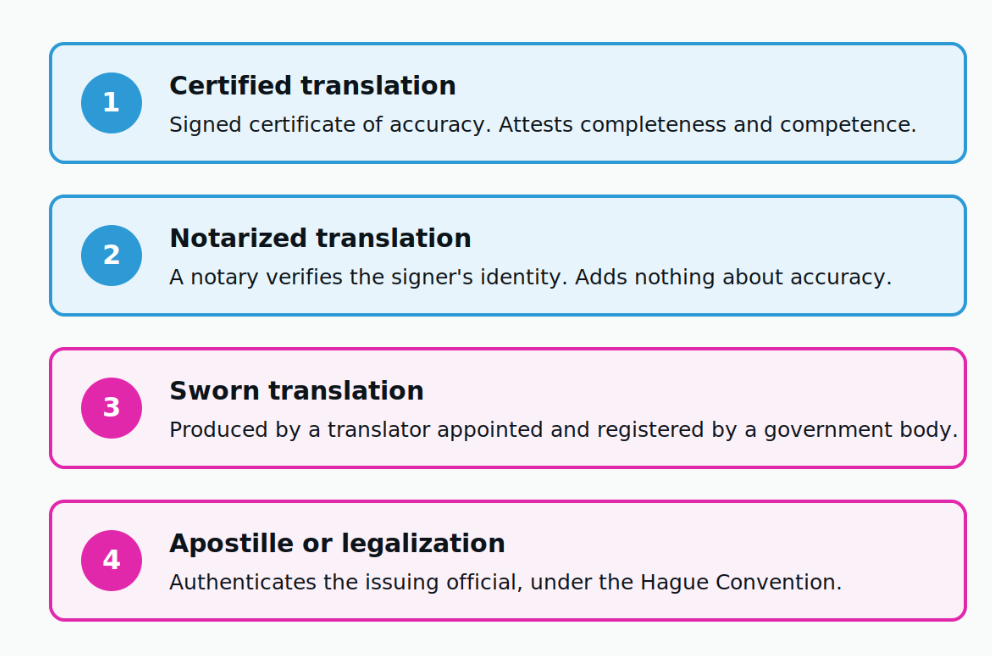
Notarization is the most misunderstood of the four. A notary public does not read the translation, does not speak the source language, and makes no claim about accuracy. The notary confirms that the person who signed the certificate is who they say they are. Paying for notarization as a quality signal buys identity verification and nothing else.
| Layer | Who issues it | What it actually proves | Typical trigger |
|---|---|---|---|
| Certified | The translator or provider | The translation is complete and accurate | US, UK and Canadian filings |
| Notarized | A notary public | The identity of the person who signed | Banks, some universities, some courts |
| Sworn | A government-appointed translator | State-recognized legal standing | Civil law countries in the EU and LATAM |
| Apostilled | A designated state authority | The issuing official’s signature is genuine | Public documents crossing a border |
Four layers, four issuers. They stack in some jurisdictions and substitute in none.
The rule that catches expanding companies is this one. A US certified translation cannot substitute for a sworn translation in a civil law jurisdiction, and notarizing it or apostilling it does not close the gap. Spain, France, Germany, Italy, Brazil and Mexico all maintain registers of translators appointed by a court, a ministry or a trade board. If the receiving body wants a name from that register, no amount of additional US paperwork will substitute.
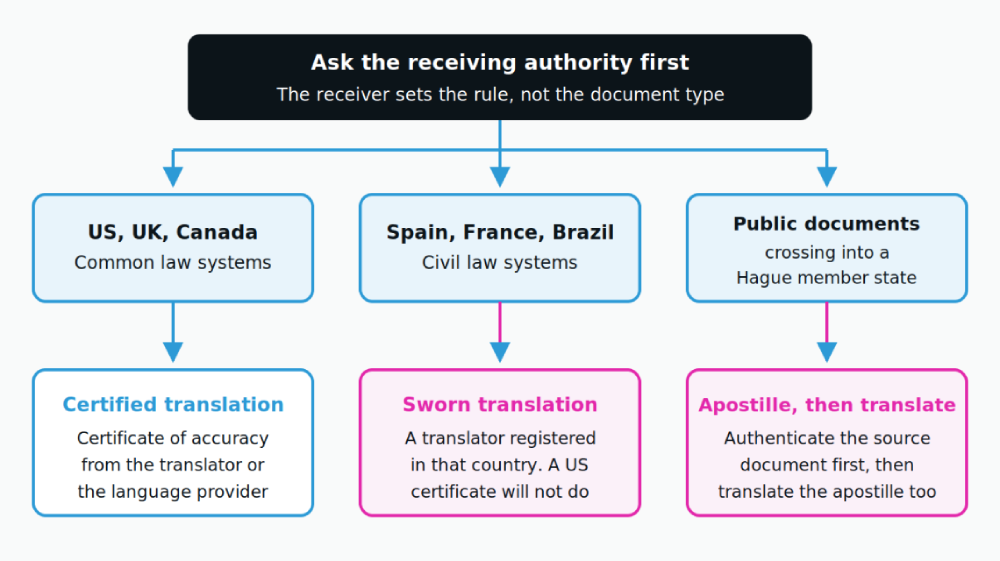
The destination decides the requirement. Confirm it with the receiving authority before a single word is translated.
Which business documents actually need certified translation
Certification is triggered by the receiving authority, not by the document type. The same employment contract needs a certificate for a work visa application and needs nothing for an internal HR portal.
That distinction matters commercially, because most companies get it backwards. They certify a whole document set on the assumption that legal content always needs it, then discover that half the set was never going to be filed anywhere. The reverse error is worse and more common: a document goes out uncertified because nobody asked the regulator what form they wanted it in.
| Document | Who receives it | Usual requirement |
|---|---|---|
| Articles of incorporation, bylaws | Foreign company registry | Sworn in civil law states, certified elsewhere |
| Patent and trademark filings | National IP office | Certified, often apostilled at source |
| Audited financial statements | Regulators, acquirers, tax authorities | Certified, occasionally notarized |
| Clinical and device documentation | Health regulators, ethics boards | Certified plus a documented review trail |
| Government and public tenders | Procurement authority | Set by the tender pack, read it first |
| Employee visa and relocation packs | Immigration authority | Certified, notarization rarely required |
| Marketing pages, help centre, product UI | Nobody official | None. Certifying these wastes budget |
Certification follows the receiver. The last row is where most over-spending happens.
The verticals where this comes up constantly are the regulated ones. Legal document translation for entity formation and cross-border contracts, medical and life sciences translation for submissions and clinical files, and financial translation services for audited statements and compliance reporting. Each has its own receiving authority with its own idea of what an acceptable attestation looks like, which is why a single company policy on certification usually fails at the first border it meets.
How the certified workflow differs from standard translation
A certified job differs from a standard one in three structural ways: nothing may be omitted or summarized, a named individual takes personal responsibility for the output, and a second linguist who did not produce the draft checks it before the certificate is signed.
The completeness rule is the one that trips teams up. Stamps, seals, marginal handwriting, illegible signatures and struck-through text are all in scope. Where source text cannot be read, the translation must say so rather than quietly leave a gap. Partial renderings and tidy summaries are the single most common reason certified documents come back rejected, and they are entirely preventable at scoping.
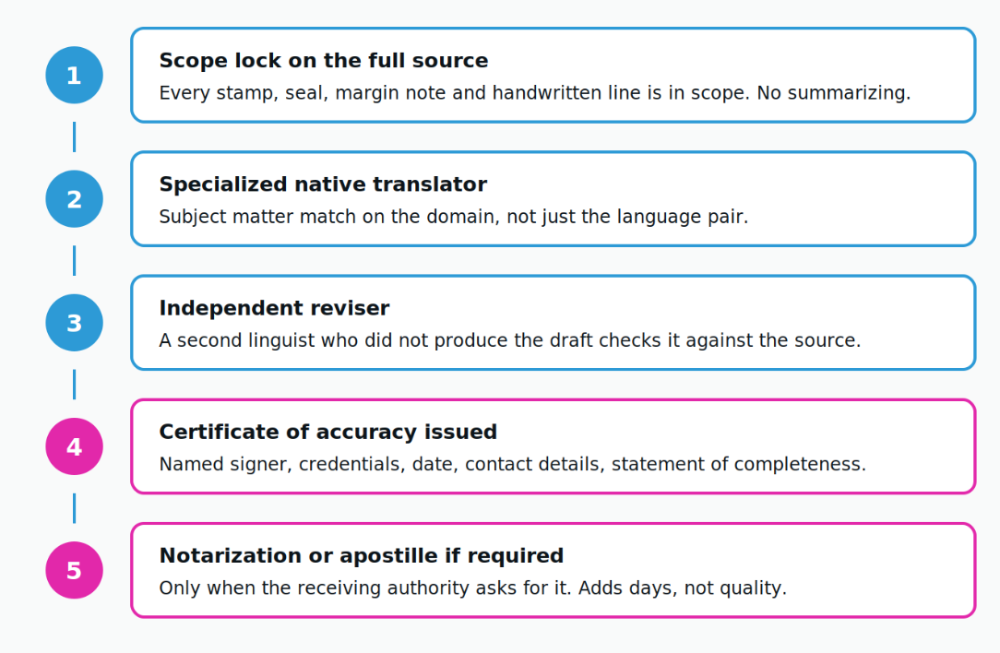
Five stages. Stage three is the one buyers try to cut, and the one that makes the certificate defensible.
This is also where the routing logic matters. The NEX Translation Matrix™ scores each piece of content on five inputs, content type, business risk, customer impact, regulatory requirement and quality expectation, then routes it to one of three workflows: AI drafting is sufficient, human linguists refine meaning, or independent Linguistic Quality Assurance (LQA) before publication. The matrix routes content, not projects. One market entry produces all three outcomes at once, which is why routing runs per document rather than per job.
Anything that will carry a certificate lands in the third outcome every time. Regulatory requirement alone forces it, regardless of how the other four inputs score. That is the useful thing to know when a provider quotes a certified rate: the price reflects a second named linguist and a documented review trail, not a surcharge for printing a signature block.
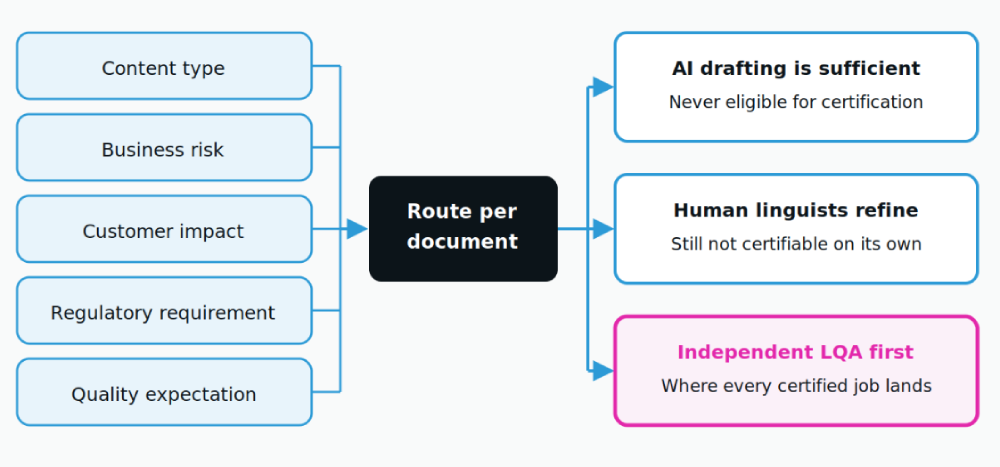
Certified work always routes to the third outcome. The regulatory input overrides everything else in the score.
What certification does not guarantee
A certificate of accuracy is an assertion by the provider, not an audit by a third party. It does not prove the translation was reviewed, does not verify that the source document is genuine, and does not make the translated document legally valid in the destination country.
Anyone can sign a certificate of accuracy in the United States. That is the honest reading of the standard, and it is why the certificate on its own is weak evidence of quality. What separates a defensible certified translation from a signed PDF is the process behind it, and the process is only visible if the provider can describe it.
Three questions separate a real certified workflow from a signature block:
- Who is the named signer, and what are their credentials in this language pair
- Did a second linguist review the file, and can that step be evidenced
- Is the provider working to a published standard such as ISO 17100, which sets translator qualification and revision requirements
That second question is the one worth pressing. A certificate signed by the same person who produced the draft is self-attestation. An independent LQA step puts a separate linguist between the draft and the signature, and produces a record of what was checked. For regulated content the record matters as much as the result, a point covered in more depth in the NexTranslate guidance on accuracy and compliance in medical documents.
How to buy certified translation without overpaying
Confirm the requirement with the receiving authority in writing before commissioning anything, then buy per word rather than per page. Those two decisions account for most of the difference between a controlled certified spend and a chaotic one.
Per-page pricing is the older convention in the certified market and it is where buyers lose money quietly. A page is not a unit of work. A dense contract page and a sparse certificate page carry wildly different word counts, and per-page rates are set to protect the provider against the dense one. Per-word pricing prices the actual work, and it makes quotes comparable across vendors.
Four practices that keep certified spend proportionate:
- Get the requirement in writing from the receiver, naming the exact form of attestation they accept
- Separate the documents that will be filed from the ones that will only be read
- Batch filings by language and jurisdiction rather than commissioning one document at a time
- Build a glossary once for entity names, job titles and product terms, then reuse it across every filing
On rate expectations, certified work sits at the top of any provider’s range because it carries a specialized translator, an independent reviser and a named signer. The transparent per-word pricing that NexTranslate publishes places legal, healthcare, finance and government tender content in the Premium tier at 0.12 per word, with terminology management and a dedicated project manager included rather than quoted as extras. Human proofreading is included at every tier, which removes the separate proofreading line that inflates certified quotes elsewhere.
One more practice worth adopting: apostille the source document before translating it. The apostille itself is a certificate that will need translating, and companies that translate first routinely pay twice, once for the document and once again for the apostille that arrives afterwards.
Frequently asked questions
Is a certified translation the same as a notarized translation?
No. A certified translation carries a signed statement of accuracy from the translator or provider. A notarized translation is a certified translation whose signature has been witnessed by a notary public. The notary verifies identity only and makes no assessment of the translation itself.
Does a certified translation expire?
The certificate itself does not expire, but receiving authorities frequently impose their own recency rules, commonly three to six months for corporate and civil records. The expiry sits with the underlying document and the authority’s policy, not with the translation.
Can a machine translation be certified?
Only if a qualified human translator has reviewed the full output against the source and is willing to sign the certificate personally. Raw machine output cannot be certified, because certification is a personal attestation of competence and accuracy that no engine can make.
Who can certify a translation in the United States?
Any competent translator or translation company. The United States has no government register of certified translators, so the credibility rests on the signer’s qualifications, the reviewer behind them, and whether the provider can be reached to verify the certificate.
Do I need an apostille as well as a certified translation?
Only when a public document issued by one Hague Convention member state has to be accepted by another. The apostille authenticates the original document’s issuing official, not the translation, so it is obtained on the source document and then translated alongside it.
How long does certified translation take?
A short corporate document set typically turns around in 24 to 72 hours in a specialist workflow. Notarization adds a day, and an apostille adds anywhere from several days to several weeks depending on the issuing authority, which is the part worth starting first.
Conclusion: certification is a routing decision, not a product upgrade
The companies that handle certified translation well do not buy more certification. They ask one question earlier than everyone else, which is what form of attestation the receiving authority will accept, and they let that answer route the document. Everything downstream, the tier, the reviser, the notary, the apostille, follows from that single answer.
The German registry rejection at the top of this piece cost six weeks and was avoidable with one email. Certification is not the expensive part of expanding across borders. Guessing at it is.
If you have filings, submissions or tenders coming up, we can tell you which documents genuinely need certification and which do not before you commit budget. Our translation and localization services cover certified corporate, legal and regulatory documents with a named signer and an independent reviser on every file, and you can request a quote with your document set to get a per-word price and a realistic timeline.
Written by Karuppusamy Arunachalam, NexTranslate
Published August 2026 · Filed under Translation Services
