






A market entry plan usually contains one line for translation. It sits near the bottom, it carries a small number, and it looks like the easiest thing in the budget to defer. So the team ships English-only into Germany or Japan or Brazil, tells itself it will localize once the market proves itself, and moves on.
The number does not disappear. It relocates. It comes back as pipeline that stalls in the security review, as support tickets that are really comprehension problems, as trial users who never activate, and eventually as an engineering quarter spent extracting hardcoded strings from a codebase that was never built to hold them.
Every published answer to the question of what localization costs is a rate card. Almost nobody prices the alternative. The decision a SaaS team is actually making is not whether to spend on language. It is which of two costs to absorb.
What localization actually costs, and why that number misleads teams
Localizing a SaaS product into one new language typically costs between USD 1,200 and USD 2,800 in translation spend for a first pass. That number misleads teams because it is the only cost in the entire market entry decision that arrives with a price tag attached before launch.
Take a mid-stage SaaS product with roughly 40,000 words across product interface strings, help documentation, and the top-of-funnel pages that carry organic traffic. At the entry tier of NexTranslate’s transparent translation pricing, USD 0.03 per word, that first pass costs USD 1,200 per language. At the professional tier, USD 0.07 per word, it costs USD 2,800. Glossary creation and a style guide add USD 80 once, and they carry across every language that follows.
Set that against the rest of the market entry budget. Local payment processing, tax registration, a support rota covering a new time zone, a paid acquisition budget to test demand, a legal review of local contract terms. Translation is usually the smallest of those line items and by far the most predictable.
It is also the first line cut, precisely because it is the only one that can be cut without an immediate visible consequence. Nothing breaks on launch day. The consequence arrives two quarters later, in a different budget, and by then nobody connects it back to the decision to postpone translation and localization services until the market proved itself.
The costs that appear when you skip localization
Skipping localization does not remove the cost. It moves it into four places that no one budgets for: lost pipeline, higher support load, faster churn, and engineering rework. None of them appear on the market entry plan, and all four are harder to reverse than a translation invoice.
| Hidden Cost | Where It Surfaces | How to Measure It |
|---|---|---|
| Lost pipeline | Buyers who never enter the funnel | Conversion rate by country against the site average |
| Stalled deals | Procurement, legal and security review | Win rate by country at late funnel stages |
| Support load | Repeat comprehension tickets | Tickets per active account by locale |
| Weak activation | Onboarding drop-off in market | Trial to paid rate by billing country |
| Churn | Renewal, not first response | 90-day retention segmented by language |
| i18n retrofit | Engineering backlog, years later | Share of strings still hardcoded in components |
Four hidden costs, six places they surface. Every one of them is already measurable in reports most teams already run.
Lost pipeline is the largest of the four and the hardest to see, because the buyers who bounce never enter the funnel to be counted. CSA Research surveyed 8,709 consumers across 29 countries and found that 76 percent prefer to buy products with information in their own language, and 40 percent will not buy at all from websites presented in other languages. A 2023 RWS study of 6,500 consumers put the figure above 80 percent for buyers who will not purchase from a brand that offers no local language support.
The standard B2B objection to those numbers is that enterprise software buyers read English. The champion often does. The procurement lead, the data protection officer and the legal reviewer frequently do not, and those are the people who can stop a deal without ever contacting the vendor. An English-only security questionnaire response is a stall that shows up in the CRM as went dark, not as a language problem.
Support load is more immediately measurable. An English-only product in a non-English market produces a recognisable ticket pattern: repeat questions about steps that are already documented, low help centre deflection, longer handle times. Those are comprehension tickets wearing the costume of product tickets, and each one carries a fully loaded cost per contact.
Churn follows the same line, later. Activation and retention diverge by locale long before anyone thinks to segment the dashboard by language. A user who cannot read the onboarding flow does not fail loudly or file a complaint. They fail quietly, at renewal, and the post-mortem blames pricing or competition.
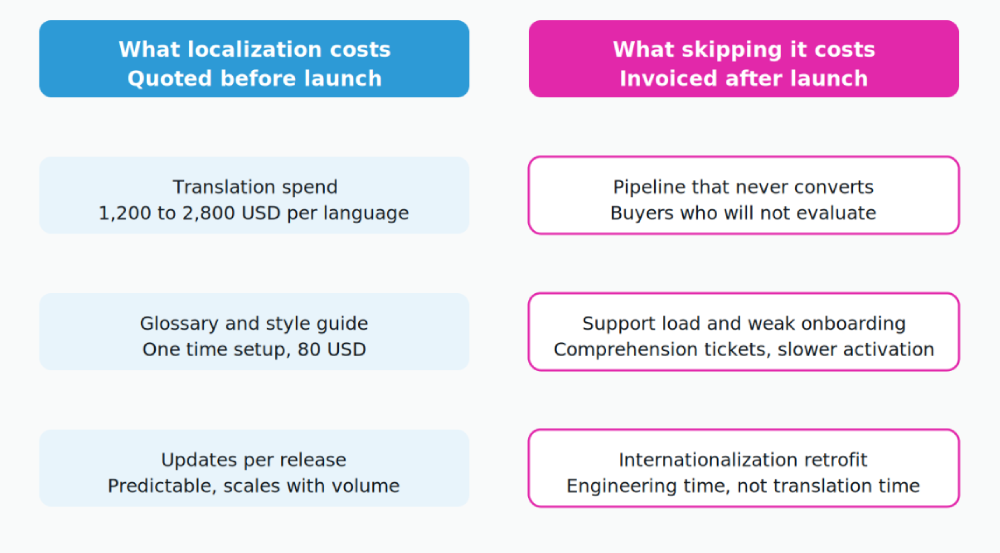
Two ledgers for the same market entry. The left one is quoted before launch. The right one is invoiced after it.
Why deferring localization multiplies the bill instead of delaying it
Deferral does not hold the cost flat. It compounds it, because every release shipped without internationalization (i18n) adds strings that will later have to be extracted by hand, and every month in market without local language builds a first impression that has to be won back rather than simply made.
The retrofit is the part teams underestimate most. Internationalization done at build time is a convention: strings live in resource files, sentences are not concatenated from fragments, plurals and date formats are handled by the framework rather than by each component. Done at year three it is a migration, and it touches every screen. Teams who have run it describe the work in engineering quarters, not in words translated. The practical version of avoiding that is set out in the NexTranslate breakdown of internationalizing a SaaS product before the first market.
The second compounding factor is reputational, and it is newer. Reviews, community threads and AI answer engines index what buyers say about a product and keep surfacing it long after the fact. A market entered badly is a market that has to be entered twice, and the second attempt starts behind where the first one did.
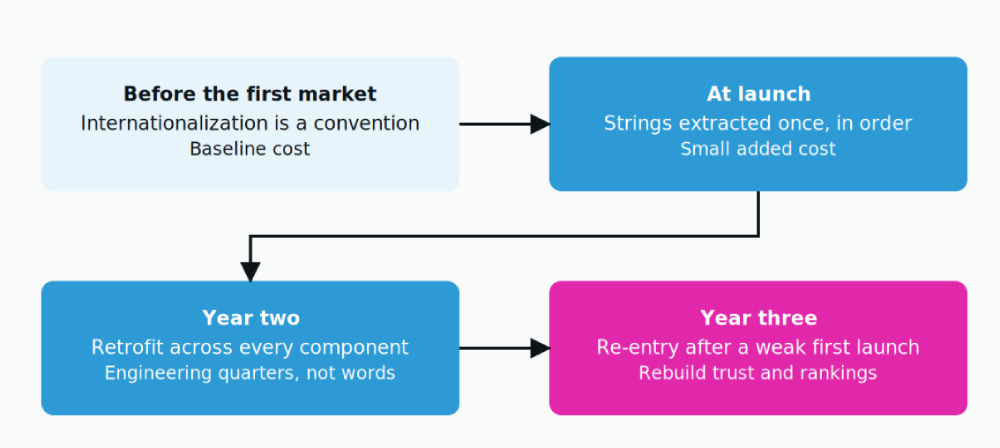
The same decision at four points in time. Notice that the unit of cost changes from words to engineering quarters between stage two and stage three.
The cheapest moment to internationalize is before the first market. The second cheapest is now. There is no version of this decision in which waiting makes the number smaller.
How to tell whether a market is already leaking
The cost of skipping localization is invisible in aggregate dashboards and obvious in segmented ones. Four reports will tell a team within an hour whether an English-only market is already losing revenue, and all four use data that is already being collected.
- Sessions and conversion rate by country, compared against the site-wide average. A market with real traffic converting at half the average rate is a language problem until something else is proven.
- Organic impressions for in-language queries in Google Search Console. This shows demand the site is visible for but cannot actually serve.
- Support tickets per active account by country, alongside help centre deflection rate by locale. A gap between the two points straight at documentation that cannot be read.
- Trial to paid conversion and 90 day retention segmented by billing country, rather than by plan.
Run those four and the argument stops being philosophical. A market with 4,000 monthly sessions converting at half the site average is not underperforming because the product is a poor fit. The gap between that market’s numbers and the site-wide average, multiplied by its traffic, is the working estimate of what the skipped translation line is actually costing per quarter.
How to price the decision before committing to a market
Approve market entry against three gates rather than one revenue projection: validated demand, full-cost economics, and operational readiness. Most failed market entries clear the first two comfortably and fail on the third.
That sequence is the NEX Framework™, and each gate has a specific evidence bar.
- Need asks whether demand is already visible without any local marketing. Signup geography, in-language organic search, support requests from the region, inbound that arrived unprompted. A competitor’s expansion announcement is not evidence.
- Economics asks whether the commercial case survives the full cost rather than the translation line alone. Ongoing content maintenance as the product ships, local support coverage, payment and tax handling, local contract review.
- eXecution asks whether the organisation can sustain the locale after launch week. A named owner for the market, a workflow that pushes updates without a manual re-translation cycle, and product internationalization that will not break when a German string runs 30 percent longer than the English one.
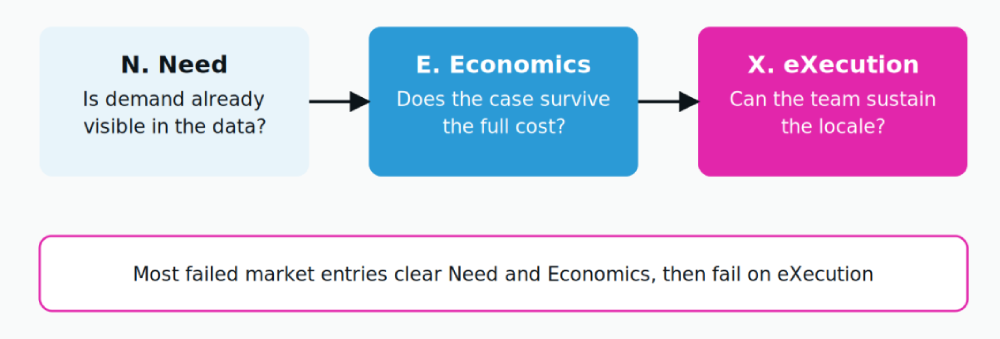
The NEX Framework as three sequential gates. The third gate is the one that fails, and it fails quietly, months after approval.
The eXecution gate is where the cost of skipping localization is genuinely decided. A team can price the words correctly, approve the budget, launch a translated site, and still absorb the full skip cost within a year, because nothing keeps the localized version current after week one. Every release since launch has shipped in English only, and the market is now reading a product that is six versions out of date. That is a workflow problem rather than a translation problem, and it is what multilingual content management exists to solve.
| Line Item | Localize at Entry | Enter English-Only |
|---|---|---|
| Translation, 40,000 words | 1,200 to 2,800 USD | 0 USD |
| Glossary and style guide | 80 USD, once | Not applicable |
| Ongoing updates | Scales with release volume | Deferred, accrues as backlog |
| Support handling | Baseline for the locale | Higher tickets per account |
| Conversion rate | Trends toward site average | Typically below site average |
| Engineering | i18n done once, in order | Retrofit later, across components |
| Second market attempt | Not required | Likely, at a higher cost |
Twelve months in one new market, two paths. Translation figures reflect a 40,000 word first pass at published per-word rates.
What can safely be left untranslated
Cost control in localization comes from routing content by risk, not from buying a cheaper quality tier across the board. Most teams translate too much low-value content and under-invest in the handful of strings that carry real legal or commercial exposure.
The NEX Translation Matrix™ scores each piece of content on five inputs: content type, business risk, customer impact, regulatory requirement, and quality expectation. Three outcomes follow from the score.
- AI drafting is sufficient for low-risk, high-volume, internal or evergreen content. Changelog entries, the help centre backlog, internal enablement material.
- Human linguists refine meaning where tone, terminology or nuance decide whether the message lands. Pricing pages, onboarding flows, product marketing. This is machine translation post-editing (MTPE) territory, and ISO 18587 defines what full post-editing is supposed to include.
- Independent linguistic quality assurance (LQA) runs before publication on regulated, legal, safety-critical or high-exposure content, where a second linguist signs off on work the first one completed.
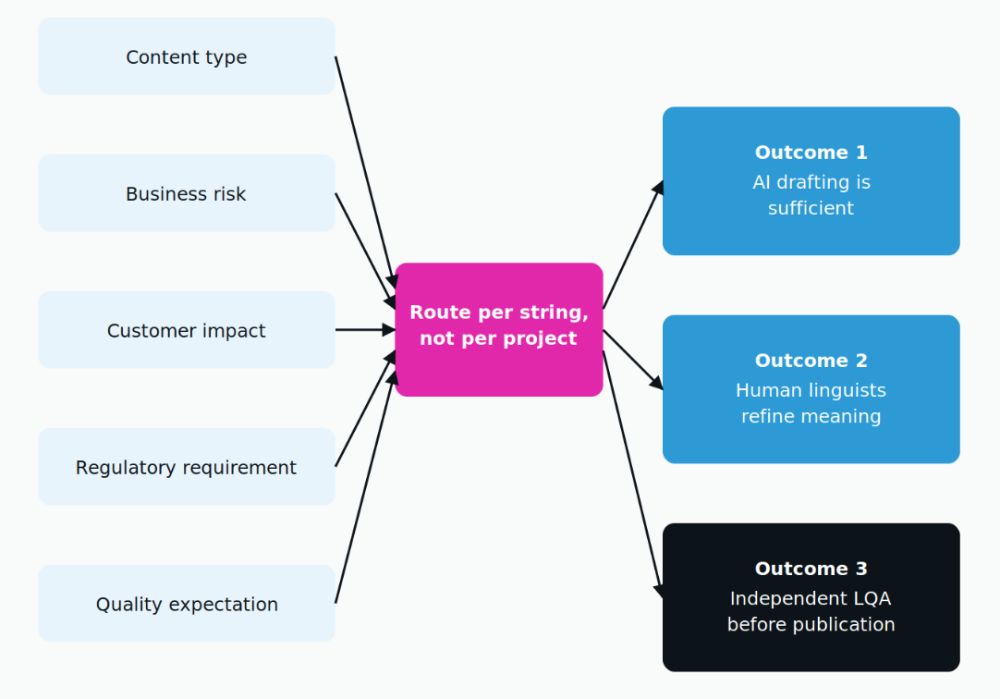
Five inputs, one routing decision, three outcomes. The routing runs per string, which is why one release produces all three at once.
The routing rule matters more than the categories. The matrix routes content, not projects. A single product release usually produces all three outcomes at once, so the decision runs per string or per document, never per job. Teams that route per job either overpay for the changelog or underpay for the terms of service, and the second mistake is the one that gets expensive.
Frequently asked questions
What does localization cost per language?
A first pass on a mid-sized SaaS product, roughly 40,000 words of interface, documentation and key marketing pages, costs between USD 1,200 and USD 2,800 per language at published per-word rates. Cost after that scales with release volume rather than with the size of the original product, because translation memory (TM) reuses segments that have already been approved.
Is it cheaper to localize later, once a market proves itself?
No. Waiting raises the total in two ways. Strings shipped without internationalization have to be extracted retroactively, which is engineering work rather than translation work, and a market that has already formed an impression of an English-only product has to be re-entered rather than entered.
Can machine translation alone cover a new market?
For low-risk, high-volume content, machine output with a human review pass is usually enough. For anything carrying legal, financial or safety exposure it is not, and the failure mode is silent: fluent output that is confidently wrong. That is why human proofreading is included at every NexTranslate tier rather than sold as an upgrade.
How do you measure the cost of not localizing?
Segment four reports by country: conversion rate against the site average, in-language organic impressions in Search Console, support tickets per active account, and trial to paid conversion. The gap between a market’s numbers and the site-wide average, multiplied by that market’s traffic, is the working estimate.
Which languages should a SaaS company localize first?
Start where demand already exists without local marketing. Signup geography, in-language search impressions and inbound support requests are stronger signals than raw market size. The full sequencing method, including how to phase a rollout so it does not overwhelm the team, is set out in the NexTranslate guide to SaaS global expansion.
Conclusion: the localization line item is the cheaper of two costs
The question asked in budget review is what localization costs. The question that decides the outcome is what the alternative costs, and the alternative is never zero. It is a translation line deferred into a pipeline number, a support metric, a retention curve and an engineering backlog, where it is harder to see, harder to attribute, and considerably more expensive to fix.
A market entry that budgets for language at the start is cheaper than one that pays for the absence of it across four departments for a year. The translation invoice is the only version of this cost that comes with a number on it in advance.
Teams sizing a first or next market can start with the three-tier pricing model to put a real number against the language line, or request a quote with a word count and target locales to see what a first pass looks like before the budget meeting.
Written by Karuppusamy Arunachalam, NexTranslate
Published August 2026 · Filed under Global Expansion
