




A fintech onboarding screen fails in a new market for a reason most teams never see coming. The translation was fluent. It was also wrong in a way that matters to a regulator. A risk warning that softened its wording, a Know Your Customer prompt that changed what the user was actually consenting to, an interest disclosure that dropped a required phrase. None of it looked broken. All of it created exposure.
In fintech, the cost of a bad translation is rarely just an awkward sentence. It is a compliance event. A mistranslated disclosure can get a product rejected at review, force a re-release, or trigger a fine once it is live. The words that carry legal weight in English carry legal weight in every language you ship them in, and financial regulators across the European Union, the United Kingdom, and the Gulf are increasingly explicit about that.
This is why fintech translation is a governance problem before it is a language problem. The teams that scale into new markets cleanly are the ones that treat regulated content differently from marketing copy, route each type of content to the right level of human review, and can prove how every string was translated. This post breaks down where the risk actually lives inside a financial product, and how a disciplined workflow keeps localization fast without letting it become a liability.
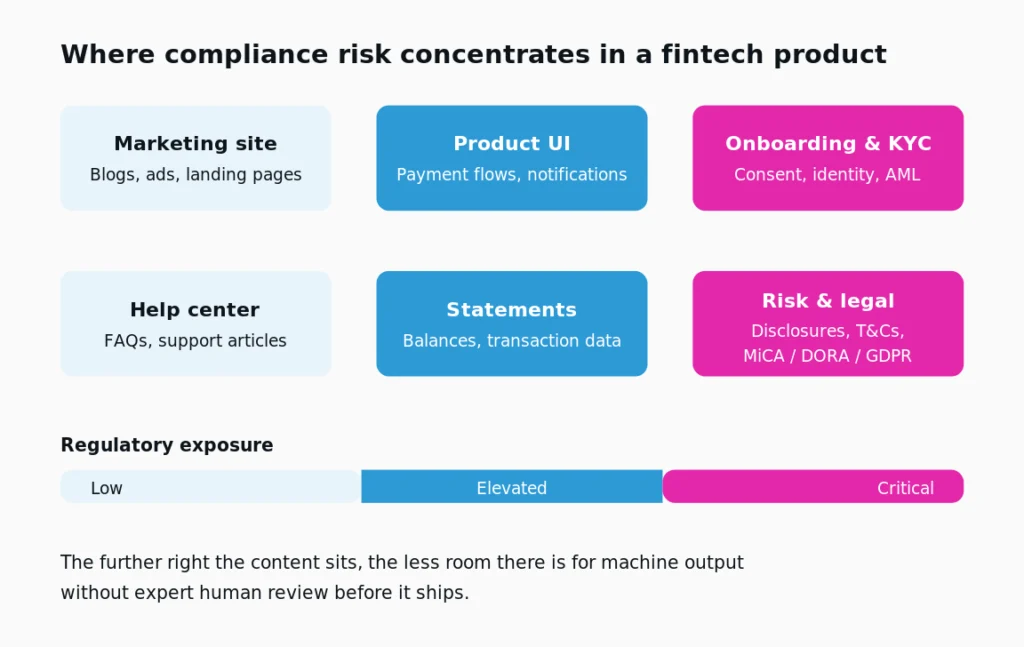
The content zones of a fintech product, ranked by regulatory exposure. Onboarding, KYC, and legal content carry the highest risk and the least tolerance for unreviewed machine output.
Why fintech translation is a compliance risk, not just a language task
In fintech, a translation error can become a regulatory breach because the words themselves are the regulated object. A risk disclosure, a consent prompt, or an interest calculation is not describing the product. It is the legal interface between the company and the customer, and regulators judge it in the local language.
That raises the bar well above general business translation. A generic machine translation engine can quietly substitute a strict legal definition with a friendlier everyday phrase. “Guaranteed” and “expected” mean very different things in an investment context. “Insured” and “protected” are not interchangeable in a deposit disclosure. When a large language model smooths that language for readability, it can erase the exact distinction a regulator requires you to keep.
The frameworks make this concrete. Under the European Union’s Markets in Crypto-Assets Regulation (MiCA), crypto and stablecoin issuers must publish clear, fair, and non-misleading disclosures in the languages of the markets they serve. The Digital Operational Resilience Act (DORA) adds obligations around how financial entities document and communicate operational risk. The General Data Protection Regulation (GDPR) requires consent language to be specific and unambiguous, which means the translated version has to carry the same precision as the original. Get the wording wrong in any of these and the content is not just off-brand, it is non-compliant.
The takeaway: treat customer-facing financial and regulatory copy as controlled content from the first word, not as something to clean up after a fast machine pass.
Where the risk actually lives inside a financial product
Risk in a fintech product is not spread evenly. It concentrates in a handful of content types where a single wrong term changes legal meaning or user consent. Knowing where those hotspots sit is what lets you move fast on everything else.
Onboarding, KYC, and consent flows
This is the highest-exposure zone in most fintech products. Know Your Customer (KYC) prompts, anti-money-laundering (AML) declarations, and data-consent screens define what the user is legally agreeing to. A translation that shifts the meaning of a consent checkbox can invalidate the consent entirely, which is both a GDPR problem and an onboarding-conversion problem when users hesitate at wording they do not trust.
Risk disclosures and legal terms
Investment warnings, fee schedules, terms and conditions, and product disclosures are written to a legal standard and have to stay at that standard in every language. These share the same failure modes as regulated legal content, which is why the patterns in NexTranslate’s breakdown of legal document translation compliance risks apply almost directly to financial disclosures. Precise terminology and a documented review trail matter more than raw speed here.
Numbers, currency, and formatting
Financial content fails silently on formatting. Decimal separators, thousands separators, currency placement, date order, and percentage conventions all vary by locale. A statement that reads 1,000.50 in one market and should read 1.000,50 in another is not a style choice, it is a correctness issue that can misstate a balance. Numbers need a human quality check on every regulated document, not just a spellcheck.
Not every string needs the same treatment. Mapping content type to risk level shows where to spend human review budget and where machine speed is safe.
| Content Type | Risk Level | Recommended Workflow |
|---|---|---|
| Blog, ads, landing pages | Low | AI draft, light human review |
| Help center, FAQs | Low to medium | AI draft, human review of terms |
| Product UI, notifications | Medium | Native translator, editor review |
| Statements, transaction data | High | Human translation, numbers QC |
| KYC, consent, onboarding | Critical | Specialist translator, independent review |
| Risk disclosures, T&Cs | Critical | Specialist plus compliance sign-off |
Content-to-risk mapping for a typical fintech product. Human oversight scales with regulatory exposure, so machine speed is reserved for low-risk content.
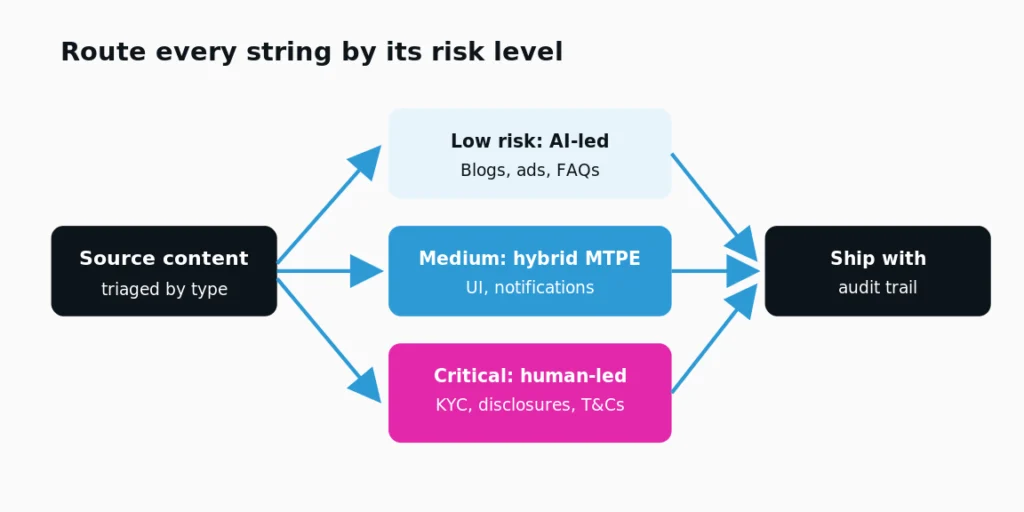
Routing content by risk level. Low-risk strings move fast on AI, while critical financial and consent copy is human-led with a documented trail before release.
How the AI plus human workflow protects regulated content
The safest fintech localization model is hybrid: let AI carry speed and volume, and let human experts carry trust on anything that touches compliance. This is the core of how NexTranslate approaches financial translation services, and it maps cleanly to the risk tiers above.
In practice the workflow runs in four stages. An AI engine produces a fast first draft. A native financial translator refines it against the correct terminology and local regulatory wording. A second linguist or reviser runs quality control on meaning, numbers, and consistency. A final approval step signs the content off with a record of who changed what. For low-risk content the later stages compress. For a KYC prompt or a MiCA disclosure, every stage runs in full.
Two disciplines make this reliable. Machine translation post-editing gives you a structured way to use AI speed while a qualified linguist corrects the output to a defined standard, which is exactly what the ISO 18587 post-editing standard was written for. Linguistic quality assurance then checks the delivered content in context, catching the number-formatting and terminology errors that slip past a sentence-level review.
Used together, machine translation post-editing and linguistic quality assurance let a fintech move quickly on everything low-stakes while guaranteeing that regulated copy gets expert eyes before it reaches a customer. That is the difference between localization that scales and localization that creates exposure.
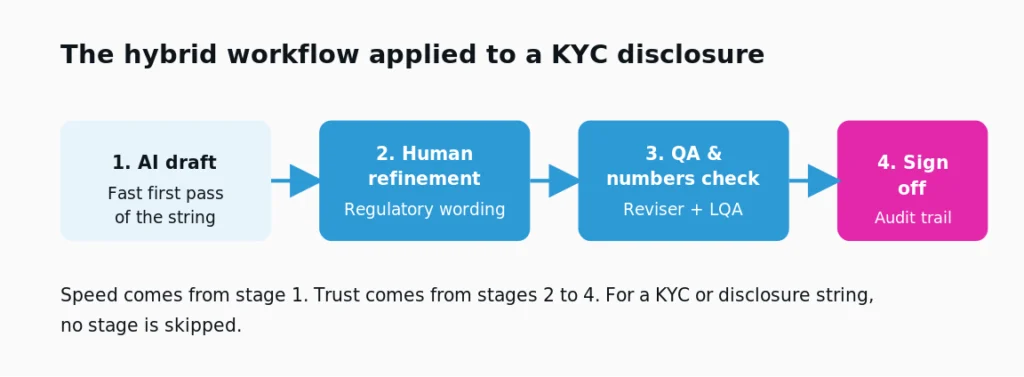
The four-stage hybrid workflow applied to a KYC disclosure. AI supplies the first draft, but human refinement, QA, and sign-off carry the compliance load.
What to check before you localize a financial product
Before translating a single string, a fintech team should lock down five things: terminology, security, formatting, review ownership, and an audit trail. Missing any one of them is where compliance risk re-enters after the words are correct.
- Build a bilingual glossary of regulated terms first. Lock the approved translation of every legal and product term so “guaranteed,” “insured,” and “regulated” cannot drift between screens or releases.
- Confirm data security before sending content out. Financial source files carry sensitive data, so require signed non-disclosure agreements and a provider whose systems align with standards like ISO 27001.
- Set locale formatting rules for numbers, currency, and dates up front, and quality-check them on every regulated document rather than trusting the engine.
- Name a compliance owner for critical content. Every KYC, consent, and disclosure string should have a human who signs it off in the target language.
- Keep an audit trail. If a regulator asks how a disclosure was translated, you should be able to show the workflow, the reviewers, and the versions.
None of these slow down a launch when they are set up before translation begins. They only feel expensive when they are bolted on after a rejection.
Does compliant fintech translation have to be expensive?
No. Compliant fintech translation costs more than a raw machine pass, but far less than a failed regulatory review, and the gap is smaller than most teams assume. The trick is matching spend to risk instead of paying premium rates for every word.
Low-risk marketing and help content can run on a fast, affordable tier, while KYC, disclosures, and legal terms move to a specialist tier with independent review. Because transparent translation pricing includes human proofreading at every level rather than charging for it separately, the cost of doing regulated content properly is more predictable than with providers that bill review as an add-on. For a wider view of how this plays out across regulated sectors, the industry-specific localization guide maps the same risk-based approach to legal, medical, and financial content.
Frequently asked questions
Is machine translation safe for fintech content?
Only for low-risk internal or marketing content. For KYC flows, risk disclosures, and legal terms, raw machine output can alter legal meaning, so those require a specialist human translator and independent review before release.
What is the difference between financial translation and localization?
Financial translation converts content into another language while preserving exact legal and numerical meaning. Localization goes further and adapts formatting, currency, tone, and cultural context. Compliance documents lean on precise translation, while user interface and marketing content need full localization.
Which regulations affect fintech translation in Europe?
The main ones are GDPR for consent and data language, MiCA for crypto and stablecoin disclosures, DORA for operational resilience communication, and MiFID II for investment product wording. Each requires customer-facing content to be accurate in the local language.
How do you keep financial terminology consistent across languages?
With a locked bilingual glossary and translation memory (TM). The glossary fixes the approved translation of every regulated term, and translation memory reuses it across screens and releases so wording does not drift over time.
Who should sign off on translated compliance content?
A named compliance owner who reads the target language, or a specialist reviser working alongside your compliance team. The point is that no critical financial string ships without a human who is accountable for its accuracy in that market.
Conclusion: in fintech, trust is translated one disclosure at a time
Expanding a financial product into new languages is not a copy-paste exercise. Every consent prompt, risk warning, and disclosure carries the same legal weight in the target language that it carried in the source, and regulators are reading it that way. The fintechs that scale cleanly are the ones that treat regulated content as controlled from the start, route each string to the right level of human review, and can prove how it was translated.
AI gives you the speed to localize at product pace. Human experts give you the trust that keeps you compliant. If you are planning a market launch and want a workflow that protects both, get a quote from a team that translates financial products for a living.
Written by: Karuppusamy Arunachalam, NexTranslate
Published: July 2026 · Filed under Industry Use Cases
