





Most teams that buy AI plus human translation never find out what the human actually did. The invoice says post-edited. The delivery lands on time. Six weeks later a German enterprise prospect points out that the pricing page calls a monthly subscription an Abonnement in one place and a Mitgliedschaft in another, and nobody on the team can say which linguist saw that string or what they were asked to check.
The phrase has become a checkbox. Almost every translation vendor now claims a hybrid workflow, which means the claim no longer separates anyone from anyone. What separates them is the specification underneath it. Which stages exist. What each stage is allowed to change. How a given sentence gets routed to the right depth of human attention instead of the same depth as everything else in the batch.
This post opens the box: the four stages of a working hybrid pipeline, what the human layer changes at each one, why routing has to happen per string rather than per project, and the four places these workflows quietly fail.
What AI plus human translation actually means
AI plus human translation means a machine engine produces the first draft and qualified human linguists own every decision that carries risk. It is not machine output with a spellcheck pass, and it is not human translation with an AI badge attached for marketing reasons.
The distinction has a standard behind it. ISO 18587, the international standard for post-editing of machine translation output, separates light from full post-editing. Light post-editing fixes only what blocks comprehension and leaves style, register and minor errors alone. Full post-editing requires correction of every error that affects meaning, alignment with approved terminology, and grammar at professional standard. It also sets competence requirements for the post-editor: proven linguistic qualifications, translation experience, and subject matter expertise where the content calls for it. The finished output has to be comparable to a professionally translated deliverable, which means an AI draft buys no reduction in the quality bar. That is the premise behind machine translation post-editing as a defined service rather than a discount tier.
Two vendors can both say AI plus human and be selling opposite things. One is selling full post-editing by a domain linguist. The other is selling light post-editing by whoever was free. The two look similar across three sample sentences and diverge sharply across ten thousand. Ask which one is in the contract.
The four stages of a hybrid translation workflow
A hybrid workflow has four stages: an AI draft, a human refinement pass, an automated quality assurance sweep, and a human sign-off. The machine handles volume and consistency. The human handles meaning and consequence. Collapsing any stage into another is where quality claims start to drift from delivery.
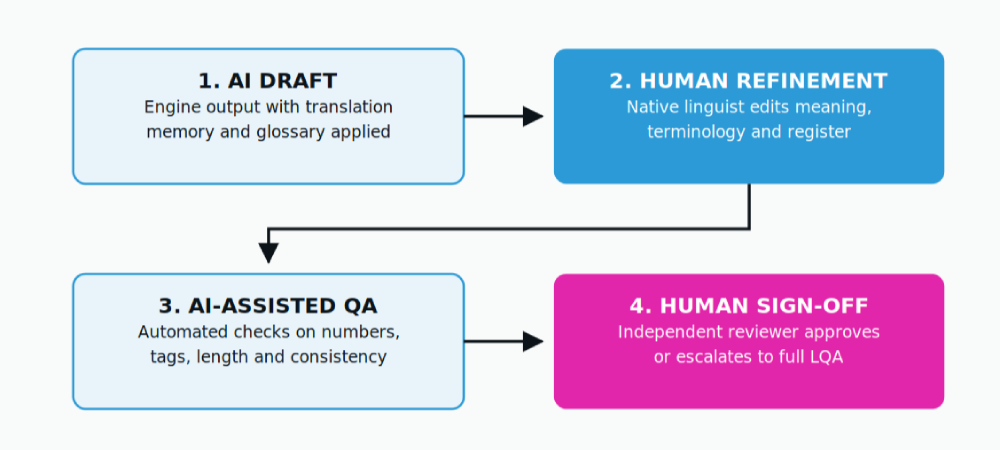
The four stages of a hybrid translation workflow. Stages 2 and 4 are separate people, not the same linguist checking their own work.
The order matters less than the separation. Stage 2 and stage 4 have to be different people. A linguist reviewing their own refinement reads what they meant to write rather than what is on the page, and that is the most common way an error survives a workflow that looks complete on paper.
| Stage | Owner | What it decides | What it cannot catch |
|---|---|---|---|
| 1. AI draft | Engine plus TM and glossary | Baseline rendering, consistency with prior approved segments | Whether the source itself is ambiguous |
| 2. Human refinement | Native domain linguist | Meaning, register, terminology, cultural fit | Systematic formatting and tag errors at volume |
| 3. AI-assisted QA | Automated checks | Numbers, dates, units, placeholders, tags, string length, term compliance | Whether the sentence is persuasive or legally sound |
| 4. Human sign-off | Independent reviewer | Fitness for publication, escalation to full review | Nothing, if the reviewer has source context |
Each stage catches a class of error the others structurally cannot. Remove one and that class ships.
Stage 3 is the one most teams underuse. Automated checks are unglamorous and they catch the errors that damage credibility fastest: a currency symbol that survived from the source locale, a date in the wrong order, a broken placeholder that ships a literal variable name into a customer email. Feeding those checks properly is a tooling question, covered in more depth in the guide to the modern localization tech stack.
What the human layer actually changes
The human layer changes five things a language model consistently gets wrong: product terminology, register, regulated detail, cultural load, and interface constraints. Everything else in a modern engine draft is usually serviceable, which is exactly why the human effort has to be aimed rather than spread.
Product terminology
Engines translate meaning, not conventions. A model asked to render workspace, seat and plan into Japanese produces a defensible answer for each, and a different defensible answer three weeks later in another file. The linguist enforces the term base so the noun in the app matches the noun on the invoice and the noun in the help centre.
Register
Formality is a business decision encoded in grammar. German du against Sie, Japanese keigo levels, Spanish tu against usted by market. An engine picks one. A linguist picks the one that matches the brand and holds it across every surface. Getting this wrong does not read as a translation error to a native speaker. It reads as a company that does not know who it is talking to.
Regulated and numeric detail
Dosages, financial disclaimers, jurisdiction names, contract terms, units. This is where an error stops being embarrassing and starts being expensive. Automated QA flags the mismatch. A domain human decides the correct value and whether the sentence still says what the source obligated it to say.
Cultural load
Idiom, humour, imagery, colour, and anything that references a local institution. A campaign line built on a baseball metaphor is grammatically translatable into Portuguese and commercially useless there. This is the boundary where post-editing stops and transcreation begins, and the linguist is the one who has to recognise it and say so.
Interface constraints
A button label that runs to 34 characters in Finnish breaks a layout designed around 12. Right-to-left languages invert more than text direction. Plural rules differ in count, not just form. These are engineering constraints expressed as language problems, and they need a reviewer who has seen the interface.
How to route content to the right level of review
Content should be routed by risk, not by project. The NEX Translation Matrix™ scores five inputs for each piece of content and produces one of three outcomes, so review effort concentrates where a mistake would actually cost something.
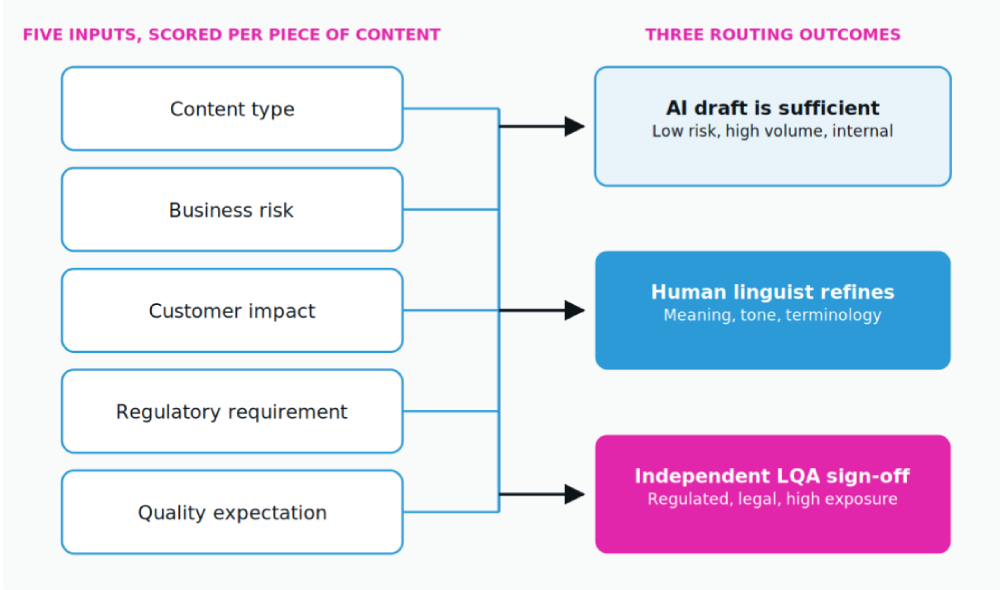
The NEX Translation Matrix. Five scored inputs, three routing outcomes, applied to the content rather than to the job.
The five inputs are content type, business risk, customer impact, regulatory requirement, and quality expectation. The three outcomes are that an AI draft is sufficient, that a human linguist refines meaning on top of the draft, or that an independent reviewer signs the content off before it publishes.
The routing rule matters more than the scoring: the matrix routes content, not projects. A single product release produces all three outcomes at once. Release notes are low risk. The onboarding flow is customer-facing and needs a linguist. The updated data processing terms are regulated and need independent sign-off. Routing runs per string or per document, never per job. Teams that route per job overspend on the release notes and underspend on the terms, usually in the same quarter.
| Content | Risk profile | Routing outcome | Why |
|---|---|---|---|
| Release notes, changelogs | Low | AI draft is sufficient | High volume, short shelf life, low consequence |
| Help centre and knowledge base | Low to medium | AI draft is sufficient | Volume favours speed, errors are correctable |
| Product UI and onboarding | Medium | Human linguist refines | Register, terminology and string length all bind |
| Marketing and campaign copy | Medium to high | Human linguist refines | Cultural load, often escalates to transcreation |
| Contracts, DPAs, terms | High | Independent LQA sign-off | Legal exposure, a second linguist must sign |
| Medical, financial, safety content | High | Independent LQA sign-off | Regulated, error cost is not recoverable |
A worked routing example. One release can produce all three outcomes in the same sprint.
The matrix maps onto pricing without being the same thing as pricing. Roughly, low-risk content sits at the entry tier, human refinement at the middle tier, and independent sign-off at the top, which is why the transparent translation pricing model is structured in three tiers rather than one blended rate. Routing first and pricing second is what stops a team from paying premium rates for a changelog.
Where hybrid workflows break
Hybrid workflows fail in four predictable places, and none of them are the engine. They are scoping failures, routing failures, feedback failures and context failures, in roughly that order of frequency.
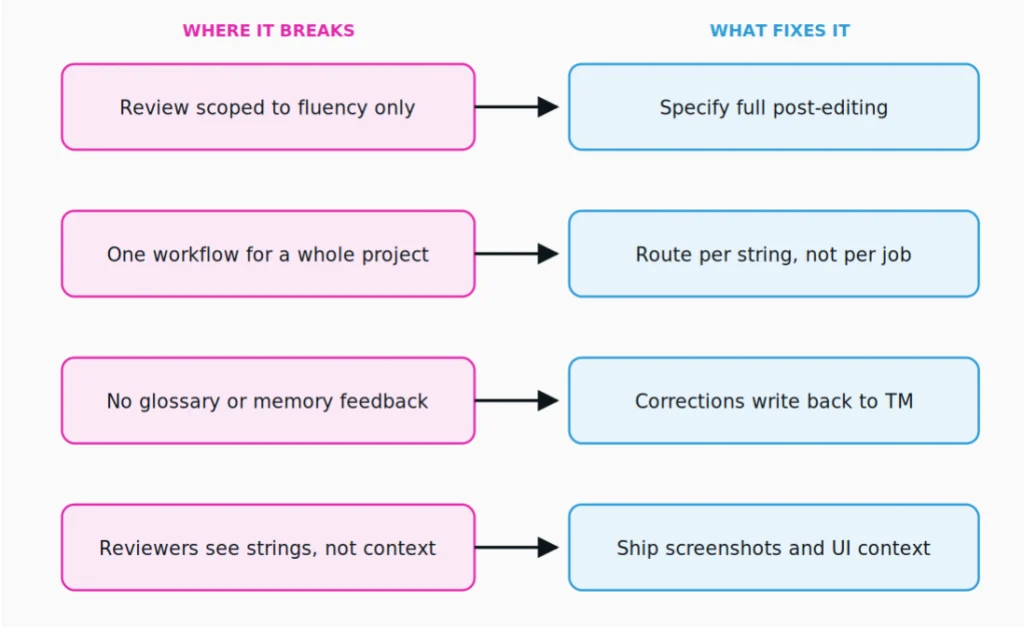
The four failure modes and their fixes. Each one is a process decision, not a model limitation.
The review is scoped to fluency, not accuracy
A reviewer told to make it read well will make it read well. Fluent machine output that has quietly dropped a negation still reads well. Scope the brief to accuracy against source first and fluency second, and specify full post-editing rather than leaving the depth to whoever picks up the file.
One workflow is applied to the whole project
Batch-level routing is the most expensive habit in localization. It sends regulated content through the same path as a blog post and charges the blog post for the privilege. Route at the string or document level, which requires the content to carry a risk attribute before it enters the queue.
Corrections do not write back
If a linguist fixes the same product noun in every cycle, the workflow has no memory. Every human correction has to write back into translation memory (TM) and the glossary so the next AI draft starts from the corrected version. Without that loop, human effort is spent re-solving solved problems and the cost curve never bends.
Reviewers work without context
A linguist handed a spreadsheet of isolated strings cannot know that Open is a button and not an adjective. Screenshots, character limits and a note on where the string appears cut the error rate more than any engine upgrade will. This is the cheapest fix on the list and the one most often skipped.
All four are process decisions rather than model limitations, which is the useful part: they are fixable without changing vendors or engines. What happens when the human layer is removed entirely is covered separately in the breakdown of where AI-only translation breaks down.
How NexTranslate runs the hybrid workflow
NexTranslate runs the four stages as separate, named responsibilities with human proofreading included at every service level. The AI draft is generated against the account’s translation memory and glossary, a native domain linguist refines it, automated checks run across numbers, tags and terminology, and a second linguist signs off where the routing calls for it. The translation and localization services scope covers 60 or more languages through certified linguists, and the review layer is a named second native linguist rather than a self-check by the person who did the refinement.
Where content routes to the top outcome, linguistic quality assurance runs as an independent stage with its own reviewer rather than as an extended version of the refinement pass. Where the volume is continuous rather than project-based, multilingual content management keeps the term base and memory current so each cycle starts from a better draft than the last one.
The commercial consequence of including proofreading at every level is that the quality floor does not move with the budget. Most providers price proofreading as an add-on at 0.02 to 0.05 per word, which means the cheapest option is usually the one with no second pair of eyes. The published per-word rates fold that review in, which is where the 30 to 40 percent total cost difference against unbundled vendors comes from. Buyers comparing quotes should confirm what the review layer is before comparing the number.
The way to test any of this rather than take it on trust is to send the same 500 words through two vendors, ask both for the post-editing level in writing, and diff the outputs against a term base you control. The scoring method is set out in the guide on how to evaluate and benchmark AI translation quality.
Frequently asked questions
Is AI plus human translation the same as machine translation post-editing?
Machine translation post-editing is one stage inside an AI plus human workflow, not the whole workflow. MTPE describes a human editing machine output. A full hybrid workflow adds the automated quality sweep, an independent sign-off, and the routing logic that decides which content needs those extra layers at all.
How much of the AI draft does the human actually change?
It varies by content type far more than by language pair, and that variance is the point. On low-risk repetitive content backed by a mature translation memory, edits are light. On marketing copy or regulated text, the linguist may rewrite most of the draft. A vendor quoting one fixed edit-distance figure across all content is describing a billing convention, not a workflow.
Can a hybrid workflow be used for regulated content?
Yes, provided the routing sends it to independent sign-off and the post-editing is full rather than light. ISO 18587 requires the final output to be comparable to a professionally translated deliverable, which for regulated content means a second qualified linguist reviews it before publication. The AI draft is an efficiency at the start, not a reduction in what gets verified at the end.
Does adding AI to the workflow lower translation quality?
Not by itself. Quality drops when the AI draft is used as a reason to shorten the human stages, which is a commercial decision rather than a technical one. A draft built from approved terminology and prior segments usually gives the linguist a better starting point than a blank file. The risk sits in what the review layer is scoped to catch.
How does the hybrid workflow change cost and turnaround?
It moves effort rather than removing it. Turnaround improves because the linguist edits rather than types, and cost falls on content that routes to the lighter outcomes. Content routing to independent sign-off costs roughly what it always did, because the work protecting it is human work either way.
What should a buyer ask to verify the human layer is real?
Four questions. Is the post-editing full or light under ISO 18587. Is the sign-off reviewer a different person from the refinement linguist. Do corrections write back into translation memory and the glossary. What context do reviewers receive alongside the strings. A vendor that answers all four specifically is running a workflow. A vendor that answers in adjectives is running a batch.
Conclusion: the hybrid workflow is a specification, not a slogan
Every translation vendor now claims AI plus human, so the claim carries no information. The specification does: four separated stages, a review layer scoped to accuracy before fluency, an independent second reviewer where the content warrants one, routing applied per string rather than per project, and a feedback loop that makes each cycle start from a better draft.
AI gives the workflow its speed. Humans give it the part a buyer is actually paying for, which is trust that the sentence means what the source meant. Any workflow that blurs which stage does which is selling the slogan.
If you are comparing vendors or auditing an existing pipeline, the fastest diagnostic is to map your own content against the three routing outcomes and see how much of it is getting the wrong one. We are happy to run that mapping with you: request a quote with a content sample and we will come back with the routing, the tier each bucket lands in, and what it would cost.
Written by Karuppusamy Arunachalam, NexTranslate
Published August 2026 · Filed under Product & Technology
