





A SaaS team translates its whole website into Spanish, German, and French, waits three months, and watches organic traffic from those markets stay flat. The pages exist. They read well. And they rank nowhere. This is the most common way multilingual expansion quietly fails.
The reason is simple and expensive to learn the hard way: translation is not multilingual SEO. Converting your English pages word for word gives search engines a copy of your site in another language, not a set of pages built around how people in that market actually search. Ranking in a new language market is a different job with its own keyword research, technical signals, and authority-building work.
This post breaks down what multilingual SEO really involves, in the order that matters, so your product shows up when a buyer in Berlin or Bogota searches for what you sell.
What is Multilingual SEO?
Multilingual SEO is the practice of optimizing a website to rank in more than one language, combining translation quality, per-market keyword research, technical signals like hreflang, and locally earned authority. It is a full stack of work, not a translation step bolted onto an existing site.
Each layer depends on the one beneath it. Accurate translation is the floor, not the finish. On top of it sits keyword localization, then the technical signals that tell search engines which page belongs to which market, and finally the local links and trust signals that decide how high you rank once you are eligible. Skip a layer and the ones above it stop working, which is exactly why a beautifully translated site can still be invisible.
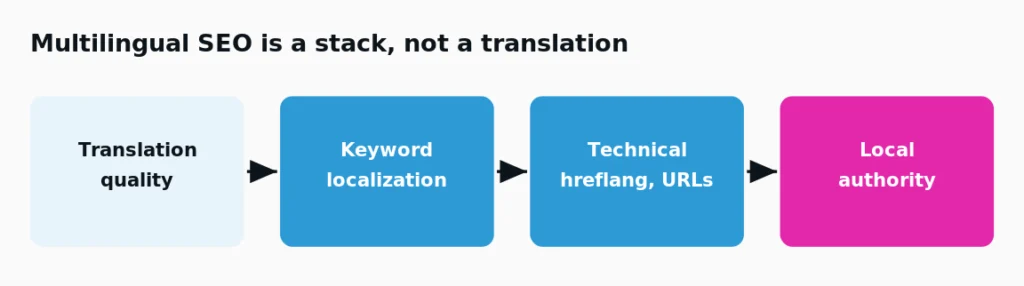
Multilingual SEO builds in layers. A translated site with no keyword or technical work sits at the bottom of the stack.
Why translation alone does not rank
Translation alone does not rank because it reproduces your source-market keywords in another language instead of targeting the terms local buyers actually type. The words are correct and the search demand is missing.
There are two failure modes. First, direct translation of a keyword often lands on a phrase nobody searches: the literal German rendering of your English feature name may be grammatically perfect and commercially dead. Second, raw machine translation reads unnaturally to native speakers and mishandles regional vocabulary, and search engines have become good at detecting low-effort machine output. Accuracy for SEO keywords from unedited machine translation sits around 60 to 70 percent, which is nowhere near good enough to compete. The fix is to treat every target language as its own market with its own research, and to put a native reviewer between the machine and the published page.
Keyword research for each market, not each language
Effective multilingual keyword research studies how a specific market searches, because demand and phrasing differ even between countries that share a language. The single most common mistake is assuming a keyword performs the same everywhere.
A term with strong volume in the United States can have almost no demand in the United Kingdom, and Spanish for Mexico is not Spanish for Spain in either vocabulary or intent. Start from local search data rather than a translated keyword list. Look at what native speakers actually type, which competitors already rank, and whether the intent behind a term shifts across borders. This is where localization outperforms translation: you are adapting to the market’s language of search, not just its grammar. For a SaaS product specifically, the
SaaS Global Expansion Guide walks through how to choose which markets justify this research in the first place, so you are not funding keyword studies for countries that will never convert.
Choosing a URL structure that search engines can read
The best URL structure for most SaaS companies is a subdirectory (site.com/fr/), because it consolidates domain authority, simplifies analytics, and ranks faster than fragmented alternatives. Subdomains and country domains fit narrower cases.
Your options each send a different signal. Subdirectories inherit the authority of your main domain, so new language pages benefit from the reputation you have already built. Subdomains (fr.site.com) are treated more independently and add operational overhead. Country-code top-level domains, or ccTLDs (site.fr), give the strongest geo-targeting signal but force you to build authority separately for every country, which is a heavy lift most teams should avoid until a market clearly earns it.
| Structure | Example | Best for | Trade-off |
|---|---|---|---|
| Subdirectory | site.com/fr/ |
Most SaaS; fastest to rank | Weaker per-country geo-signal |
| Subdomain | fr.site.com |
Separate stacks or teams | Authority is partly split |
| ccTLD | site.fr |
Country brand or legal need | Build authority from zero per country |
Default to subdirectories unless a market has a specific branding or legal reason to stand alone.
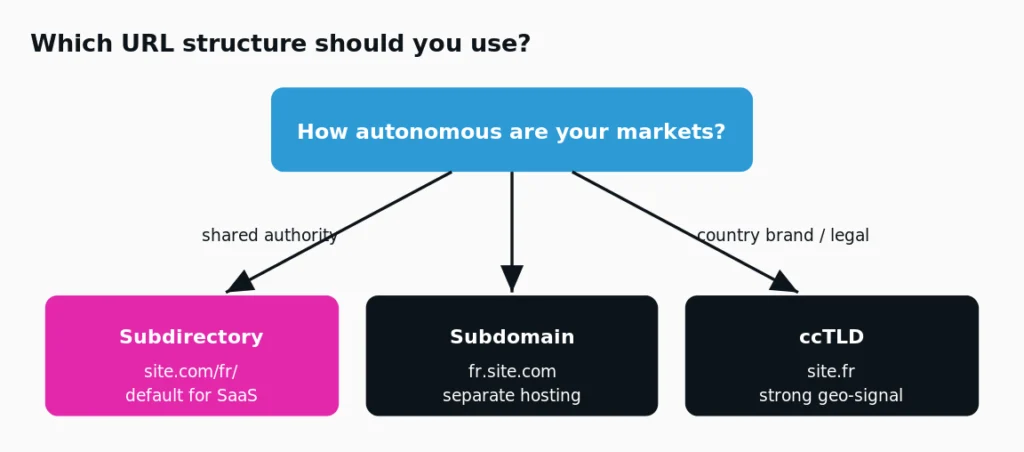
A quick routing rule for URL structure. Autonomy and country-level need push you right; everything else stays left.
Getting hreflang right (most teams do not)
Hreflang is an HTML signal that tells search engines which language and regional version of a page to serve, and it only works when the tags are reciprocal. Every page in a set must reference every other page in the set, including itself.
This is where multilingual SEO most often breaks. Studies find that roughly three quarters of hreflang implementations contain errors: missing return tags, broken URLs, or wrong ISO language codes. A single error in a cluster can cause search engines to ignore the entire cluster, which means the wrong-language page shows up in results and your carefully localized version never surfaces. Audit hreflang regularly, confirm every page points back to every other, and validate your language and region codes against the standard.
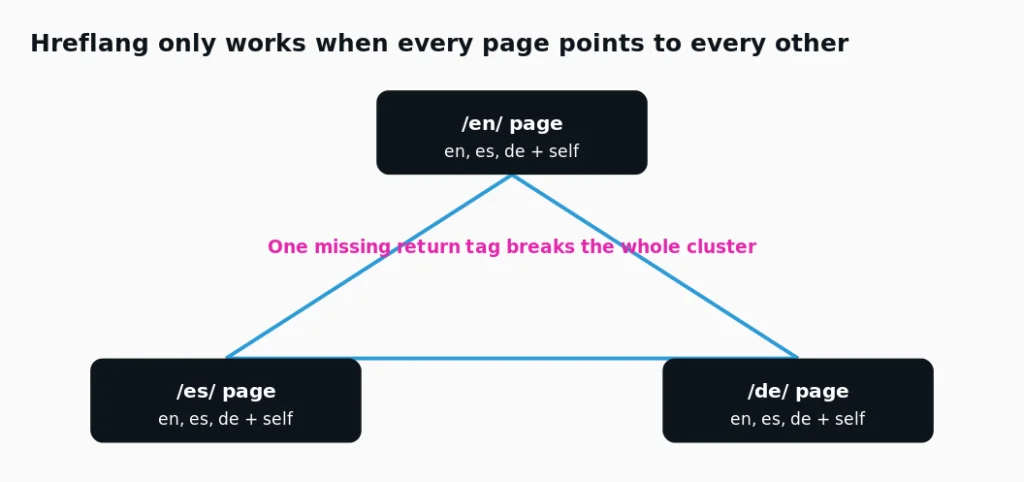
Reciprocal hreflang across three locales. Miss one return tag and search engines may discard the whole set.
Localize metadata and on-page signals, not just body copy
Ranking in a new market requires localizing the SEO signals search engines read most closely: title tags, meta descriptions, headings, image alt text, and structured data. Translating the visible paragraphs while leaving these in English is a common and costly half-measure.
Title tags and meta descriptions carry your target keyword and drive click-through, so they need to be written for local search intent, not machine-translated from the English. Headings should reflect the localized keyword, alt text should describe images in the target language, and any schema markup should match the localized content. Currency, units, dates, and examples belong in the local format too, because they signal to both users and search engines that the page was built for that market rather than dropped in from another one.
Build authority in each market
Even a perfectly localized page needs local authority to rank competitively, which means links, mentions, and trust signals earned within the target market. Technical correctness makes you eligible; authority decides your position.
Domain authority does not fully transfer across markets. A page can be flawless and still sit on page two because the local competitors have earned links from sources that market recognizes. Earning coverage in local publications, partnering with in-market brands, and building content that local sites want to reference is slow work, but it is what separates pages that rank from pages that merely qualify. This is also why market selection matters so much: authority-building is expensive, so concentrate it where the revenue is.
How NexTranslate makes localization SEO-ready
NexTranslate treats SEO as part of localization rather than an afterthought, localizing metadata, keywords, and structured data alongside the visible content, with native reviewers ensuring the output reads as though it was written in-market. The AI plus human workflow gives you speed without the machine-translation penalty that flat, literal output invites.
The SEO-ready website and app localization service localizes navigation, page copy, SEO metadata, and app store listings, and integrates with the file formats and platforms engineering teams already use, from JSON and XLIFF to WordPress, Webflow, and React. For fast-moving products, continuous localization keeps new pages localized as they ship, so your multilingual SEO does not fall behind your release cycle. It builds on the same translation and localization services that keep terminology consistent across every market, and pricing stays predictable through transparent translation pricing with human review included at every tier.
If you are standing up a multilingual site for the first time, the internationalization (i18n) best practices post covers the engineering groundwork that makes all of this possible.
Frequently asked questions
What is the difference between multilingual SEO and translation?
Translation converts your words into another language. Multilingual SEO makes those pages rank, which additionally requires per-market keyword research, correct hreflang and URL structure, localized metadata, and locally earned authority. A translated site is the starting point of multilingual SEO, not the whole of it.
Do I need hreflang tags for a multilingual site?
Yes, if you have multiple language or regional versions of the same pages. Hreflang tells search engines which version to serve to which user and prevents them from treating your locales as duplicate content. The tags must be reciprocal, since one missing or broken return tag can cause the entire cluster to be ignored.
Should I use subdirectories, subdomains, or country domains?
Subdirectories such as site.com/fr/ are the best default for most SaaS companies because they share your main domain’s authority and rank faster. Subdomains suit separate technical stacks, and country-code domains suit strong country-specific branding or legal requirements, at the cost of building authority separately for each country.
Can I use machine translation for multilingual SEO?
Machine translation is a useful first draft, but publishing it unedited hurts rankings. Its accuracy for SEO keywords sits around 60 to 70 percent, it misses regional vocabulary, and search engines detect low-effort machine output. Pair machine speed with native human review so the published pages read naturally and target real local demand.
How long does multilingual SEO take to show results?
Expect a few months before new language pages gain traction, and longer in competitive markets. Technical correctness and localized keywords make you eligible relatively quickly, but building the local authority that lifts you up the results page is ongoing work. Prioritize the markets most likely to convert so the investment pays back.
Conclusion: ranking abroad is a stack, not a translation
Translating your site is the price of entry, not the strategy. Products that rank in new language markets do the layered work: local keyword research, a clean URL structure, correct hreflang, localized metadata, and authority earned market by market. Each layer is ordinary on its own. Together they are the difference between a site that exists in five languages and a product that gets found in five markets.
If you want localization built to rank from day one, request a tailored quote or contact the NexTranslate team to map your target markets to an SEO-ready localization plan.
Written by: Karuppusamy Arunachalam, NexTranslate
Published: July 2026 · Filed under Global Expansion
